

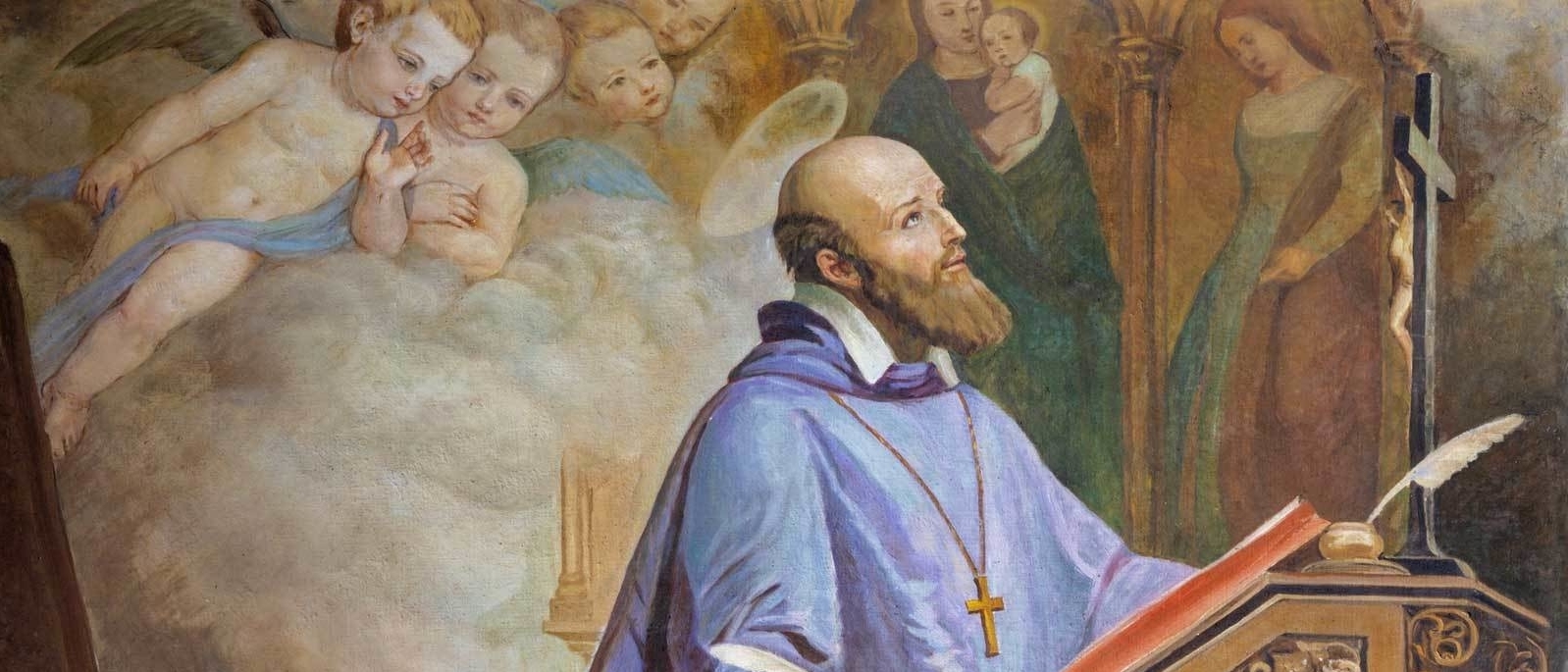
Saint Francis de Sales
FEAST JANUARY 24
Francis de Sales was born in the Duchy of Savoy, in present-day France, in the Château de Sales. His father was Francis, Lord of Boisy, Sales and Novel and his mother Frances de Sionnz, the daughter of a prominent magistrate. Born prematurely, Francis was delicate but slowly strengthened, though his health was never robust.
Being the oldest son of six, his father destined him for a secular career, despite Francis’ early leanings to the religious life. He attended the Jesuit college of Clermont in Paris where he excelled in rhetoric, philosophy and theology. During this period, Francis suffered a terrible temptation to despair of being saved. He was miraculously delivered before an image of Our Lady and there and then made a vow of chastity.
At twenty-four he received his law degree in Padua. With a brilliant career ahead of him, and a noble prospect of marriage, Francis declared his intention of following an ecclesiastical career. A sharp struggle ensued between him and his father who only relented in his opposition when Bishop Granier of Geneva offered Francis the post of Provost of the Chapter of Geneva in the patronage of the Pope.
Francis was ordained in 1593. The next year he volunteered to evangelize the region of Le Chablais, recently returned to the Duchy of Savoy from Calvinist Geneva and on which the Genevans had imposed their creed. With enormous tact, charity and zeal the young provost confuted the preachers sent to debate him, converted several prominent Calvinists and at great personal risk and traveling extensively brought back to the Church tens of thousands of the people of Chablais.
He was consecrated Bishop of Geneva in 1602, ruling his diocese from Annecy in France where he immediately established regular catechetical lessons for young and old. He himself taught the children of whom he was beloved.
He visited the parishes throughout his rugged diocese, made provisions for the clergy, reformed religious orders, and preached incessantly, everywhere known for his kindness and patient zeal.
Those who flocked to hear the holy bishop said, “Never have such holy, apostolic sermons been preached.”
With St. Jeanne Frances de Chantal he founded the Order of the Visitation for girls and widows who had not the health or inclination for the austerities of the great orders.
In the midst of all his activities he found time to write numerous letters and works, among the most famous being his Introduction to the Devout Life.
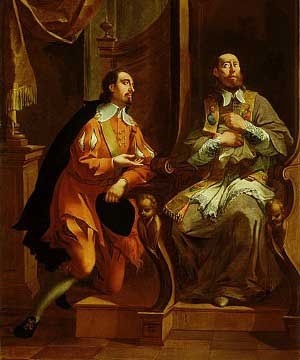
Francis de Sales died in 1622 at age fifty-six and crowds thronged to venerate him.
He was canonized in 1665 and proclaimed a Doctor of the Church by Blessed Pope Pius IX in 1877.
Do Not Mistake Piety for Weakness
Saint Francis of Sales, though one of the gentlest of the saints of God, knew how to defend himself from the swords of his enemies in the day of danger.
As a young man, the great saint took up residence in Padua, where his father sent him to pursue his studies. It happened that certain young men, who seemed to live for no other purpose than to gratify their evil passions, were offended at his humility and meekness. These virtues were a condemnation of their own sinful ways. They mocked the holy youth behind his back, attributing his good conduct to cowardice and effeminacy. In their wicked hearts they formed the design of waylaying him and giving him a severe beating.
To accomplish their design, they made plans for an ambush. They took up arms and hid in a thicket which the saintly youth had to pass on his return to his house.
They, knowing his habitual gentleness, imagined that he would offer them no resistance, and that, after having beaten him severely, they would be able, by running speedily away, to make their escape without being recognized.
But in this they deceived themselves, for they had forgotten, or perhaps were not aware, that the virtue of religion which teaches meekness and humility of heart inspires also courage and intrepidity in the hour of need.
When Saint Francis had reached the spot where his assailants were waiting, they rushed out to attack him unawares, and began by trying to raise a quarrel; then they called him names, and finding all these of no avail to provoke him to anger, they prepared to inflict on him the bodily cruelties they had previously designed.
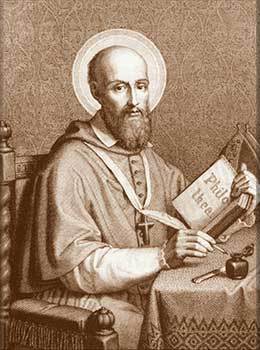
But the pious youth, knowing that here he owed himself the duty to resist, promptly drew his sword. Brandishing it over his cowardly aggressors, he caused them to beat a hasty retreat.
Saint Francis pursued them for a time, then—surprise. Realizing their own danger, his attackers turned to him trembling in confusion. Falling to their knees, they implored the saint’s forgiveness, and promised never to repeat such unpardonable conduct.