Winning the heart and soul of South Africa for Mary by spreading the Fatima Message

Winning the heart and soul of South Africa for Mary by spreading the Fatima Message

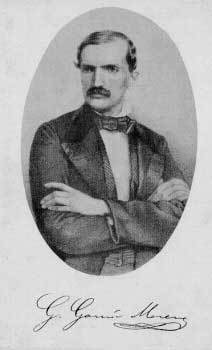
Gabriel Garcia Moreno

6 August

Faith, Order & Progress

1821 – 1875

There is an entirely false idea that is often repeated and promoted by modern secularists that the Catholic Church is and has always been contrary to progress. The Catholic Church, with its incomparable doctrines and immutable moral positions, is portrayed consistently as an old-fashioned institution incapable of coping with the tremendous changes of the modern era. This has even led false Catholics to challenge the Church’s view regarding anything that does not deal with faith. These misled people forget that the Church’s confident stance on complicated moral issues has been developed over the last 2000 years with divine help and its decisions have all been subjected to the vigorous and unforgiving test of time.

A quick perusal of any modern history book gives the impression that when the Church became involved in the moral guidance of nations the result was misery for the poor, gross corruption by the clergy and industrial stagnation. These same history books are sure to contain lurid tales about crimes committed by the Spanish Inquisition, yet they gloss over the horrific crimes of the French Revolution, Stalin’s purges or Pol Pot’s re-education camps. The truth about history is that whenever the Church’s guidance was replaced in civil society by the “will of the people” chaos was the rule of the day. Ecuador’s history is a good example of the radical contrast between the Catholic and so-called liberal rule.

Battle of Guayaquil

In the Midst of Turmoil . . .

Ecuador, in the middle of the nineteenth century, was a piteous country with bloody civil wars and public corruption being the order of the day. Ecuador was coming apart at the seams as one unelected president after the other made himself and his cronies rich at the expense of the national treasury. Things went from bad to worse under anti-clerical dictators like Juan José Flores and José María Urbina, and there was no end to the rampant atrocities. Rich and poor alike were robbed regularly and sometimes killed by marauding bands of irregular soldiers, religion was brutally repressed and the press was completely silenced. Such were the bitter fruits resulting from the actions of men who boasted loudly that liberty and equality were their supreme goals.

Battle of Guayaquil

Then in 1859, at the height of the misery and chaos, there came a ray of hope for Ecuador. A young man with a profound faith and tremendous willpower appeared on the political scene wishing to bring the bandits to task. Gabriel Garcia Moreno had long been involved in Ecuador’s politics without actually entering government. His early activism was limited to attacking the governing party’s corruption in the press, resulted in his being exiled twice. However, events forced him to lay his pen aside and defend his high ideals with the sword. Although untrained in war, he clearly understood that armies win battles not by using brute force alone but by extraordinary valour and good leadership.

After gaining an unlikely military victory in the uprising against the dictator Urbina, he was voted to head a triumvirate charged with reforming the constitution and voting procedure. Upon completion of this task, he stepped down, only to be elected unanimously by the people as their new president despite his protests. The next fifteen years were a period of remarkable progress. Although Garcia Moreno did not remain in office for the entire time, his contributions to Ecuador’s peace and development were manifest.
Bringing Order Out of Chaos

Garcia Moreno’s first agenda was to put down the rebellions crippling Ecuador. This he did with such tact and forceful energy that soon his mere presence without troops in any part of Ecuador was enough to put the rebels into a panic. The military was reformed gradually to become a small but well-trained force of dedicated men instead of a ruthless band of poorly paid rogues. Military discipline was imposed with severe penalties for misconduct and disrespect of authority. Under these conditions the tiny army finally became an asset rather than a liability to Ecuador.

Next, Garcia Moreno cracked down on corrupt judges who had long abused their power and then reformed the system for governmental appointments. Positions of power were given to competent men of proven honesty rather than to the highest bidder, and the rampant practice of nepotism was limited severely. Garcia Moreno led the fiscal reform in government by refusing any payment for his services during his first term. His response when pressed by his friends to take a salary was, “I am president, not to enrich myself but to serve my country.”1 Finally, several unjust taxes were repealed and the massive foreign debts of his unethical predecessors were repaid, thereby restoring foreign trust in the Ecuadorian economy.

Garcia Moreno ruled with a compassionate iron hand. He was inflexible and his judgments were swift toward those found guilty of brigandage, murder and rebellion. However, he was forgiving to a fault the minute he sensed remorse. For example, having captured the chief of a notorious band of bandits, he had the wretch brought in chains to the presidential palace. The man was shaking when Garcia Moreno approached but instead of a severe sentence, the bandit was offered a reprieve. Garcia Moreno promised the bandit total amnesty on the condition he would return to his band and convince them to give themselves up. If they did, all their crimes would be pardoned, and every effort would be made to reintegrate them into society. Soon the threat hanging over travellers for so long had dissolved. So effective were his methods of reforming criminals that by 1875 there were only 50 convicted prisoners remaining in Quito’s jail.

Uniting the Country

The common people, so long used to political instability and strife, understood they had a paladin in Garcia Moreno and began to work the land again. Therefore, to take full advantage of the fruits of this era of peace and prosperity, Garcia Moreno set an audacious goal to connect Guayaquil and Quito with a highway. Facing criticism and opposition from his friends and enemies, Garcia Moreno not only completed the highway in ten years but opened four other major roads to the rest of the country at the same time. Father Berthe in his biography of Garcia Moreno wrote, “Agriculture and commerce, finding these openings for their produce, at once devoted themselves to production and Ecuador woke up from a sleep [that] had lasted a thousand years.”2

Presidential Charity

As a good Catholic, Garcia Moreno was solicitous to the poor, the sick and his enemies. Having been given a large sum of money to entertain the diplomats and senators by his wife, Garcia Moreno proceeded to the poorest hospital in Quito and bought a delicious meal for all the patients. On another occasion he arrived unannounced at a hospital that was notorious for its tasteless food. Finding the food indeed unpalatable he promptly had the problem corrected to the point it rivalled the food on his own table. It is a matter of historical record that his entire presidential salary was given over to charities, and after his death it was discovered he had arranged for the upkeep of the aged mother of his worst political enemy.
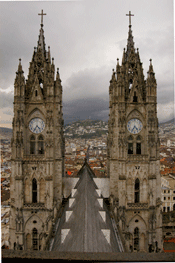
The Basilica Quito, Ecuador

A National Consecration to the Sacred Heart

Garcia Moreno’s secret to success can be found in this simple phrase of Christ, “Seek ye first the kingdom of Heaven and all other things will be given to thee.”3 He achieved his audacious goals by ordering all things according to the will of the Sacred Heart of Jesus. He believed, as does the Church, that any civil society that does not acknowledge the King of Heaven cannot truly progress. Thus in 1874, in an official ceremony attended by the ecclesiastical and civil authorities, Ecuador was consecrated officially to the Sacred Heart of Jesus. The liberals protested that this act was a step backward and would ruin Ecuador. However, Ecuador did not regress and from that point on all undertakings seemed to flourish in an incredible way.

Because of the constant upheavals during his predecessors’ reign, the state of public education was at a nadir when Garcia Moreno began to tackle the problem. He first started with primary education, making it mandatory for all children older than eight years to attend school. To alleviate the pressure upon the various religious orders caused by this expansion, he opened a college to train laity for the teaching profession. Then he sent for teaching orders from Europe, like the Christian Brothers, to work in secondary schools. He finally focused his attentions on the college level by inviting the Jesuits to open a university in Quito and later colleges in the other major cities. His zeal was infectious, and the nation finally began to shake off its liberal coma and take a serious attitude toward public education.

A quick look at the numbers is illuminating. In 1873, there were approximately 8,000 children in the primary schools but just two years later, thanks to Garcia Moreno’s efforts, there were over 32,000 children attending school. After six years of intensive schooling, there was more real progress in Ecuador than had occurred in the previous 50 years of revolutionary rule. Sadly, after Garcia Moreno’s death, Ecuador returned to a primitive state of schooling by expelling most religious orders from their schools and replacing them with revolutionary teachers. The poor and the Indians, who had gained the most from the dedication of the religious orders, were relegated again to second-class citizenship without the benefit of public education.

Economic Development

The national finances under Garcia Moreno improved dramatically since trustworthy individuals were placed in positions of authority. Whereas previous liberal regimes had thrived upon rampant corruption, under Garcia Moreno’s firm hand, public officials soon realized that such infractions were not tolerated. Thus, the treasury was filled for the first time in Ecuador’s history and the lot of the common people improved dramatically. Again, some numbers may help. “Between 1852 and 1890, Ecuador’s exports grew in value from slightly more than US$1 million to nearly US$10 million. Production of cacao, the most important export product in the late nineteenth century, grew from 6.5 million kilograms to 18 million kilograms during the same period.”4 Under no other ruler in its entire history has Ecuador developed economically at the pace it did during the reign of its truly Catholic president.
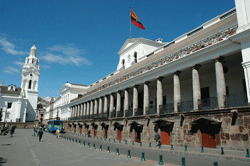
Presidential Palace at Ecuador

The Leftists React

So, what was the response of the high-minded liberals in face of such obvious progress? Was it to put aside prejudice and admit that a truly Catholic state could indeed bring a nation forward? Of course not. Modern liberals will never admit that anything good can exist outside of their twisted and perverse parameters of absolute equality and liberty. When faced with proof of evident progress by a Catholic society, the liberals’ response to all the benefits Garcia Moreno had bestowed upon Ecuador was to plot his ruin. But Garcia Moreno was not afraid, for he had learned long ago from Our Lord’s divine example that true glory cannot be attained in this world, and so he prepared himself for the blow.

On August 4, 1875, Garcia Moreno sent an acquaintance a letter in which was written these prophetic words, “¡Adios! We shall never meet again on earth . . . I am about to be assassinated but I am happy to die for my Faith.”5

Two days later, Garcia Moreno returned home before going to the presidential palace. Sinister men shadowed Garcia Moreno’s every move and arranged themselves throughout the main plaza facing the Palace. Leaving home unattended, Garcia Moreno then made his way to the Cathedral to adore the Blessed Sacrament. The assassins, noting that he was spending a long time in prayer, sent a messenger into the church to call him out. Seemingly oblivious to the mortal danger, Garcia Moreno had only one aide-de-camp with him.

“God Does Not Die!”

With savage cruelty, a man named Faustino Rayo attacked Garcia Moreno with a machete and struck a terrible blow on the head. Reeling and blinded by his own blood, Garcia Moreno tried vainly to draw his pistol while the other assassins shot him. After striking Garcia Moreno twice more, severing his left arm and right hand, Rayo and his vile band again levelled their pistols. Garcia Moreno was knocked into the street motionless. Rayo, however, was not satisfied, for he attacked Garcia Moreno once again shouting, “Die, destroyer of liberty!”6 Garcia Moreno’s dying words for all to hear were: “God does not die!” 7
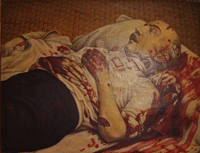
Painting of Moreno's Death

Garcia Moreno’s Story

Modern liberals clamour loudly for social justice, harmony and peace. Garcia Moreno brought all these to Ecuador. His reward was a cruel death at their hands. He did not believe in absolute liberty, rather he believed that freedom was necessary for good to flourish. One of his most memorable quotes says it all, “Liberty for everyone and for everything, except for evil and evil doers.” 8

In a truly Christian civilization, evil has no rights and those who practice evil lose their rights. In our modern neo-pagan society, it would seem that not only does evil have rights but people who practice evil do so without reprisal. However, though modern society looks with benevolence upon every type of sin, the God of justice is neither blind nor deaf to the cries of the innocent.

The story of Garcia Moreno’s heroic life, so full of Catholic spirit and charity, does not grace the pages of any American history book.

Ecuadorians may forget his deeds one day. Liberalism has influenced us to such a degree that some may even think him to have been too anachronistic and backwards for the modern era and therefore deserving of his fate.

But even liberals cannot deny that Garcia Moreno strove mightily to bring to fruition that prayer of Our Lord in the Our Father, “Thy kingdom come, Thy will be done, on earth as it is in heaven.” In these dark days, it is a consolation to remember the faith professed in his last words:

“God does not die!”

Photo of the Deceased Moreno

References:

  1.  Father Augustine Berthe, Garcia Moreno (London: Burns and Oates, 1889), 278.
  2.  Ibid., 276.
  3.  Ibid., 278
  4.  “The Era of Conservatism, 1860-1895,” https://www. hipecuador.net/ecuador/history/the-era-of-conservatism.html.
  5.  Father Augustine Berthe, Garcia Moreno (London: Burns and Oates, 1889), 320.
  6.  Ibid., 322.
  7.  Ibid
  8.  ”Gary Potter, “Gabriel Garcia Moreno—Catholic Statesman and Martyr,” https://www.acla-inc.org/moren… (excerpts from an article that originally appeared in From the Housetops magazine).
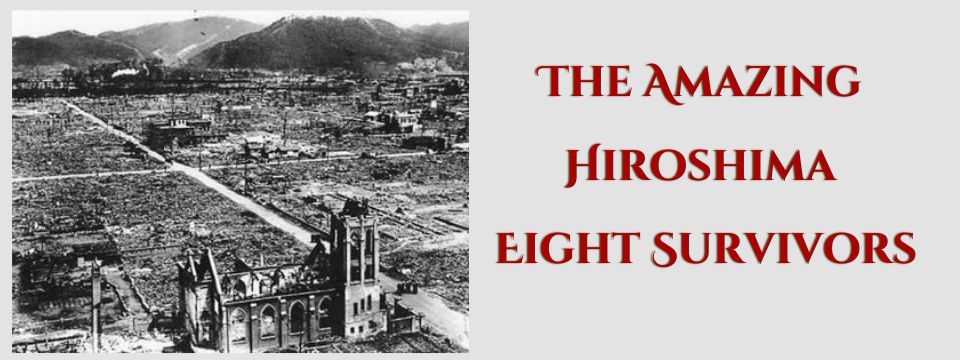
The Amazing Hiroshima Eight Survivors

Early on 6 August 1945, a lone American B-29 Superfortress bomber circled in a vividly blue sky over the Japanese city of Hiroshima. The unsuspecting inhabitants on the ground barely glanced at the plane. They were unaware of the deadly payload it was about to unleash on them, ushering in the atomic age with unimaginable death and destruction.

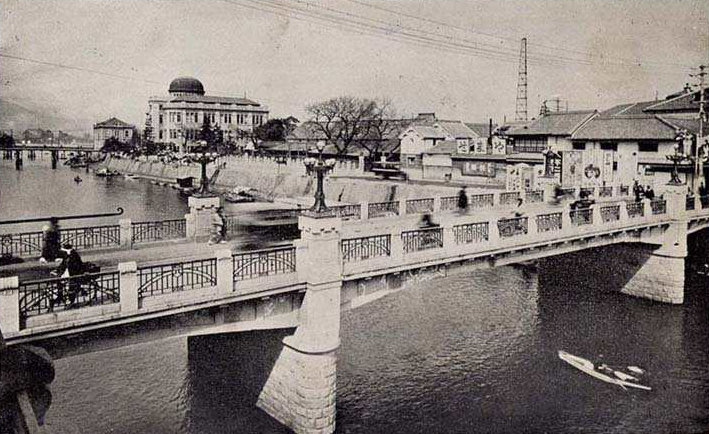
Hiroshima before the bombing.

As one single bomb neared the ground, a city died in an instant. Houses crumbled, people evaporated, an immense ball of fire shot skywards, and a terrible wave of super-heated gas bulged out from ground zero, flattening buildings for miles.

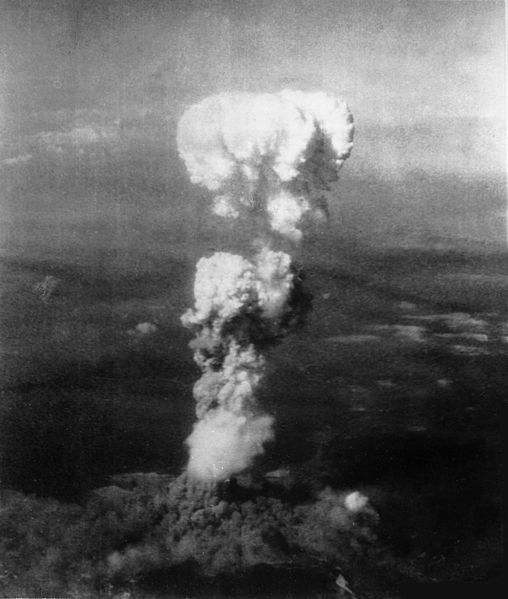
Atomic cloud over Hiroshima. The cloud rose to over 18 300 metres in about ten minutes, while smoke from the burst of the first atomic bomb had spread over 3000 metres at the base of the rising column.

Amongst the unsuspecting inhabitants of Hiroshima was Fr. Schiffer, a Jesuit missionary assisting the many Catholics of that city. On the morning of 6 August 1945, he had just finished Mass and sat down at the breakfast table. As he plunged his spoon into a freshly sliced grapefruit, there was a bright flash of light. His first thought was that a fuel tanker had exploded in the harbour, as Hiroshima was a major port where the Japanese refuelled their submarines. Then, in the words of Fr. Schiffer: “Suddenly, a terrible explosion filled the air with one bursting thunder stroke. An invisible force lifted me from the chair, hurled me through the air, shook me, battered me, whirled me round and round like a leaf in a gust of autumn wind.” Next thing he remembered was that he opened his eyes and found himself on the ground. He looked around, and saw there was nothing left in any direction: the railroad station and buildings in all directions were gone. Yet, the only harm to him was a few slight cuts in the back of his neck from shards of grass. As far as he could tell, there was nothing else physically wrong with him.

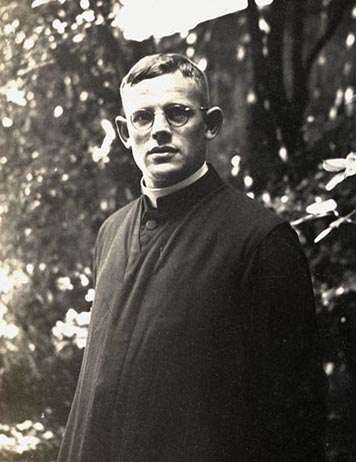
Father John Seimes, S.J., one of the eight Jesuit Fathers that miraculously survived the atomic bombing.

The small community of Jesuits to which Fr. Schiffer belonged lived in a house near the parish church, situated only eight blocks from the centre of the blast. When Hiroshima was destroyed by the atomic bomb, all eight members of the small Jesuit community escaped unscathed, while every other person within a radius of one-and-a-half kilometres from ground zero died immediately. The house where the Jesuits lived was still standing, while buildings in every direction from it were levelled. Father Hubert Schiffer was 30 years old when the atomic bomb exploded right over his head at Hiroshima. He not only survived, but also lived a healthy life for another 33 years!

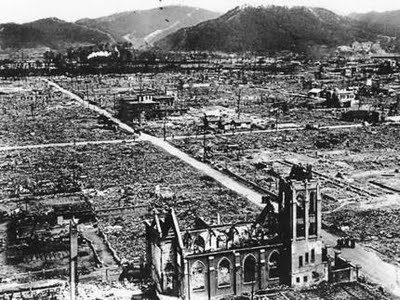
Our Lady of the Assumption Church and the Jesuit Rectory.

How did this group of men survive a nuclear blast that killed everyone else, even people over ten times further away from the blast? It is absolutely unexplainable by scientific means. An interesting detail is that this group of Catholic clergy was made up of ardent enthusiasts of the Message of Fatima. They lived the Message. Was their fidelity to Our Lady rewarded by this stupendous miracle of their survival?

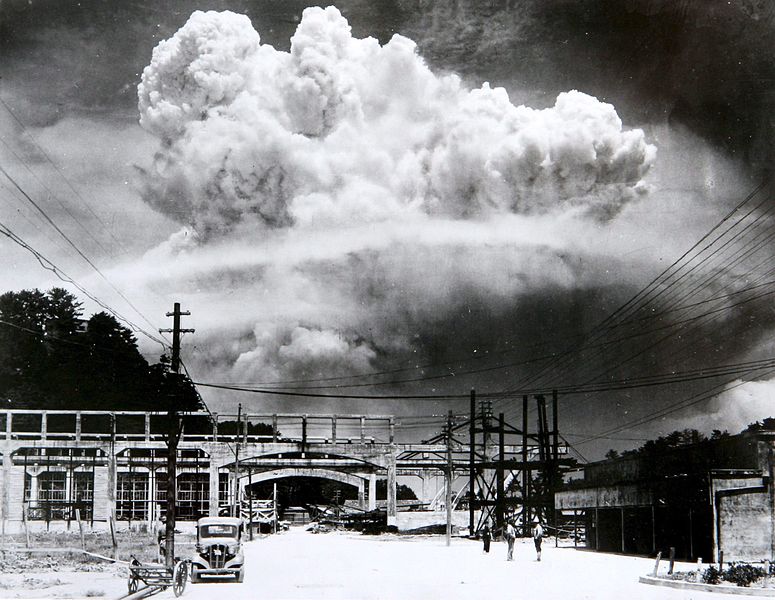
Atomic cloud over Nagasaki from Koyagi-jima on 9 August 1945.

Even more astonishing is that the story was to be repeated a few days later at Nagasaki, the second Japanese city to be hit by an atomic bomb. In both Hiroshima and Nagasaki, the survivors were Catholic religious. Most other buildings were levelled to the ground, even at 3 times the distance, but in both cases their houses stood – even with some windows intact! All other people, bar a handful of scattered mutilated survivors, even at thrice the distance from the explosion, died instantly. Those within a radius ten times the distance of the Jesuits from the explosion were exposed to fierce radiation and died within days.

After the American conquest of Japan, U.S. army doctors explained to Fr. Schiffer that his body would soon begin to deteriorate because of the radiation. To the doctors’ amazement, Fr. Schiffer’s body showed no radiation or ill effects from the bomb. All who were at this range from the epicentre should have received enough radiation to be dead within a matter of minutes. Scientists examined the group of Hiroshima Jesuits over 200 times during the next 30 years and no ill effects were ever found.

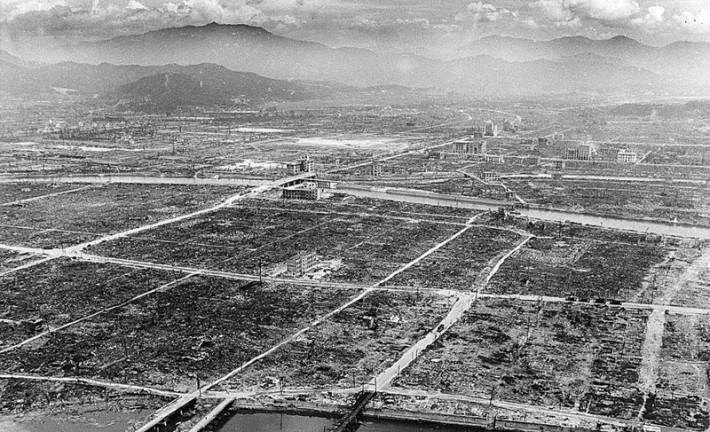
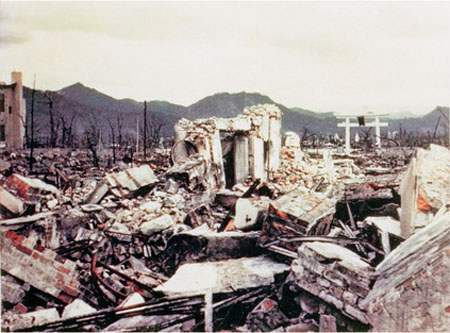
Hiroshima after the bombing.

Could it have been a fluke? Could the bomb’s makers have designed it to avoid killing U.S. citizens? There is no known way to design a uranium-235 atomic bomb so it could leave such a large discrete area intact while destroying everything around it. The Jesuits say: “We believe that we survived because we were living the message of Fatima. We lived and prayed the Rosary daily in that house.” Fr. Schiffer feels that he received a protective shield from the Blessed Virgin, which protected him from all radiation and ill effects. Fr. Schiffer attributes this to his devotion to Our Lady, and his daily Fatima Rosary: “In that house the Holy Rosary was recited together every day.” Secular scientists are dumbfounded and incredulous at his explanation. They are sure there is some ‘real’ explanation. However, over 60 years later the scientists still have not been able to explain it.

From a scientific standpoint, what happened to those Jesuits at Hiroshima still defies all the laws of physics. It must be concluded that some other force was present, whose power to transform energy and matter as it relates to humans is beyond our comprehension.

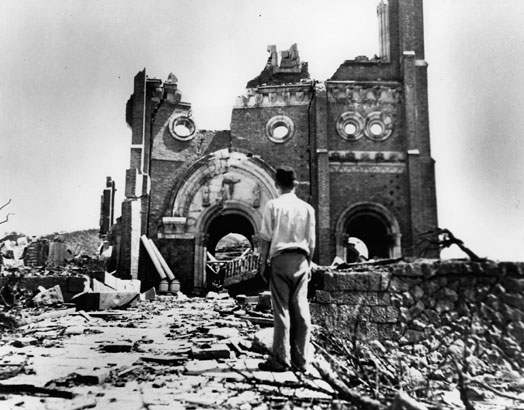
Urakami Cathedral after the bomb. Only 150 metres from the hypocentre of the blast stood the original Urakami Cathedral, a centre for Nagasaki’s Catholic community. Catholic missionaries first came to Nagasaki in the 16th century, and within several decades hundreds of thousands of people in South-western Japan were practicing Catholics.

Dr. Stephen Rinehart of the U.S. Department of Defence is widely recognized as an international expert in the field of atomic blasts. Says Rinehart: “A quick calculation says that at one kilometre the bulk temperature was in excess of 11 000 to 16 000 degrees C, and the blast wave would have hit at sonic velocity with pressures on buildings greater than 600 PSI. If the Jesuits, at one kilometre from the geometric epicentre, were outside the atomic bomb’s “plasma” their residence should still have been utterly destroyed. Un-reinforced masonry or brick walls, representative of commercial construction, are destroyed at 3 PSI, which will also cause ear damage and burst windows. At 10 PSI, a human being will experience severe lung and heart damage, burst eardrums and at 20 PSI limbs can be blown off. All the cotton clothing would be on fire at 176 degrees Celsius, and your lungs would be inoperative within a minute of breathing even one lungful of air at these temperatures.

Hypocentre of the blast in Hiroshima was Shima Hospital.

“No way could any human have survived nor should anything have been left standing at one kilometre. At ten times the distance, about ten to fifteen kilometres, I saw the brick walls standing from an elementary school and there were a few badly burned survivors; all died within fifteen years of some form of cancer. Reconnaissance pictures taken of a panoramic view from epicentre of the blast, at Shima Hospital looking towards the Jesuits’ house, did show some kind of two-story building totally intact, at least from what I could make out, and it looked to me the windows were in place. Also there was a church with walls still standing a few hundred yards away, but the roof was gone.

“The Department of Defence never commented officially on this and I suspect it was classified and never discussed in open literature. I think it is possible the Jesuits were asked not to say anything either at the time.”

For God, who made all matter and energy, it is simply a matter of willing it and the laws that govern them are suspended. This is what happened at Hiroshima and Nagasaki. It also happened in ancient times, to the loyal servants of God Sidrach, Misach, and Abdenago, as is related in the Book of Daniel (3:19-24):

    “Then was Nebuchodonosor filled with fury: and the countenance of his face was changed against Sidrach, Misach, and Abdenago, and he commanded that the furnace should be heated seven times more than it had been accustomed to be heated. And he commanded the strongest men that were in his army, to bind the feet of Sidrach, Misach, and Abdenago, and to cast them into the furnace of burning fire. And immediately these men were bound and were cast into the furnace of burning fire, with their coasts, and their caps, and their shoes, and their garments. For the king’s commandment was urgent, and the furnace was heated exceedingly. And the flame of the fire slew those men that had cast Sidrach, Misach, and Abdenago. But these three men, that is, Sidrach, Misach, and Abdenago, fell down bound in the midst of the furnace of burning fire. And they walked in the midst of the flame, praising God and blessing the Lord.”

As seen on: https://nobility.org/2015/08/hiroshima-70-years/

Daily Prayer of Abbot Pfanner

Saints of God obtain for me
the grace which I desire through the Precious Blood of Jesus Christ, namely:
Always to do the will of God
Always to remain united with God
To think of nothing but of God
To do everything for the love of God
To seek in all things the honour of God
To realize fully my own nothingness
To recognize ever more the will of God
To preserve a spirit of recollection.
Amen.

NOVENA TO THE SERVANT OF GOD ABBOT FRANCIS PFANNER

WHAT IS A NOVENA?

Our Divine Saviour promised that our Heavenly Father will answer our prayers if we “pray without ceasing.” Since the Church’s earliest days it has been a pious custom to ask God’s favours directly or through the intercession of His saints by means of a “Nine Days Devotion” or a Novena.

We have many examples that prove that God does grant special graces at the end of a Novena that was made with confidence and absolute trust in the Will of God.

This Novena is intended for private use only. A public veneration of the servant of God, Abbot Francis Pfanner, is only permitted after he has been declared “Blessed”. 

However, you may report any favour or blessings received through the intercession of Abbot Francis to:  info@mariannhillmonastery.org.za

NOVENA PRAYERS


FIRST DAY 


RUN SO AS TO OBTAIN THE PRIZE 


When Francis Pfanner became Abbot of Mariannhill, he chose the motivational words of St. Paul (1 Cor. 9:24) as his motto. Through his commitment to his faith and his need to prove his loyalty to God as a priest, monk and missionary, Father Francis devoted his life to helping as many people as possible to know God better, and to enable them to live fulfilled lives by their understanding and keeping of God’s commandments.


PRAYER: Father in Heaven, with great confidence I turn to you in my need: (mention your intention…) I thank you for giving us Abbot Francis Pfanner as an example of true commitment to the Catholic Faith. Like him, I too wish to be loyal to the Church’s teachings, and wish to serve You through my being of service to others.


Glorify Your Name, Father, and listen to my prayer, through the intercession of Abbot Francis, your Venerable Servant and Apostle of our people. Our Father… Hail Mary… Glory Be…

SECOND DAY


GOD’S PROVIDENCE DOES ALL THINGS FOR US, BUT NOT WITHOUT OUR CO-OPERATION 


Father Francis placed his absolute trust in Divine Providence and he appealed to God whenever he needed help. His life’s work and achievements are testimonies to his belief that absolute faith and the power of prayer can indeed move mountains and make all things possible.


PRAYER: Father in Heaven, with great confidence I turn to You in my need: (mention your intention…) Help me to maintain my trust in You, even though there is little to hope for and not many people whom I may trust. I know that You do not refuse a sincere prayer from the heart, even if it means that You must pertorm a miracle. I am in desperate need of Your help and love.
Glorify Your Name, Father, and listen to my prayer, through the intercession of Abbot Francis, your Venerable Servant and Apostle of our people. Our Father… Hail Mary… Glory Be…

THIRD DAY


IF THE LOVE OF THE SACRED HEART CANNOT IMPEL US TO GREATER COMMITMENT,
THEN LET SATAN’S EAGERNESS FOR SOULS MAKE US ASHAMED… 


The source of Abbot Francis’ love of people, particularly those in need, came from his zealous love of the Sacred Heart. Like his fellow Cistercian, St. Bernard, he always worked eagerly and enthusiastically for his “fairest Lord Jesus”. Mariannhill has flourished because of his faithful service to the Son of God. 


PRAYER: Father in Heaven, with great confidence I turn to You in my need: (mention your intention…) Like Father Francis, I take refuge in the merciful and generous love of the Heart of Your Son, Jesus. I want to live my love for You in all that I say and do, but I am weak. Forgive me, and have mercy on me for Jesus’ sake.
Glorify Your Name, Father, and listen to my prayer, through the intercession of Abbot Francis, your Venerable Servant and Apostle of our people. Our Father… Hail Mary… Glory Be…

FOURTH DAY


I TRY TO DO GOD’S WILL IN ALL I WISH
TO ACHIEVE OR SUFFER 


Francis Pfanner’s daily prayer from the time he joined the seminary was simply to know the will of God, so that he could carry out all that God wanted him to do. Any setbacks merely confirmed God’s will for Abbot Francis, and once he was sure that he had made the right decision he would continue undeterred until his task was completed.


PRAYER: Father in Heaven, with great confidence I turn to You in my need: (mention your intention…) Let “Your Will be done” for only You know best what is good for me. Help me to understand the inspirations of Your grace in my daily life, so that I may learn to recognize Your Will and live my life according to Your Holy Word.
Glorify Your Name, Father, and listen to my prayer, through the intercession of Abbot Francis, your Venerable Servant and Apostle of our people. Our Father… Hail Mary… Glory Be…


FIFTH DAY


EVERY GRACE, GOOD THOUGHT AND ASPIRATION COMES FROM THE HOLY SPIRIT 


Father Francis was inspired and guided by the Holy Spirit in his missionary work and, therefore, he encouraged every church to openly display a symbol of the Holy Spirit. He also advised anyone in a position of leadership to pray humbly on a daily basis for the spirit of wisdom.


PRAYER: Father in Heaven, with great confidence I turn to You in my need: (mention your intention…) Let me be open to Your guidance and I ask You to call me back when I go astray. I wish to give my life in such a way that I may be of service to the Church, motivated by my admiration of the Spirit’s great deeds in and through holy Christians.
Glorify Your Name, Father, and listen to my prayer, through the intercession of Abbot Francis, your Venerable Servant and Apostle of our people. Our Father… Hail Mary… Glory Be…


SIXTH DAY


IF GOD DOES NOT GRANT US WHAT WE ASK,
IT IS BECAUSE HE WANTS TO GIVE US SOMETHING BETTER 


Abbot Francis turned his every thought into purposeful action in his own life that was dedicated totally to the service of God. “How many souls have you saved by your prayer, suffering and personal efforts?” he would ask. Daily, at Emaus, he prayed the Stations of the Cross.


PRAYER: Father in Heaven, with great confidence I turn to You in my need:(mention your intention…) Help me to walk in Your Presence like Abbot Francis, and remain in communion with You. Let my prayer be pure and simple. I wish to be concerned more about the needs of those I love, rather than my own.
Glorify Your Name, Father, and listen to my prayer, through the intercession of Abbot Francis, your Venerable Servant and Apostle of our people. Our Father… Hail Mary… Glory Be…


SEVENTH DAY


I DO NOT MIND TO SUFFER SEASICKNESS MANY TIMES OVER TO GAIN HEAVEN FOR THOSE WHO DO NOT YET KNOW CHRIST 


Not only did Father Francis have weak lungs, a sensitive stomach, arteriosclerosis and frequent bouts of malaria, but he also suffered great emotional anguish through his misjudgement, rejection, failure and isolation by others. Despite this he persevered in his service of God.


PRAYER: Father in Heaven, with great confidence I turn to You in my need: (mention your intention…) I unite my sufferings with those of Your Son, Jesus. Make me ready to bear my small crosses in life patiently. May my faith in Your compassionate love never falter.
Glorify Your Name, Father, and listen to my prayer, through the intercession of Abbot Francis, your Venerable Servant and Apostle of our people. Our Father… Hail Mary… Glory Be…


EIGHTH DAY


WE ARE REDEEMED AT THE PRICE OF CHRIST’S BLOOD; ALL ARE ENTITLED TO KNOW WHO LOVES THEM SO MUCH 


The Precious Blood of Jesus was for Abbot Francis a sanctuary from evil and a source of strength. He founded the Missionary Sisters of the Precious Blood “for the purpose of making this treasure fruitful in many souls.” “Courage,” he said, “you have not yet shed blood in God’s service!”


PRAYER: Father in Heaven, with great confidence I turn to you in my need: (mention your intention…) I thank you for Your Son, Jesus. He died for me so that I, and my loved ones, might follow Him and one day be with You in Heaven.
Glorify Your Name, Father, and listen to my prayer, through the intercession of Abbot Francis, your Venerable Servant and Apostle of our people. Our Father… Hail Mary… Glory Be…


NINTH DAY


JUST AS MARY PLAYED A VITAL ROLE IN
THE WORK OF REDEMPTION, SO ARE WOMEN INVITED TO PARTICIPATE IN THE WORK OF EVANGELISATION 


Father Francis dedicated himself, his life’s work and all his achievements to Our Lady. Therefore it was most appropriate that the first hymn sung by the monks at Mariannhill was the Salve Regina. Abbot Francis recognized the power of a mother’s love to nurture her children, so he established groups of women to share in the work, thereby nurturing the growth of the missions.


PRAYER: Father in Heaven, with great confidence I turn to You in my need: (mention your intention…) Like Our Lady, I dedicate myself whole-heartedly to You. Do with me as You please; I wish to be Your humble servant so that many people may find salvation.
Glorify Your Name, Father, and listen to my prayer, through the intercession of Abbot Francis, your Venerable Servant and Apostle of our people. Our Father… Hail Mary… Glory Be…


NOVENA PRAYER FOR THE INTRODUCTION
OF THE CAUSE OF BEATIFICATION OF
ABBOT FRANCIS PFANNER


Lord, through Your Son, Jesus, we know the depths of Your unfailing love for all mankind and that it is Your will that we follow paths which lead to happiness, peace and final union with You.


You accepted the life service of Francis Pfanner to improve the lot of men and women and to carry out Your every wish and command. lt was his constant appeal for “all to recognize, love and serve the One Who loved them so much as to die for them.” Abbot Francis embraced the cross of pain, failure and disrepute unreservedly in the knowledge that he had succeeded in establishing new communities that were firmly rooted in the true Faith and totally dedicated to doing Your Will.


We humbly ask You to show us the true stature of Your Servant, and as a sign of Your approval of him, to grant us the help we need at his intercession. Father, manifest Your glory through the beatification of Francis Pfanner. As you heard the many prayers of Francis Pfanner, so we ask You to listen to ours. 


Our Father… Hail Mary… Glory Be…

Missionary Sisters of the Precious Blood

A as a result of his enthusiastic articles in the German Catholic press, five young German women travelled to South Africa to join Abbot Pfanner’s missionary work and arrived on 1 September 1885. They aspired to a vocation in the religious life, and were eager to have a specific common rule of life.

They were given red material to sew a simple uniform which they wore for the first time on 8 September 1885, and received their community rules. This is considered the foundation date of the Congregation of the Missionary Sisters of the Precious Blood.


Mother Paula arrived at Marianhill at 19 years of age on 7 October 1886. A month later she made her commitment and took her first vows on 8 December 1888. At age 22 she took up the leadership of the Sisters.

In 1907, Sr Paula was elected as First Canonical Superior General of the Missionary Sisters of the Precious Blood. By this time new congregations had spread to many parts of the world.


Abbot Franz Pfanner regarded himself as the founder of his “Red Sisters” and personally recruited all the members of the newly founded congregation up to 1892. Impressed by his personality and his program, hundreds of women followed him into uncharted territories as he instilled in them his God-given charism, zeal and enthusiastic penchant for mission life!

Maria Linden Mission

The land designated for the Mission station, Maria Linden, was granted by the local chief in 1896. Building commenced immediately, which included a school, and was completed in 1897.

The church, in the inimitable style of the early Trappist stations has a lovely façade. It is situated on the road from Matatiele to Mariazell and was initially an outstation of Mariazell.


This Mission is once again named after a famous Marian Shrine in Europe near the village of Otterweiler.

Maria Linden has a history that dates back to the time of Christianisation around the year 700AD. Early records show that in 1484 a church was built in an open field, near a well and a linden grove, where for many centuries an ancient image of Mary had been venerated.


There is a legend that surrounds the emergence of this place of pilgrimage. It tells of a miraculous rediscovery of the Image of Grace in the hollow of a linden tree, which came to light again after periods of war and destruction. Many people came, according to the legend, to see the miracle and to pray there.

Maria, “by the seven linden trees,” as an old name referred to her, proved to be a special advocate for all help and consolation seekers.

Mariazell Mission

Nestling in the foothills of the renowned Lesotho peaks, is the Mariazell Mission which was established by the Trappists on 2023 hectares in 1894. 

The name derives from the Marian pilgrimage shrine in Austria which is famous for a miraculous image of Our Lady. 

A Benedictine monk named Magnus was in a forest looking for a place to build a monastery in 1157. At one point, his path became blocked by a huge boulder that was too big to go over or around, so Magnus took a small wooden statue of the Virgin Mary he had in his knapsack, knelt in prayer, and asked Our Lady for guidance. Soon there was a great rumble and the rock split in two, allowing him to pass through. Magnus placed the statue reverently on a white branch and soon after, he and some of the local people built a small chapel to house the statue. 

Due to many miracles, Our Lady of Mariazell came to be known by the titles “Great Mother of Austria, Great Lady of Hungary, and Great Mother of the Slavic People.” 

It is also the starting point from which Fr Pavlikec initiated the Austrian Rosary Crusade which would eventually see the withdrawal of Soviet forces from Austrian territory. 


Our “own” Mariazell is thus able to claim magnificent spiritual ancestry! It is a very picturesque Mission station which has always boasted fine educational institutions, counting many public figures amongst its alumni. It also boasts extensive farming operations and even generates its own electricity from a self-sufficient hydro-electrical system built more than 120 years ago. The Church is a magnificent imposing structure and one which manifests Br Nivard’s building expertise and his architectural genius.

Maria Ratschitz Mission

Maria Ratschitz Mission was established in 1889 on 3200 hectares in the fertile Nkuzi Valley at the base of the Hlatikulu mountain.

At the request of a European Benefactress it is named after the Marian shrine in Leitmeritz in the Czech Republic. This shrine has an eventful and ancient history, and is closely connected with the history of the Cistercian monastery Osek and with the veneration of the image of the Sorrowful Mother of God.


The Maria Ratschitz church takes pride of place as another masterpiece of the Trappists’ skills and boasts a tall elegant bell tower, visible from a good distance. As was common to churches of those days, magnificent stained glass windows, lovely frescoes and a carved high altar and pulpit adorn the interior.


The Mission has been lovingly restored over the last couple of decades, thanks to generous donors, and counts many social projects amongst its outreach.


It was not always so – and from its early glory days had fallen into a state of terrible neglect and disrepair. The reasons for this tragedy are many and varied, amongst which were the destructive social and political polices of early South African governments. The restored Mission has a convent, school and hospice.

Kevelaer Mission

Kevelaer mission was founded 1888 by Abbot Franz Pfanner near the village of Donnybrook, Ixopo.

He called this place after a town in Northern Germany, Kevelaer, which had been a well known place of Pilgrimage since 1642. A benefactor from Kevelaer in Germany wished the new station to be called this. It was the custom of the Founder to call his new foundations in Africa after famous places of pilgrimage in honour of Our Lady, scattered all over Europe.

In 1932 Fr Vitalis Fux, the then missionary priest at Kevelaer Mission, travelled to Switzerland to raise funds to enlarge the church. The full story of how a miraculous picture of Kevelaer came to South Africa, and the priest’s role in this, is told in the back of this calendar.


Since the year 1947, pilgrims from all walks of life and every racial group of South Africa, began to make their way to this shrine of Our Lady and place their petitions before her. The number of pilgrims increased year after year so that Kevelaer was declared officially a place of pilgrimage in 1953 by Bishop A Streit.

The whole Diocese had been dedicated by Bishop Fleischer to Our Blessed Mother on 21 November 1943, in the midst of the unrest of World War II. Kevelaer was chosen as a place of pilgrimage especially because of the presence of the precious shrine of Kevelaer with its picture as old and venerable as that of the original Kevelaer in Germany.


It was resolved to celebrate the Feast of the Assumption with special solemnity at Kevelaer. Under the title of the Assumption, Mary was chosen as Patroness of the Diocese of Mariannhill. Every year thousands of pilgrims visit Kevelaer especially on the weekend of the Feast of the Assumption in August, when commemorations take place from Saturday afternoon to midday on Sunday.

In common with the shrine in Germany there have been numerous reports of prayers being heard as a result of devotions in the mission church. Indeed, the many plaques and dedications on the Chapel walls bear testimony to this.

KEVELAER IN GERMANY


At Christmastime in 1641, a tradesman named Hendrick Busman, on his daily journey from Weeze to Geldern, heard a mysterious call on three separate occasions while praying at a crucifix that stood at a crossroads near Kevelaer, “Here you should build a chapel for me.” These requests caused him great anguish because he was a man of small means and circumstances. Nevertheless he started to put away some little savings for the building of the sanctuary.


His testimony to these events was recorded when an ecclesiastical examination was convened at the Synod of Venlo in 1647, which gave unusually rapid approval to the Kevelaer pilgrimage.


Then one night, a month before Pentecost, his wife, Mechel, had a vision in which she saw a great shining light with the image of a holy house, and a picture similar to those she had seen in the hands of two soldiers.


They had brought two paper pictures of Our Lady of Luxembourg and tried to sell them to Mechel. She did not buy them because they were too expensive.


These soldiers were engaged in the Thirty Years War between France and Germany and had visited the shrine of Our Lady of Luxembourg to pray for the safety of their captain who had been captured. Before leaving, they had purchased the small prints of the picture, known as “Our Lady Comforter of the Afflicted”. 


On hearing this, Hendrick sent his wife to those soldiers to look for the pictures. They had given them to their captain who was in custody in Kempen at the time, and when he was released, Mechel asked him for one of the pictures.


In May 1642, the priest of Kevelaer placed the picture in the little shrine that was built by Hendrick Busman according to the vision his wife had seen.


On the same day a large crowd of people gathered and some miracles happened which are recorded.

KEVELAER IN SOUTH AFRICA


In 1932, the then missionary at Kevelaer, Fr. Vitalis Fux of the Congregation of the Mariannhill Missionaries was allowed by his Bishop, Mgr. Adalbero Fleischer, to go to Switzerland to raise funds in order to build a larger church at his mission station. The ever growing number of Christians necessitated this. When Fr. Fux thought he had fulfilled his task, his superiors asked him to stay on and help build up his Congregation in that country. 


During a break from this task he made a pilgrimage to Kevelaer in Germany in order to place before “Our Lady, Consoler of the Afflicted” all his worries, and especially his people and the station of Kevelaer in Natal. There he saw for the first time the miraculous picture of Our Lady and he also had a chance to preach to the pilgrims about Kevelaer in the mission lands. He got to know the history of this shrine and also that the second picture was still in the possession of the descendants of the soldier. 


Because of the wonderful and miraculous cures wrought at the shrine, this other picture was much treasured and was handed down through the family for nearly 300 years. The last owner, an elderly lady in her seventies, was approached by Fr. Fux in August 1933 and asked to donate the picture for a shrine that he wished to erect at Kevelaer in Natal. She refused, however, as after the First World War their family business had been brought to ruin and this picture was her only treasured possession.


After a visit to Our Lady’s shrine in Lourdes in France, Fr. Vitalis Fux received a considerable sum of money from a lady to whom he had shown kindness during this trip. Her intention was to support him in erecting a shrine in honour of Our Lady in South Africa. 


Thereupon he once more visited the elderly lady and showed her and her husband a series of coloured slides of the missions in Natal. Their hearts were touched and the lady brought out the treasured picture. With a last kiss she gave it to Fr. Fux to take back to South Africa. The family’s name was Struckenbaur, living at Suchtelen near Kevelaer in Germany. 


In October 1933 the happy Fr. Vitalis on returning to his Mission house in Brig, Switzerland, paid a visit to the famous visionary Therese Neumann in Konnersreuth, Germany. She was completely unable to see, as two streams of blood were coursing down her face from her eyes. However, as soon as the picture was held in front of her she placed her finger on the spot where 1640 was printed and then slowly moved to the face of Our Lady, saying: “This is the Mother of Our Redeemer, Consoler of the Affiicted.” With this the priest felt a certainty, without doubt, as to the authenticity of the picture.


Before Father started his return journey to South Africa, he was again approached by another kind lady who wished to fund an ornate frame plated with gold and silver and studded with precious stones in memory of her husband who had been killed in the First World War. For at least two years artists and craftsmen worked on this beautiful frame at the firm of Kosters and Seegers in Kevelaer. After hundreds of hours of work it was completed – an exact replica of the original at Kevelaer in Germany, and ready to come to South Africa. Another benefactor, Franz Hof, paid for the expenses of the wooden altar and the sepulchre under the altar. This was made by the sculptor Anton Mussner in Ortisei, Southern Tyrolia.


In the meantime work was going on to build the new church at Kevelaer. The successor of Fr. Vitalis Fux, Fr. Felix Seeger, was working with his own hands and the help of some African builders on this structure while Fr. Fux was still in Europe. But the Lord demanded a great sacrifice. The zealous missionary, Fr Seeger, responded to a call to visit a sick man. He came back home drenched to the skin. He contracted pneumonia and died as a result of this in the year 1938.


But the return of Fr. Fux was hindered by the outbreak of the Second World War. Only in 1947, after an almost 14 year break in his missionary work, could he go back to South Africa. With the precious picture in his luggage, his homeward journey was very eventful. He survived several serious accidents, but Our Lady was looking after her image. One of the accidents was an air crash over the jungles of the Congo basin, when flying on the final stage home to Natal. The engines failed and the plane had to make a forced landing. Providentially a clearing appeared in the sea of green which stretched as far as the eye could see. The pilot was able to land successfully with no injury to any of the passengers or crew. After camping near the wreck for several days they were rescued; and so a final chapter was written in the travels of the picture to its new home. Back in Mariannhill, the precious picture was solemnly transferred to the new church at Kevelaer and installed on the wooden carved altar.


Since 1947 pilgrims from all walks of life and every racial group of South Africa began to make their way to this shrine of Our Lady and place their petitions before her. The number of pilgrims increased year after year – so much so that the Bishop of Mariannhill, Rt. Rev. Alphonse Streit, thought of declaring Kevelaer an official place of pilgrimage. 


The many plaques adorning the walls in the chapel of the shrine have been placed there by grateful people and families – a visible testimony to the graces received. 


The actual picture of “Our Lady, Consoler of the Afflicted,” which came to us from Kevelaer looks inconspicuous and insignificant. It’s size is 75mm by 110mm, dated 1640, and probably made in Antwerp. Yet it has been the object of countless pilgrimages. In the foreground the Madonna is in a wide, open cloak, with the Baby Jesus, and a crown and globe on her left arm; a sceptre in her right hand, and a crown on her head. In background is the town of Luxembourg on the left, and on the right is the Chapel of Luxembourg which is outside the walls of the town. Above the picture is the inscription: “Consolatrix Afflictorum ora pro nobis – Comforter of the Afflicted, pray for us.” The following words appear on the prints: “True copy of the picture of the Mother of Jesus Comforter of the Afflicted – as it is well known through the many miracles and venerated by many in the neighbourhood of the city of Luxembourg.” 


However, a further statue of Our Lady as Sorrowful Mother and Consoler of the Afflicted is situated beneath the altar. It is this image which also inspires many pilgrims to pray and to offer their gifts. The church also houses an image of Jesus tied to the pillar during his scourging. This too is an object of much devotion and veneration. It was carved for Kevelaer by the Swiss sculptor, A. Payer. Outside the church a beautiful fountain can be seen, above which is enthroned the figure of Our Lady of Kevelaer as seen on the actual picture of the shrine. People love to take home some of the water which pours into the basin of the fountain from the mouths of four figurines. The whole fountain is the work of the Munich artist, Fischer.


Kevelaer is now known far beyond the boundaries of the Diocese of Mariannhill and Kwazulu Natal. Pilgrims come from all over. They love to come together as a great family of God, loved by Him and taking refuge under the mantle of “Our Lady, the Consoler of the Afflicted”. 


Our Lady of Kevelaer, Pray for us!

Oetting Mission

Oetting Mission was bought in 1887 and lies at the foot of the Hlokozi Mountains in the Highflats District. It is named after the pilgrimage town of Altötting which is located in the lovely Upper-Bavarian Alpine region between Munich, Passau and Salzburg.


This small town may be termed the Bavarian Loreto, and is famous for the Chapel of Grace, one of the most visited shrines in Germany. This is a tiny octagonal chapel which keeps a venerated statue of the Virgin Mary and Child and the complexion of both is black. The image which undoubtedly originates in the East, is covered with the most profuse and costly decorations of gold, brocade and precious stones, the gifts of rich and pious worshippers of twelve centuries (since 696) during which the Virgin has occupied her present abode.

During the Thirty Year’s war she was removed to Salzburg for a short period together with her treasures, to protect them from the Swedes. According to the legend, in 1489, a 3-year-old local boy who had drowned in the river was revived when his grieving mother placed him in front of the wooden statue of the Virgin Mary at the high altar. News of the miracle quickly spread, and the chapel was immediately extended by the erection of a nave and a covered walkway.


A replica of this famous image is to be found over the altar in the Oetting Mission Church, as well as a painting reflecting the miracle of the revival of the drowned child.