

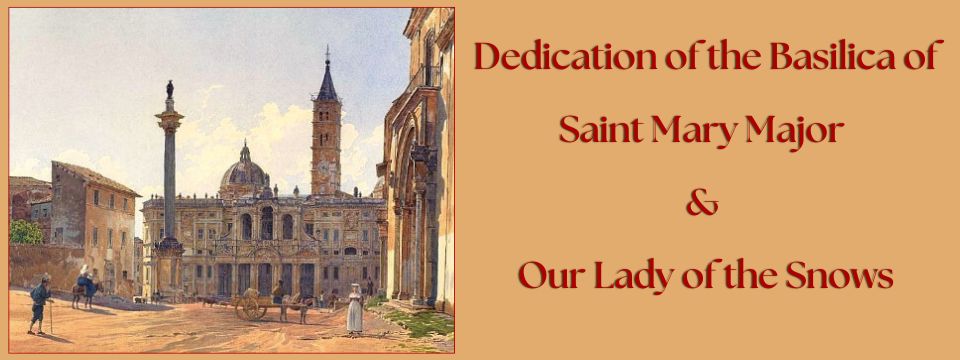
The Largest Church in the World Honouring the Virgin Mary
Feast August 5
Santa Maria Maggiore or Saint Mary Major is the largest church in the world honouring the Virgin Mary and was erected in the immediate aftermath of the Council of Ephesus of 431, which proclaimed Mary Mother of God.
Standing atop one of Rome’s seven hills, the Esquiline, it is also called Santa Maria ad Nives, or “at the snow.”
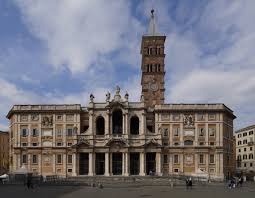
Improbable as it is for snow to fall during August, history tells of a snowfall that seemed more impossible, namely in Rome, Italy. August 5, 352, snow fell during the night in Rome.
There lived in the Eternal City a nobleman, John and his childless wife, who had been blessed with much of this world’s goods. They chose the Mother of God as the heir to their fortune, and at the suggestion of Pope Liberius, prayed that she might make known to them how to do this by a particular sign.
In answer, the Virgin Mother during the night of August 5, appeared to John and his wife and also to the Holy Father, Pope Liberius, directing them to build a church in her honour on the crown of the Esquiline Hill. And what would be the sign that John and his wife had requested?
“Snow will cover the crest of the hill.”
Snow rarely falls in Rome, but the flakes fell silently during that night, blanketing the peak of the historic hill. In the morning the news quickly spread and crowds gathered to throng up the hill and behold the white splendour. The snow had fallen in a particular pattern, showing the outline of the future church. When it became known that the snow was a sign from Mary, the people spontaneously added another to her long list of titles, Our Lady of the Snows.
The church built there is now known as Saint Mary Major. It is the focal point of devotion for many of Mary’s millions of children, one of the most popular churches in the world. There Mary has been pleased to secure various and many blessings as numerous and varied, as the flakes of snow that fell that August night.
The church built by John and his wife in honour of Our Lady of the Snows, restored and enlarged at various times was known by different names: The Basilica of Liberius, Saint Mary of the Crib because it enshrines relics of Christ’s Crib; lastly, Saint Mary Major, to distinguish it from the many other Roman churches dedicated to the Mother of God; Major, means Greater.
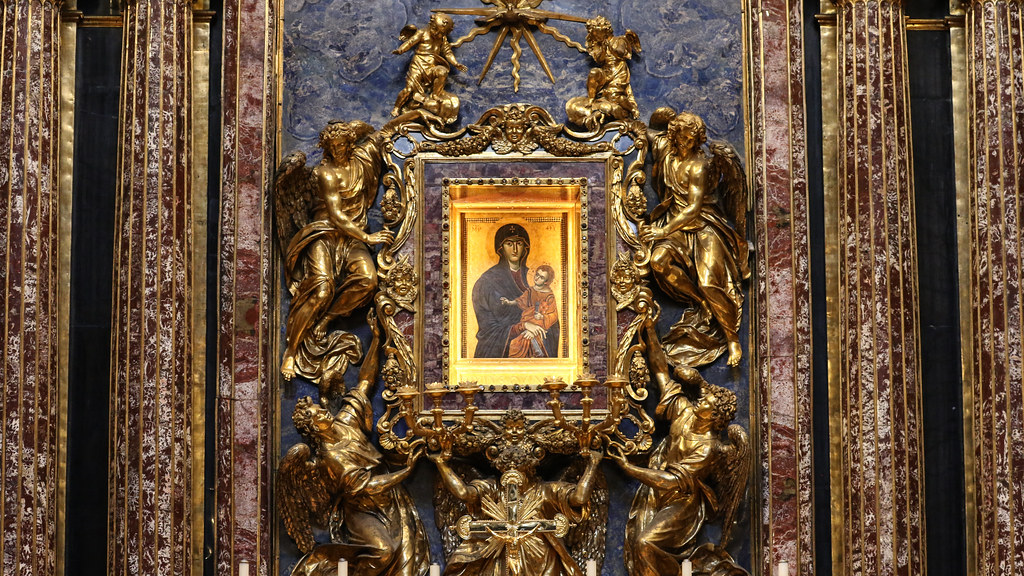
Another venerable treasure of Santa Maria Maggiore is the icon of Our Lady under the invocation of “Salus Populi Romani,” literally translated as “health (or salvation) of the Roman people.” According to tradition, this image of Mary embracing Jesus as a young boy was the work of the evangelist St. Luke, who painted it on a table top made by Our Lord himself in St. Joseph’s carpentry shop.
This miraculous icon has been carried in processions around Rome on many occasions. In 593 the newly-elected Pope St. Gregory the Great had the icon carried in public procession through the streets of Rome praying for an end to the Black Plague.
Pope St. Pius V followed his example in 1571 to pray for victory during the Battle of Lepanto, as did Pope Gregory XVI in 1837 to pray for the end of the cholera epidemic.
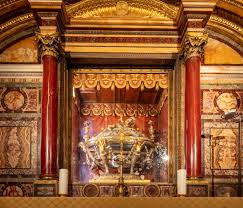
The basilica is also home to a few remnants of the humble crib in which Christ was laid at His birth. These pieces of the manger were carried to Rome by Christians fleeing the Muslim conquest of the Holy Land in the 7th century. They are preserved in a silver reliquary resembling an ordinary manger, upon which lies an image of the Infant Jesus.
The Holy Crib is the object of particular devotion and veneration during the liturgical ceremonies of Christmas Eve and Midnight Mass. On Christmas morning there is a procession in honour of the Holy Crib of the Infant Jesus, which culminates in the exposition of the sacred relic on the high altar.
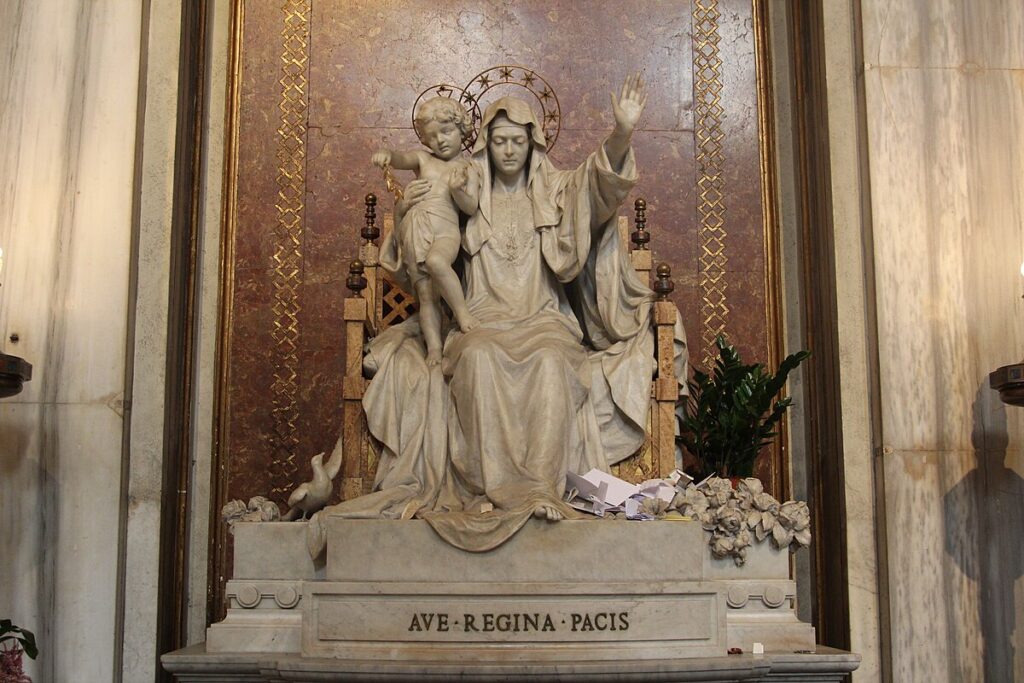
St. Mary Major is a treasury of sacred art and religious artifacts. Among its most moving works is the statue of Our Lady, Queen of Peace, located to the left as one enters the nave. Commissioned by Pope Benedict XV in thanksgiving for the end of the First World War, this marble statue was completed in 1918 by the Roman artist Guido Galli. Beneath it is the simple yet profound inscription: Ave Regina Pacis – “Hail, Queen of Peace.”
Mary is enthroned high against the wall, her left arm extended outward as if to cry, “Enough! Stop the war and violence!” Her eyes are cast downward, filled with the sorrow of a mother who has witnessed the devastation and loss of countless lives. In her right arm she holds the Child Jesus, who dangles an olive branch, ready to let it fall at His Mother’s word as a sign of peace for the world. A dove, poised to take flight, fixes its gaze upon the branch, waiting for the signal that peace may finally descend.
The statue is a profound meditation on Mary’s intercessory role in the life of the Church. The dove waits for the branch; the branch waits for Christ; Christ waits for Mary; and Mary, with patient, sorrowful love, waits upon us—to accept and live the peace her Son longs to give.
Saint Mary Major is one of the four basilicas in which the pilgrims to Rome must pray in order to gain the indulgences of the Holy Year. Most fitting do we call Mary Our Lady of the Snows. The white blanket of that August night symbolizes Mary, pure as the driven snow; her blessings and graces, numerous and varied as the falling snowflakes.
Science tells us that every snowflake is different in form and make-up: size, outline, structure, ornamentation, are all without limit, infinite in wondrous beauty, startling complexity, perfect symmetry as they fleet, dancing down from the sky. What a wonderful figure of the blessings Mary obtains for us! Snow changes the face of the earth, painting even a field of mud with a white coat. The grace of God won through prayer to Mary, also changes the face of the earth. Snow preserves the heat of the earth, protects vegetation, supplies moisture with slow effectiveness.
Grace serves similar purposes: it preserves the warmth of God’s love in our hearts; it protects the soul from the chill of temptation and sin; it nourishes the soul with new life. We see a further symbolism in this feast. There are millions living in lands of ice and snow who have not come to the knowledge of Mary and her Divine Son. We might ask that with the actual snowflakes, she shower down upon them the graces of the True Faith.
In particular, may that land where snow falls long and heavily, Russia, come to share in a fall of graces through prayer to her whom we honour on August fifth as “Our Lady of the Snows.”
Sources:
The Woman In Orbit & James Fitzhenry, roman-catholic-saints.com, & www.anf.org