Winning the heart and soul of South Africa for Mary by spreading the Fatima Message

Winning the heart and soul of South Africa for Mary by spreading the Fatima Message

Our Lady of the Bowed Head
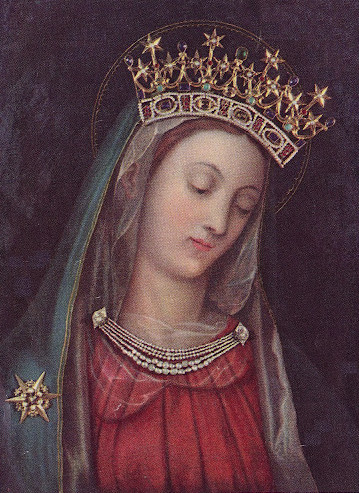
Our Lady of the Bowed Head

Feast Day: 7 February


Among the many miraculous images of the Mother of God through which she deigns to grant her favours, there is one in the monastery church of the Carmelites in Vienna, entitled the Mother of Grace, or Our Lady of Grace, also known also as Our Lady of the Bowed Head.

In 1610 a Carmelite, Dominic of Jesus-Mary, found among the votaries of an old altar in the monastery church of Maria della Scala in Rome, an oil painting of the Mother of God, dust-covered and somewhat torn, which grieved him. Taking it into his hands, he shook the dust off it, and kneeling down venerated it with great devotion.

He had the picture renovated and placed it on the shelf in his cell, where he made it the object of his love and supplications in favour of those who came to him in their necessities and afflictions.

One night while he was praying fervently before the picture, he noticed that some dust had settled on it. Having nothing but his coarse woollen handkerchief he dusted it with that and apologized,

“O pure and holiest Virgin, nothing in the whole world is worthy of touching your holy face, but since I have nothing but this coarse handkerchief, deign to accept my good will.”

To his great surprise, the face of the Mother of God appeared to take on life, and smiling sweetly at him, she bowed her head, which thereafter remained inclined.

Fearing he was under an illusion, Dominic became troubled, but Mary assured him that his requests would be heard: he could ask of her with full confidence any favour he might desire. He fell upon his knees and offered himself entirely to the service of Jesus and Mary, and asked for the deliverance of one of is benefactor’s souls in purgatory. Mary told him to offer several Masses and other good works; a short time after when he was again praying before the image, Mary appeared to him bearing the soul of his benefactor to Heaven. Dominic begged that all who venerated Mary in this image of Our Lady of Grace might obtain all they requested. In reply the Virgin gave him this assurance:

“All those who devoutly venerate me in this picture and take refuge to me will have their request granted and I will obtain for them many graces; but especially will I hear their prayers for the relief and deliverance of the souls in purgatory.”

Dominic soon after placed the image into the church of Maria Della Scala so that more devotees of Mary could venerate it. Many wonderful favours were obtained by those who honoured and invoked Mary here. Reproductions were made of Our Lady of Grace and sent to different parts of the world.

After the death of Dominic, the original painting was lent to Prince Maximilian of Bavaria. He gave it to the discalced Carmelites in Munich in 1631; they gave it to Emperor Ferdinand II of Austria and his wife Eleanore. After Ferdinand’s death, Eleanore entered the Carmelite convent in Vienna and took the picture with her. During the succeeding years the image was transferred to various places.

Today it is in the monastery church of Vienna Doabling. On 27 September 1931 it was solemnly crowned by Pope Pius XI – its 300th anniversary of arrival in Vienna.

From: The Woman in Orbit

Our Lady of Victory

Our Lady of Victory of Prague

FEAST DAY: 13 JANUARY

Among shrines dedicated to Our Lady of Victory, that at Prague has become world-famous because it is also the home of the statue of the Infant of Prague.

The story of the shrine is an unusual one. In 1620 the Austrian Emperor Ferdinand II and Prince Maximillian of Bavaria gained a major victory over a coalition of Protestant armies in the battle of the White Mountains near Prague. The previous day, Rev Fr Dominic of Jesus-Maria, a discalced Carmelite, had found in the castle of Strakowicz a picture representing the nativity of Christ. It showed the Blessed Virgin kneeling before her Divine Son, while St Joseph stood behind her holding a lantern. In the background were two shepherds. The Calvinists had shown their fanaticism by piercing the eyes of Mary and her spouse, St Joseph.

Carrying the picture to the camp, the monk held it up and urged the soldiers to restore Mary’s honour. His words decided the hesitation of the generals and gave courage to the men. They adopted Mary’s name as their battle cry and Mary blessed their efforts. In the moment of success, they hailed the painting as Our Lady of Victory and carried it in triumph into Prague, where their leaders adorned it with rich jewels.

In gratitude to God for his great success, and in recognition of the help given by Father Dominic, Ferdinand II founded several Carmelite monasteries, including one at Prague which was solemnly blessed under invocation of Our Lady of Victory.

Before this time, however, Father Dominic had taken the picture of Our Lady of Victory to Rome where it was first venerated in the Basilica of St. Mary Major, then carried – in the presence of Pope Gregory XV – to the church of St Paul near the Carmelite convent, on 8 May 1622. Pope Paul V subsequently changed the name of the church to Our Lady of Victory, and the feast was officially inaugurated.

The original painting was destroyed in a fire in 1833 and has been replaced by a copy. Another copy hangs in the church of Our Lady of Victory in Prague, in a building erected in 1706 replacing the earlier church.

From the Shrine of Our Lady of Victory in Prague, came to the entire world the devotion to the Infant of Prague.

Our need for Mary’s help continues as long as we live, and so long, too, we need her guidance. The struggle between the forces of evil and the forces of good will continue until the end of time. The devil whose intelligence and power exceed those we can command in our own right, has an acute appreciation of the value of our souls bought with a great price. Our sure way to defeat him is to range ourselves under Mary’s banner, to call on her to bring us victory, and to acknowledge her as Our Lady of Victory when she protects us from dangers and brings us triumphant through temptation.


Notes:

*from The Woman in Orbit

Credits:

Image of Infant of Prague: By Fotobanka ČTK, René Fluger; – http://www.pragjesu.info/image-infant-jesus-l.htm, CC BY-SA 3.0, https://commons.wikimedia.org/w/index.php?curid=20428346

Front of the Church: By Ludek – Own work, CC BY-SA 3.0, https://commons.wikimedia.org/w/index.php?curid=1511758

Chancel of the Church: By Balles2601 / Wikimedia Commons / CC BY-SA 4.0, CC BY-SA 4.0, https://commons.wikimedia.org/w/index.php?curid=86612035