Winning the heart and soul of South Africa for Mary by spreading the Fatima Message

Winning the heart and soul of South Africa for Mary by spreading the Fatima Message

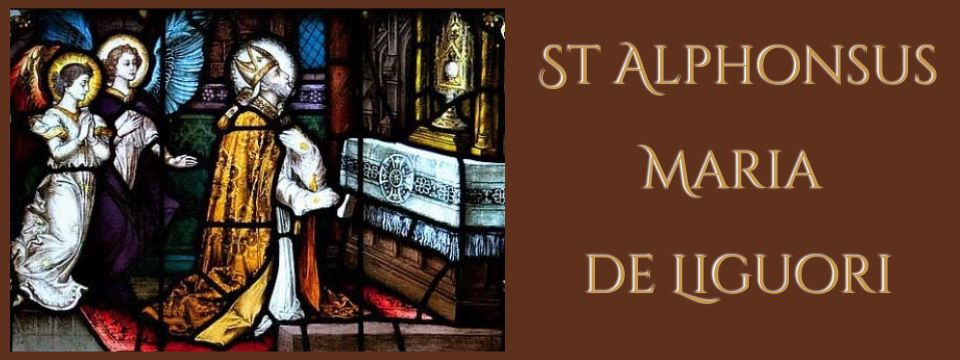
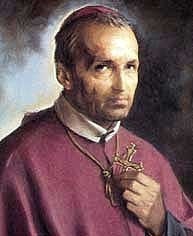
St Alphonsus Maria de Liguori

Patron Saint of Confessors and Moral Theologians

Feast Day 1 August


Alphonsus was born in 1696 near Naples, Italy, to a naval officer and his Spanish wife. Educated at the University of Naples, Alphonsus received his doctorate at the age of sixteen.

By nineteen he was practicing law, but he decided to give his life to God and left the practice to do apostolate.

On 21 December 1726 Alphonsus was ordained a priest. He spent six years doing apostolate throughout Naples, gathering followers as he went.

In 1732, he formed the Congregation of the Most Holy Redeemer, a group comprised of priests and brothers who had dedicated themselves to God and did missionary work in poor areas.

By 1749 the congregation became officially approved by Pope Benedict XIV.

In 1762, Alphonsus became bishop of Naples, although he vigorously tried to decline the honour. As bishop he immediately began to reform his diocese.

For thirteen years Alphonsus fed the poor, reorganized the seminary and religious houses, taught theology, and wrote extensively.

His personal austerities were rigorous, while he daily endured the severe pain from the rheumatism that was beginning to deform his body. He spent several years having to drink from tubes because his head was so bent forward.

In 1780, Alphonsus was tricked into signing a submission for royal approval of his congregation.

This submission altered the original rule, and as a result Alphonsus was denied any authority among the Redemptorists.

Deposed and excluded from his own congregation, Alphonsus suffered great anguish.

He died in 1787 at Nocera di Pagani near Naples. He was beatified in 1816 and canonized in 1839.

In 1871, Alphonsus was declared a “Doctor of the Church” by Pope Pius IX. His feast day is 1 August.

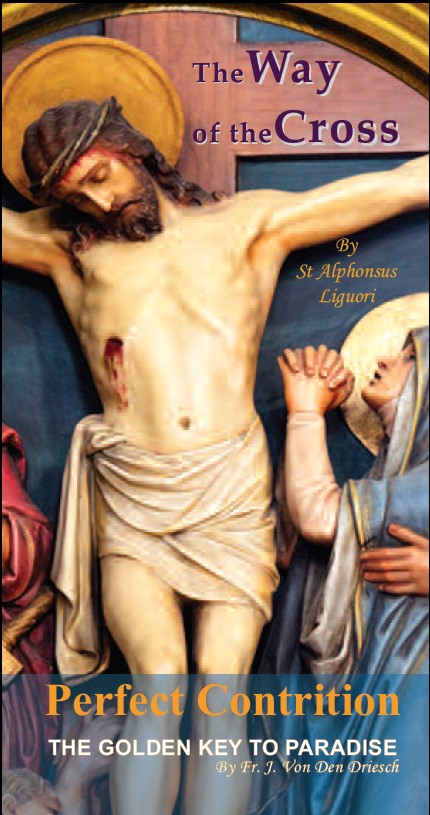
Printed and produced by South Africa Needs Our Lady, this special Way of the Cross & Perfect Contrition booklet is especially useful during Lent. It is in full colour with beautiful stations to meditate on.It is actually two books in one cover!

The Way of the Cross meditations are those of St Alphonsus Liguori and

Perfect Contrition – The Golden Key to Paradise is by Rev. Fr. J. von den Driesch.

Soft cover 36 pages. Full colour.


Click here to order…

Saint Anthony of Padua

St Anthony and the Mule

FEAST DAY 13 JUNE


Anthony was born Fernando Martins in Lisbon, Portugal, in August, 1195. His noble and wealthy family arranged for him to be instructed at the Cathedral school where he was instilled with a deep religious piety.

At fifteen, Fernando entered the Augustinian Order at the Abbey of Saint Vincent on the outskirts of Lisbon and there studied theology, Latin and the Holy Scriptures.

It was after his ordination to the priesthood that Fernando first came into contact with some Franciscan friars who settled near his monastery.

From the beginning, Fernando was strongly attracted to the simple, evangelical lifestyle of the friars. However, it was not until the news came of the first martyrs of their order – five Franciscans beheaded in Morocco – and Fernando saw their mutilated bodies, which had been ransomed, being buried in the Abbey of Santa Cruz, that he obtained permission to leave the Augustinian Order and join the Franciscans, where he received the new name of Anthony.

So inspired was he by the martyrs’ example that he set out for Morocco himself, with the hope of becoming a martyr too. However, he fell seriously ill on route and was forced to return to Portugal to regain his health. According to the designs of Divine Providence, on the return voyage, the ship was blown off course and landed in Sicily.

From Sicily he made his way to Tuscany where he was assigned to a convent of the order, but he was later assigned to the rural hermitage of San Paolo near Forlì, Romagna, a choice made after considering his poor health. There he lived in a cell made by one of the friars in a nearby cave and spent his time in private prayer and study.

One day, in 1222, in the town of Forli, on the occasion of an ordination, Anthony was persuaded to be the homilist. So simple and resounding was his teaching of the Catholic Faith that even the most unlettered and innocent might understand it and it made a great impression on all who heard. Not only his rich voice and arresting manner, but the entire theme and substance of his discourse and his moving eloquence, held the attention of his hearers.

Everyone was impressed with his knowledge of Scripture, acquired during his years of solitude at the hermitage of Forli.

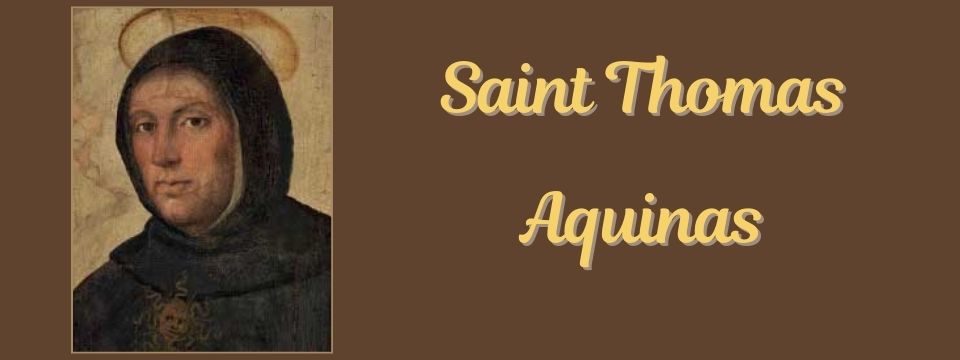
Saint Thomas Aquinas

Patron Saint of Catholic Schools, Scholars, Theologians & Booksellers

Feast January 28


Thomas Aquinas was born about 1225 in the castle of Rocca Secca, into the noble lineage of the family of Aquino. His father, Landulf, was a knight and his mother, Theodora, a countess.

At age five Thomas was sent to the Benedictines of Monte Cassino as an oblate and remained until thirteen. He was studious, meditative and devoted to prayer, and frequently asked the question, “What is God?”

Around 1236, the Abbot convinced Thomas’ father that such a talented lad should go to Naples to study, and there he shone academically. In Naples Thomas came under the influence of the Dominican Order of Preachers, and at nineteen was received into the Order.

His family was indignant because he had chosen a mendicant order. At Theodora’s orders two of his soldier-brothers imprisoned him in a castle. They even introduced a temptress into Thomas’ chamber whom he drove away with a brand snatched from the fire. Falling to his knees he begged God for the virtue of integrity of mind and body. Falling asleep, he dreamt of two angels who girded him with a white girdle saying, “receive the girdle of perpetual virginity,” and he was never tempted by the flesh again – for which he is called “The Angelic Doctor.” He spent the two years of his captivity praying, studying and writing.

Thomas Aquinas

Finally, his mother relented. Returning to the Dominicans they found that he had made so much progress on his own, that he was soon ordained. Sent to study in Cologne under St. Albert the Great, his great size and silence earned him the tag “the Dumb Ox” but hearing his brilliant defence of a difficult thesis, St. Albert responded, “We call this young man a dumb ox, but his bellowing in doctrine will one day resound throughout the world.”

Thomas received his doctorate in Theology in Paris, and went on to teach, preach, and write extensively. Between 1259 and 1268 he was in Italy as Preacher General teaching in the school of selected scholars attached to the Papal court. About 1266 he began writing the most famous of all his works, The Summa Theologica.

In 1269 he was back in Paris, where he was a friend and counsellor of King St. Louis IX. In 1272 he was recalled to Italy. In the following year, on the Feast of St. Nicholas, he received a revelation that caused him to leave his great Summa unfinished saying, “…all that I have written seems like so much straw after the things that have been revealed to me.”

Becoming ill, Thomas died on 7 March 1274 at fifty years of age. He was canonized in 1323 and declared a Doctor of the Church by Pope St. Pius V in 1567.  His feast is celebrated on January 28.