Winning the heart and soul of South Africa for Mary by spreading the Fatima Message

Winning the heart and soul of South Africa for Mary by spreading the Fatima Message

Our Lady of La Salette

On 19 September 1846, Our Blessed Mother appeared in south-eastern France to two children, Maximin Giraud and Melanie Mathieu, who were taking care of a few cows on the slope of a mountain which rises above the village of La Salette. Their attention was drawn to a globe of light a short distance away. While they gazed, the globe opened and they saw a woman seated on some stones which surrounded the bed of a dried stream. Her elbows rested on her knees, her face was buried in her hands, and she wept.

The children were frightened and did not know what to do, when the Lady arose and in the sweetest of tones, said:

“Come near, my children; do not be afraid. I am here to tell you great news.”

The children obeyed and when they were close, they saw that the woman’s countenance was of rare beauty, though her eyes were filled with tears. They saw that her shoes were sparkling white, the buckles on them were square and golden. Encircling the soles were tiny roses which did not crush as she stood on the tips of the blades of grass. Her apron was golden and it reached to the bottom of her full white dress. Her arms folded before her were concealed within broad straight sleeves which reached beyond her fingertips. Along the border of her plain white kerchief crossed on her breast, ran many-colored roses both large and small, and besides these was a flat, thin gold chain about an inch in breadth.

The face of Our Lady of La Salette was so resplendent with light that the noon-day sun lost its brightness for the children; her complexion was a pale white such as those who have been bowed down with suffering. Her beauty was radiant, so dazzling, so scintillating, that Melanie was frequently rubbing her eyes, thinking that by so doing she might see the better, while Maximin could see her face but vaguely. Her headdress was white and above it, a royal diadem wreathed with roses of many hues glittered, while on her bosom rested a golden crucifix, with the pincers and hammer of the Passion. Her majestic beauty was ravishing; her face exceedingly beautiful – yet profoundly sad. It was not earthly.

Mary, Our Lady of La Salette, stood with her head bent toward the children. Her mien and her manner were reassuring and kind, but also sorrowful. They listened to her voice; a voice far sweeter than the sweetest melody:

“If my people do not submit, I shall be forced to let go the hand of my Son. It is so strong, so heavy, that I can no longer withhold it. How long a time do I suffer for you! If I would not have my Son abandon you, I am compelled to pray to Him without ceasing. And as to you, you take no heed of it. However much you pray, however much you do, you shall never recompense the pains I have taken for you.”

Then Our Lady of La Salette told them that the two things which at that time pained her Son most were the neglect of Sunday observance and blasphemous language. She foretold a great famine, and asked the children to make known her message. She walked off a bit, lifted her gaze toward heaven and vanished. Next day a miraculous spring was present where Mary had stood.


*from The Woman in Orbit
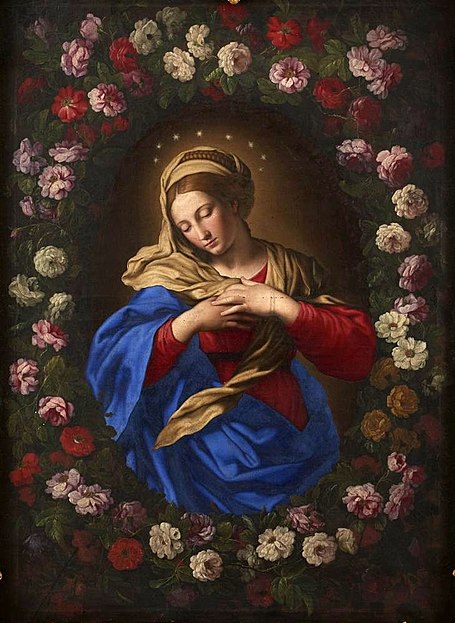
Our Lady of the Rose

Our Lady of the Rose, Lucca, Italy

Feast Day 30 January

History shows that the rose is the favourite flower of Our Lady herself, the Madonna of the Rose. In her apparition at Guadalupe, she made use of roses as a sign of her presence and even arranged them with her own beautiful hands in the tilma of Juan Diego. At La Salette she wore a profusion of roses in three garlands and had tiny roses around the rim of her slippers. She brought beautiful roses with her at Lourdes, Pontmain, Pellevoisin, Beauraing, and Banneaux. To Sister Josefa Menendez she showed her Immaculate Heart encircled with little white roses. Truly, she could be called the Madonna of the Rose.

Mary’s wedding garment, according to approved revelation, was “richly embroidered with blue, white, violet, and gold roses.” At the Incarnation, while the Angel vanished down the path that led up to Heaven, showers of half-blown roses fell on Mary.

In the Syrian capital Damascus, very familiar to Mary, hundreds of men and women once earned a living working with roses, from which they distilled rosewater and extracted attar and rose syrup. These people carried the scent of roses with them wherever they went. This is a lesson for us: let us become so saturated with the virtues of Mary, the Madonna of the Rose, that we carry their fragrance and attract other souls to our Divine Lord through His Mother, the Mystical Rose, the Madonna of the Rose.

Among the many feasts of Our Lady we find mentioned in an old Latin chronicle: “January 30, Our Lady of the Rose, at Lucca in Italy. Three roses were found in January in the arms of the statue of Our Lady there.”

Cardinal Newman says “Mary is the most beautiful flower ever seen in the spiritual world. It is by the power of God’s grace that from this barren and desolate earth there ever sprung up at all flowers of holiness and glory; and Mary is the Queen of them all. She is the Queen of spiritual flowers; and therefore, is called the Rose, for the rose is called of all flowers the most beautiful. But, moreover, she is the Mystical or Hidden Rose, for mystical means hidden.”


In the stately college of King’s Chapel, in Cambridge, England, one of the most renowned universities, built by Henry VIII in memory of his father, there can be discerned, hidden in one of the Tudor rose-bosses on the walls, a small head of Our Lady which somehow escaped observation at the despoliation of images at the Protestant Deformation. Brother John, a clever carver, was hired to carve all of the roses; knowing of the king’s quarrel with the pope, he secretly carved a tiny head of Mary, half-hidden within the rose petals in the upper tier of decorations, saying, “There you remain, Our Lady of the Rose, even if wicked men try to drive you and your Son from this Church.” His words came true, when the place was stripped of every trace of Faith, the diminutive head of the Mother of God still remained.

But a rose has thorns, and so had the Mystical Rose – the sharpest for herself alone; so she could have compassion on our infirmities. Never did the breath of evil spoil the splendour of this Mystical Rose; never did God’s lovely flower, the Madonna of the Rose, cease to give forth the sweet perfume of love and praise.

“Mystical Rose, thou hast been hailed to shed they fragrance sweet, to flood our desert with thy perfume rare. We beg thee, daily kneeling at thy feet, let fall thy petals for our repose, shower upon us thy aroma, O thou Mystical Rose.”

www.roman-catholic-saints.com

Click here to send a Rose to Our Lady of Guadalupe in Mexico in February