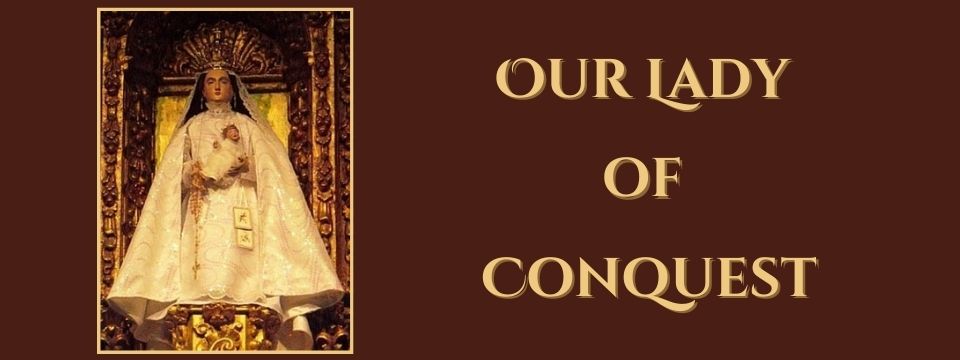
In the North Chapel of the beautiful cathedral of Santa Fe stands a little statue (scarcely one metre tall) of Our Lady holding the Child Jesus. It was skilfully carved by loving hands in Spain. Mary is clad in a richly embroidered dress, topped by a jewelled crown. Her regal countenance wears a serene, detached expression that is strangely impressive. This is Our Lady of Conquest, or La Conquistadora.
The statue of Our Lady of Conquest came to the new world in the care of the Franciscan missionary Fray Alonso da Venevides. She was installed with great ceremony in a church in Santa Fe. Over the ensuing decades, as often happens, the men living in the region did not practice their religion as they should. Mary appeared in a vision to a young girl, warning her that the colony would be overrun due to the loss of reverence for priests and the Faith.
In the year 1680 the local Indians rose up and attacked the Spanish. Twenty-one priests were killed, and the colonists completely driven out of the region. The statue was rescued from the burning church and taken back to Mexico with the colonists who escaped the wrath of the Indians.
It was not until the year 1691 that Don Diego de Vargas was sent by the King of Spain to attempt the resettlement of the city of Santa Fe. Like so many Spanish heroes who had accomplished seemingly impossible deeds during their lifetimes, he was as fervent a Catholic as he was a capable knight. Don Diego de Vargas carried with him the statue of Our Lady as he re-entered New Mexico. Although he had only a small force, he was able to peacefully negotiate a peace with the various Indian nations. He attributed his success to “the Sovereign Queen, Most Blessed Mary.” He is said to have vowed to build a chapel for her and hold a yearly procession if she would grant him a speedy and blood-less victory over the Indian, which she did.
Upon reaching his goal, however, the Indians refused to allow the Spanish colonists to return to Santa Fe. The Spanish under Don Diego were few in number, and they were forced to fight a numerically superior force.
The colonists prayed the rosary before the statue of the Blessed Virgin as the men engaged the Indians in battle. The fighting lasted all day, and it was not until evening when they reclaimed the city. Once again, Mary was credited for the victory, and to show her sovereignty, Don Diego placed an officer’s baton in her hand.
The shrine symbolizes a spirit of deep-rooted Faith and devotion which characterized the “Conquistadores” of this land. There is still a great deal of devotion shown to Mary at the Cathedral of St. Francis that includes processions, fiestas and other celebrations.
The statue was formally crowned by Cardinal Francis Spellman and in 1960 received a Papal Coronation.
As seen on https://www.roman-catholic-saints.com/our-lady-of-conquest.html
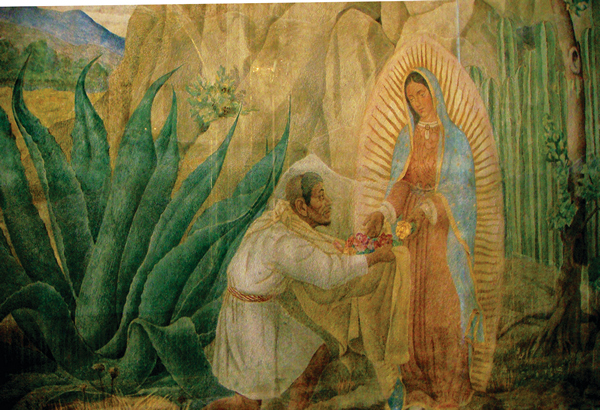
Juan Diego was born in Cuautlitlán – today part of Mexico City – in the year 1474 and given the name “Cuauhtlatoatzin” or “Eagle that speaks”. He was a gifted member of the Chichimeca people, one of the more culturally advanced indigenous groups living in the Anáhuac Valley.
In 1524, at fifty years of age, Juan Diego was baptized with his wife Maria Lucia by one of the first Franciscan missionaries to arrive in Mexico, Fray Pedro de Gante. His religious fervour, his simple artlessness, and his respectful but gracious demeanour are among his defining characteristics.
It is said that after their baptism, he and his wife, inspired by a sermon on the virtue of chastity, mutually decided to embrace this evangelical counsel by living celibately afterwards.
After the 1529 death of his wife, Juan Diego moved to be near his aged uncle Juan Bernardino in Tolpetlac. Thereafter, the pious widower was in the habit of walking to the Franciscan mission at Tlatelolco for religious instruction and to perform his religious duties. His frequent journeys took him close by the hill at Tepeyac.
At daybreak on Saturday, December 9, 1531, Juan Diego was on his way to morning Mass as usual, when he suddenly heard the exquisite sound of many birds singing. The beautiful melody came from higher up the hill, and thinking himself transported to heaven, his whole being attracted by the sound, he let it draw him up the Tepeyac.
When the birdsongs suddenly ceased, he heard his name called in his native Náhuatl language and he beheld a beautiful young maiden. She called him to come closer and Juan Diego, “filled with admiration for the way her perfect grandeur exceeded all imagination,” prostrated himself in her presence. With unutterable sweetness, she revealed her identity to him “… the ever-virgin Mary, Mother of the true God who gives life and maintains its existence. He created all things. He is in all places. He is Lord of Heaven and Earth.” She asked him to go to the bishop in Mexico City, Don Fray Juan de Zumárraga, and to request in her name that a shrine be built at Tepeyac, where she promised to pour out abundant graces upon those who invoked her.
After some difficulty in gaining admission to the bishop, the humble messenger recounted the marvels he had witnessed and delivered the lady’s message. However, the prelate’s response was discouraging and Juan Diego left downcast and disappointed.
The Queen of Heaven was waiting for him at the top of Tepeyac on his return that evening, and casting himself down he told her of his heart’s sorrow at meeting with incredulity on the part of the bishop and adds: “I beg you, my Lady, Queen, my little girl, to have one of the nobles who are held in esteem, one who is known, respected, honoured, [have him] carry, take your dear breath, your dear word, so that he will be believed. Because I am really [just] a man from the country, I am a [porter’s] rope … a man of no importance: I myself need to be led, carried on someone’s back. That place you are sending me to is a place where I’m not used to going or spending any time in, my little Virgin, my Youngest Daughter, my Lady, Little girl.”
With great gentleness, she tells him that he is the one that must carry out this commission. And Juan Diego promises that he will return to the bishop the following day with her request.
Despite the obstacles posed by the bishop’s attendants, Juan Diego was again admitted into his presence. Don Juan de Zumárraga questioned the Indian kneeling before him thoroughly but remained unmoved by the man’s account. Not on his word alone would he believe, he told him, a sign must be given to prove that the apparition was indeed from heaven.
Undaunted by the prelate’s request, he returns to Tepeyac to convey it to Our Lady, who asks him to return in the morning that she might give it to him. During the night, however, Juan Diego’s sick uncle worsens and it is clear that he is dying. Shortly after midnight, his nephew sets off for Tlatilolco to summon one of the priests that he might confess and prepare for death.
Not wanting to meet the beautiful Lady, who would surely want to send him to the bishop with the “proof” he had requested, he hurried along, set on his task. But the Queen of Heaven came down to meet him and gently chiding him she asked, “What is happening, youngest and dearest of all my sons? Where are you going, where are you headed?” Humbling himself before her, he told her of his uncle’s grave illness and his need for a priest to assist him. She assured him that the illness was not grave and that he had nothing to fear on that account. Her solicitude filled him with joy and consolation: “Am I not here, I, who am your mother? Are you not under my shadow and protection? Am I not the source of your joy? Are you not in the hollow of my mantle, in the crossing of my arms? Do you need something more? Let nothing else worry you, disturb you; do not let your uncle’s illness pressure you with grief, because he will not die of it now. You may be certain that he is already well…” And, as they later found out, his uncle became well at that very moment.
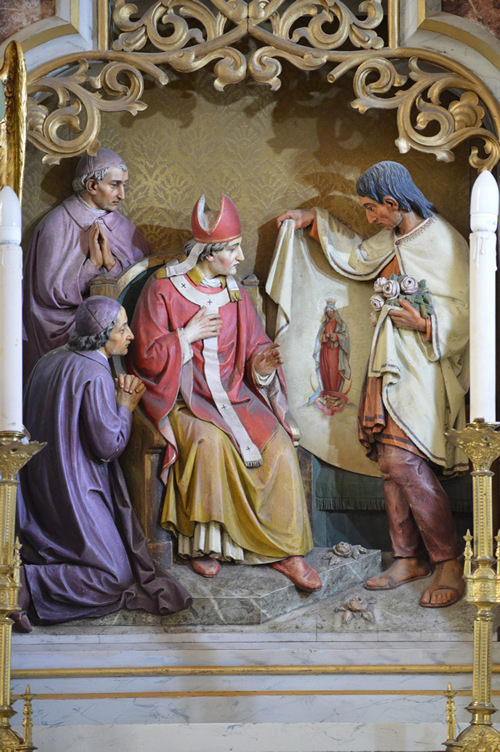
Full of confidence, Juan Diego begged her to send him immediately to the bishop with the sign she had promised. The Blessed Mother told him to climb the hill and to pick the flowers that he would find there. He obeyed, and although it was winter time and the frost at that time of year was very harsh, he found flowers of many kinds, in full bloom. Astonished, he cut and gathered the fragrant blossoms and took them to Our Lady who carefully arranged them in his mantle – the rough-woven “tilma” worn by his people – and told him to take them to the bishop as “proof”. When he opened his tilma to show the bishop the profusion of blooms, the flowers fell to the ground, and there remained impressed upon his cloak an image of the Blessed Mother, the apparition at Tepeyac.
With the Bishop’s permission, Juan Diego lived the rest of his life as a hermit in a small hut near the chapel where the miraculous image was placed for veneration. Here he cared for the church and the first pilgrims who came to pray to the Mother of Jesus.
He died in 1548 and was buried in the first chapel dedicated to the Virgin of Guadalupe. He was beatified on 6 May 1990 by Pope John Paul II in the Basilica of Santa Maria de Guadalupe in Mexico City and canonized by him on 31 July 2002. His feast day is on December 9th.