Winning the heart and soul of South Africa for Mary by spreading the Fatima Message

Winning the heart and soul of South Africa for Mary by spreading the Fatima Message

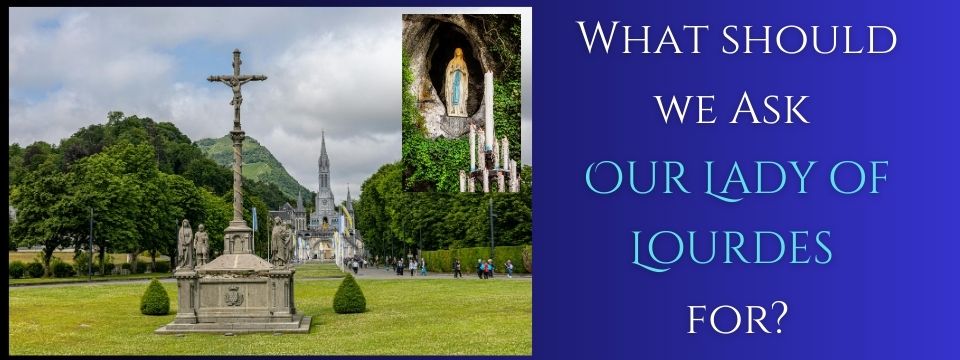
What should we ask Our Lady of Lourdes for?

As Our Lady of Lourdes wished to be known as supremely beneficent – but evidently this is merely a suggestion that should only be heeded if one has the inclination – I suggest the following: on Her feast day, think of a great grace to ask of Our Lady.

We must be bold in our prayers.

We should ask for bold things, but not foolish ones. Sensible and difficult graces, we should ask for them. And, at the same time, ask Our Lady with great insistence. Let each of us think of a spiritual grace and a temporal grace on this special Feast. A grace that pertains to sanctification and then something else that we may desire temporally, if it is for the good of our soul.

This leads to some reflection on life. It leads us to broaden our perspective on our spiritual life and, in this way, to have a more precise view of ourselves, our activities, and our paths, and to offer a grateful prayer to Our Lady. Therefore, I suggest that you do just that.

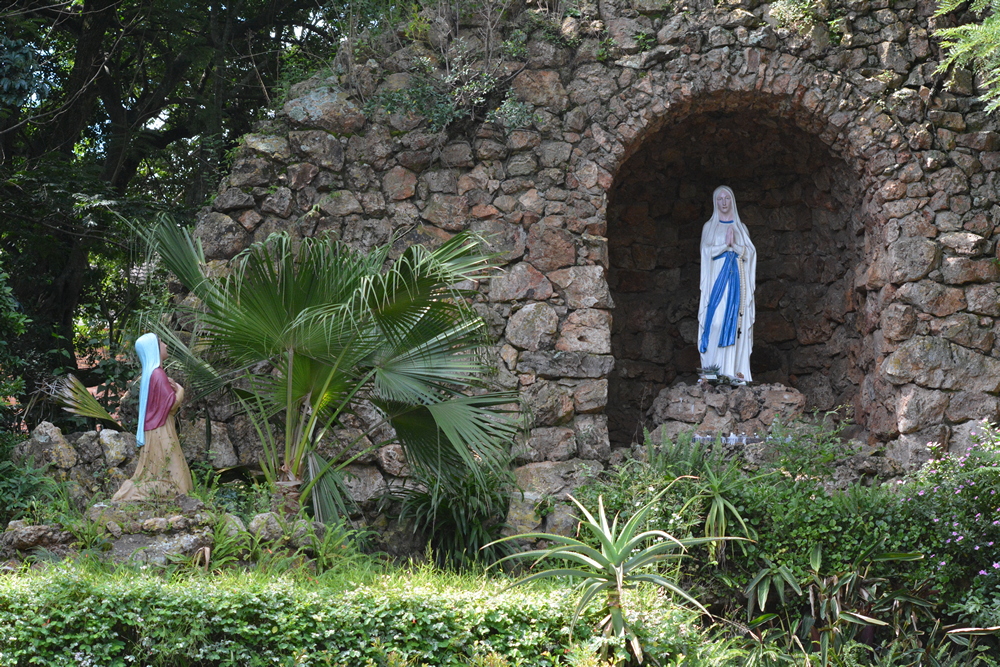
Lourdes Grotto at Marianhill, KZN

…However, we must never forget that in the Gospel, physical illnesses are treated as symbols of illnesses of the soul. Just as some suffer from physical paralysis, others suffer from spiritual paralysis; some suffer from physical blindness, others from spiritual blindness; deafness, muteness, and other things.

If we have defects of the soul that we would like to correct, this would be the appropriate time for us to bring them to the feet of Our Lady and ask Her to heal us. It is a request that has much validity, because if Our Lady so desires to heal perishable, mortal bodies, how much more will she desire to heal imperishable and immortal souls!

Our Lord Jesus Christ did not come to earth to save bodies; He came to earth to save souls, and therefore our requests cannot fail to be very pleasing to Him.

We should ask for ourselves or for someone we care about, someone for whom we do apostolate; for a soul whose difficulties frighten us; for a friend whose afflictions or temptations and dangers constitute a source of concern for us.

This is an extract of a talk given by Plinio Corrêa de Oliveira on 10 February 1965, on the  “Saint of the Day.” 

Footnotes:

  1. Source: https://www.pliniocorreadeoliveira.info/DIS_SD_650204_Lourdes_e_a_Mediacao_Universal.htm#.Y-b8XHbMJPY

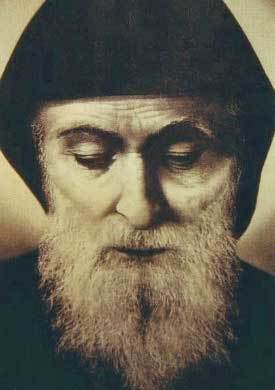
St Charbel Makhlouf

Patron Saint of Lebanon

Feast July 24

Youssef Antoun Makhlouf was born in the village of Bekka Kafra in Lebanon on 8 May 1828 and was one of five children born to Antoun Zarrour Makhlouf and Brigitta Chidiac. His father was a mule driver who died when Youssef was only three years old, leaving his widow to bring up their children alone.

Although Brigitta was left nearly destitute, she reserved a profoundly religious atmosphere in their home and instilled in her children a deep spirit of piety. Because of this fidelity, Youssef became unusually devoted and inclined to prayer and solitude at a very young age. He was greatly attracted to the life and spirituality of hermits; and as a young boy tending his family’s small flock, he would often go to a nearby grotto where he had erected a little shrine to the Holy Mother of God and would spend his whole day there in prayer.

When he was twenty-three years old, Youssef, feeling the call to the religious life, left his home and family to join the Lebanese Maronite Order at the Monastery of Our Lady in Marfouq. Here he began his formation as a monk before later being transferred to the Monastery of St. Maron near Beirut. There he received the religious habit of the Maronite monk and took the name Charbel. He made his final profession as a religious brother on 1 November 1853 when he was twenty-five years old.

Brother Charbel immediately began his studies for the priesthood under the instruction of Father Nimattullah Kassab, who was also later declared a saint by the Church. Charbel was ordained on 23 July 1859, following which he returned to the Monastery of St. Maron where he lived a life of great austerity.

In 1875, he was granted permission by his superiors to live a solitary life in the Hermitage of Sts. Peter and Paul, which was under the jurisdiction of the monastery; and there he resided for the remaining twenty-three years of his life until his death on Christmas Eve, 1898.

St. Charbel is renowned for his many miracles both during his life and after his death. His most famous miracle – which was also his first – occurred when, multiple times, he successfully lit an oil lamp which was filled with water. He is also credited with many healing miracles.

After his death, he was interned at the Monastery of St. Maron, now a famous pilgrimage site. His tomb was often witnessed surrounded by a dazzling light, and to this day his remains are incorrupt and an unexplainable blood-like fluid flows from his body.

He was canonized on 9 December 1977, by Pope Paul VI, who held him up as an example to help us understand “in a world, largely fascinated by wealth and comfort, the paramount value of poverty, penance and asceticism, to liberate the soul in its ascent to God.”