Winning the heart and soul of South Africa for Mary by spreading the Fatima Message

Winning the heart and soul of South Africa for Mary by spreading the Fatima Message

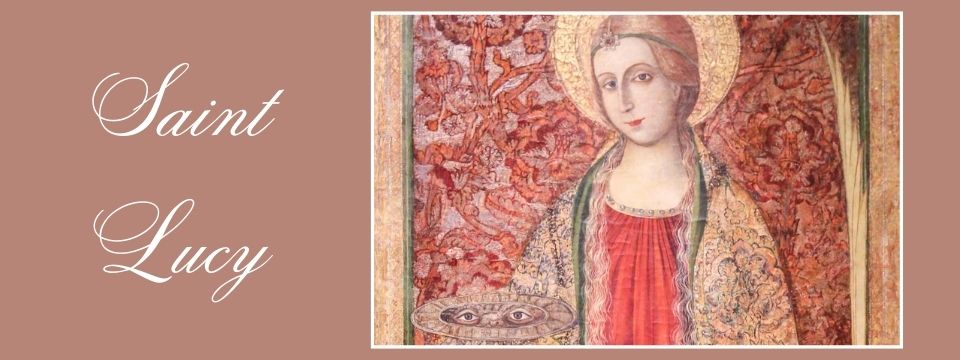
Saint Lucy

Patron Saint of the Blind, Italy, and Syracuse

Feast Day 13 December

Saint Lucy was descended of a noble family of Syracuse, which was then regarded as the principal city of Sicily. She lost her father in her infancy; but Eutychia, her mother, took care to educate her properly, and to instruct her well in the doctrines of our holy faith. When our saint arrived at a proper age, her mother began to think of giving her in marriage, but Lucy, who had consecrated her virginity to Jesus Christ, awaited only a favourable opportunity to reveal her resolution to her mother.

The opportunity soon presented itself. Eutychia was afflicted for many years with a flux of blood, without being able to find any effectual remedy. Saint Lucy therefore, persuaded her to repair to the tomb of Saint Agatha, martyred a half century before in Catania, where the Lord was pleased to work many miracles, and there to implore her cure. When they arrived at Catania, they prostrated themselves in prayer before the sepulchre of Saint Agatha, where Lucy, perhaps from fatigue of the journey, was overpowered with sleep.

The blessed martyr appeared to her, and as we read in the Roman Breviary, said: “Lucy! Why dost thou demand through my intercession that which, by thy faith, thou canst thyself obtain for thy mother?”

She then assured Lucy that God would work the desired cure, and that, for having preserved her virginity inviolate, God would reward her in Syracuse with the same glory she herself had received in Catania.

Saint Lucy, animated by this vision, was the more confirmed in her resolution of remaining always consecrated to Jesus Christ, and told her mother to speak to her no more of marriage, but to distribute her fortune among the poor. Eutychia answered, that at her death she would bequeath all to her, and that she might do with it as she pleased; but Saint Lucy replied, that gratitude for her miraculous cure ought to induce her willingly to deprive herself during life of that which, at her death, she should necessarily leave behind.

The mother consented, and when they returned to Syracuse, they commenced to sell their property, and to distribute the proceeds among the poor. Saint Lucy’s suitor perceiving this, complained to Eutychia; but he found that his representations were totally ineffectual, and, in his rage, accused her before the governor, Paschasius, as being a Christian, contrary to the edicts of Diocletian and Maximian.
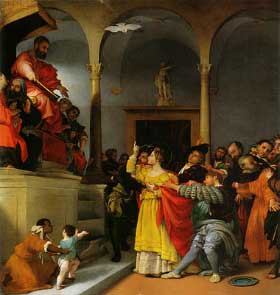
The saint was accordingly arrested and brought before the governor, who endeavoured to persuade her to sacrifice to the idols; but Saint Lucy replied, that the sacrifice most agreeable to God was the relief of the poor, in which she was actually engaged and that she was prepared to sacrifice even her life.

Paschasius replied that she ought to obey the emperor, as he did; but the saint answered: “Day and night I meditate upon the divine law; and if thou art anxious to please the emperor, I am anxious to please my God; therefore, it is that I have consecrated to him my virginity.”

Paschasius in his rage told her that she was impurity itself.

The saint replied: “No, thou art impurity, since thou dost endeavour to corrupt Christian souls, alienating them from God, to serve the devil, – wrongly preferring, as thou dost, the goods of this world to those of heaven.”

Paschasius; “Torments shall stop thy mouth.”

Lucy: “Words shall never be wanting to the servants of God, since the Lord hath promised that the Holy Ghost shall speak through them.”

Paschasius: “Then the Holy Ghost is within thee?”

Lucy: “St Paul hath said, that those who live chastely and piously are the temples of the Holy Ghost.”

“Since this is the case,” said the tyrant, “I will cause thee to be brought to an infamous place, in order that the Holy Ghost may leave thee.”

The saint replied: “The body receives no stain when the will is averse to sin; on the contrary, the violence you meditate would double my crown.”

The governor then threatened the most horrid tortures, in case she continued obstinate.

The saint intrepidly exclaimed: “Behold my body ready to suffer every torture! Why dost thou delay? Begin the execution of that which the devil, thy father, prompts thee.”

Paschasius, maddened with rage, ordered that she should instantly be brought to the place of infamy, in order that she might first lose the honour of virginity, and then be deprived of life.

The guards endeavoured to execute this command, but found that God had rendered her so immovable that all their exertions were insufficient to drag her from the spot.

Paschasius in astonishment exclaimed: “What incantation is this?”

The saint replied: “This is not an incantation, but the power of God. Why dost thou fatigue thyself? Dost thou not manifestly perceive that I am the temple of the Lord?”

Paschasius, more confused and infuriated than ever, ordered a great fire to be kindled round the saint that she might be burned.

Saint Lucy, nothing daunted, said to the tyrant: “I will pray to the Lord Jesus Christ that the fire may not injure me, in order that the faithful may witness the divine power, and that the infidels may be confused.”

The friends of Paschasius, unwilling that the people should witness any further miracle, advised him to have her beheaded; but after having been tortured in many other ways, her throat was pierced with the point of a sword.

The saint did not expire immediately; she threw herself on her knees, offered her death to God; and having foretold that peace would soon be restored to the Church, consummated her martyrdom in the year 303 or 304. Her name is inserted in the Canon of the Mass.*

She is portrayed holding a pair of eyes on a platter. Some accounts say that her eyes were tortured, others that she gouged them out to discourage her suitor. In any case, she is particularly invoked for ailments of the eyes, or eyesight problems.

The emblem of eyes on a cup or plate apparently reflects popular devotion to her as protector of sight, because of her name, Lucia (from the Latin word “lux” which means “light”).


*from Saint Alphonsus

As seen on: https://www.roman-catholic-saints.com/saint-lucy.html
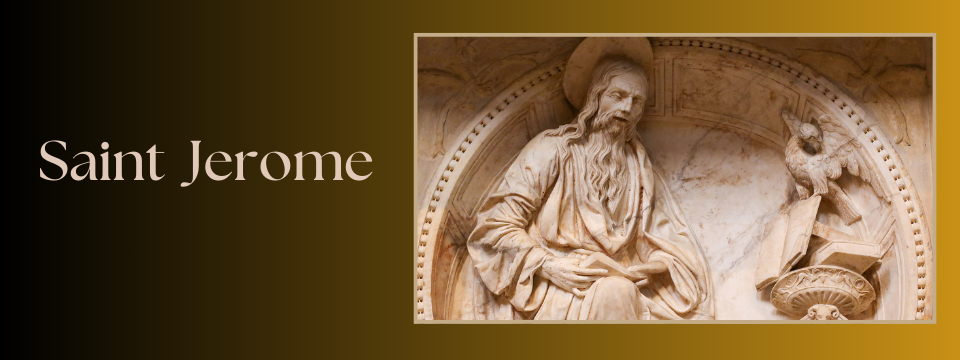
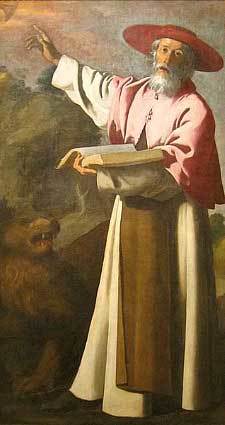
St Jerome

Patron Saint of Librarians and Libraries as well as Archivists, Translators and Encyclopaedists

Feast Day 30 September

St. Jerome is a Father and Doctor of the Church who is best known for his compiling of the Vulgate version of the Catholic Bible, now the standard edition in use.

He was born about the year 347 at Stidon, near Dalmatia, to wealthy Christian parents. Initially educated at home, his parents soon sent him to Rome to further his intense desire for intellectual learning. There he studied and excelled at grammar, Latin and Greek, rhetoric, and philosophy, and lived a deeply materialistic life alongside his fellow students.

Jerome was baptized in his late teen years, as was the custom at the time, around the time he finished his schooling.

After spending many years in travel and, notably, discovering and investigating his extreme interest in monasticism, Jerome’s life took a sudden turn.

In the spring of 375, he became seriously ill and had a dream that profoundly impacted him, because in it he was accused of being a follower of Cicero – an early Roman philosopher – and not a Christian. Afterwards, Jerome vowed never to read any pagan literature again – not even the classics for pleasure. He separated himself from society and left to become a hermit in the desert so as to atone for his sins and dedicate himself to God.

Having no experience of monasticism and no guide to direct him, Jerome suffered greatly and was often quite ill. He was plagued terribly with temptations of the flesh and would impose harsh penances on himself to repress them. While there, he undertook the learning of Hebrew, as an added penance, and was tutored by a Jewish convert.

When controversy arose among his fellow monks in the desert concerning the bishopric of Antioch, Jerome left to avoid the tension of the position he found himself in.

Having developed a reputation as a great scholar and ascetic, Jerome was ordained to the priesthood by the persuasion of Bishop Paulinus, on the condition that he be allowed to continue his monastic lifestyle and not be obliged to assume pastoral duties.

In 382, he was appointed as secretary to Pope Damascus, who urged him to undertake a Latin translation of the Bible from its original Greek and Hebrew origins.

After the death of the Holy Pontiff, Jerome left Rome for the Holy Land with a small group of virgins who were led by his close friend, Paula.

Under his direction, Paula established a monastery for men in Bethlehem and three cloisters for women. Jerome remained at this monastery until his death around A.D. 420, only leaving occasionally for brief trips.

He is the patron saint of librarians and translators.

Saint Geneviève of Paris

Patron Saint of Paris

FEAST JANUARY 3

Born about the year 422 in Nanterre, a small village outside of Paris, Geneviève was the daughter of respectable townsfolk. At the age of seven, she was singled out from a crowd of her fellow inhabitants by St Germain of Auxerre who foretold to her parents their child’s future sanctity.

The missionary prelate was on his way to Britain with St Lupus of Troyes, commissioned by the bishops of Gaul to combat the heresy of Pelagian there. Before his departure, Geneviève renewed her consecration in his presence, received his blessing, and was given a medal engraved with a cross in remembrance of her dedication to Christ.

St Geneviève of Paris, renewing her consecration in the presence of St. Germain of Auxerre and St Lupus of Troyes

On the death of her parents she went to Paris, and lived with her godmother. She devoted herself to works of charity and practiced severe fasting and physical austerities. She continued these mortifications for over thirty years until her superiors compelled her to diminish them. Many of her neighbours accused Geneviève of being an impostor and a hypocrite. Her numerous visions and prophecies were treated as frauds and deceits. Driven by their envy and jealousy, her enemies eventually conspired to drown her. It was only through the intervention of St Germain of Auxerre himself that their animosity was finally overcome. The bishop of the city appointed her to look after the welfare of the virgins dedicated to God, and by her instruction and example she led them to a high degree of sanctity.

In 451 as Attila and his Huns swept through Gaul, pillaging and destroying all in their path, the inhabitants of Paris prepared to flee. Geneviève prevailed upon them to place their trust in God and urged them to avert the scourge by prayer and penance, assuring them of the protection of Heaven. The advancing barbarian hordes inexplicably changed the course of their advance and headed towards Orléans, leaving Paris untouched. From henceforth, she was looked upon as the mother of the city of Paris and her prayers and intercession were universally sought in every malady and affliction.

Some years later, the city was again besieged and the people suffered greatly from sickness and famine. Geneviève was indefatigable in seeking relief for their needs, even calming a furious storm by her prayers when it threatened to overwhelm and sink the vessels loaded with provisions for the starving population. Through her influence, the new king and his successors displayed unwonted clemency towards the citizens. They regarded her with great veneration and respect and frequently pardoned malefactors and released prisoners, through her intercession. When King Clovis ascended the throne, he converted to Christianity and was baptized on Christmas Day, 496. He made Paris his capital and established an abbey dedicated to Saints Peter and Paul on the south bank of the Seine.


Geneviève died in the year 512 and when the church was completed, her body was placed in a solid stone tomb and interred there. The numerous miracles wrought at her tomb, caused the name of Sainte-Geneviève to be given to it. Kings, princes, and people enriched it with their gifts. This heroine who twice saved the capital of France by her courage and constancy is regarded as the Patroness of Paris. Her feast is kept on January 3.

Quotes from Saints about the Holy Souls in Purgatory

“I come to tell you that they suffer in Purgatory, that they weep, and that they demand with urgent cries the help of your prayers and your good works. I seem to hear them crying from the depths of those fires which devour them: ‘Tell our loved ones, tell our children, tell all our relatives how great the evils are which they are making us suffer. We throw ourselves at their feet to implore the help of their prayers. Ah! Tell them that since we have been separated from them, we have been here burning in the flames!’” – St. John Vianney

“It is definite that only a few chosen ones do not go to Purgatory and the sufferings there that one must endure exceed our imagination.” – St. John Vianney

“I do not think that apart from the felicity of Heaven, there can be a joy comparable to that experienced by the souls in Purgatory. An incessant communication from God renders their joy more vivid from day to day: and this communication becomes more and more intimate, to the extent that it consumes the obstacles still existing in the soul… On the other hand, they endure pain so intense, that no tongue is able to describe it. Nor is any mind capable of comprehending the smallest spark of that consuming fire, unless God should show it to him by a special grace.” – St. Catherine of Siena

“The more one longs for a thing, the more painful does deprivation of it become. And because after this life, the desire for God, the Supreme Good, is intense in the souls of the just (because this impetus toward Him is not hampered by the weight of the body, and that time of enjoyment of the Perfect Good would have come) had there been no obstacle; the soul suffers enormously from the delay.” – St. Thomas Aquinas

“If only you knew with what great longing these holy souls yearn for relief from their suffering. Ingratitude has never entered Heaven.” – St. Margaret Mary

“The fire of Purgatory is the same as the fire of Hell; the difference between them is that the fire of Purgatory is not everlasting.” – St. John Vianney

“He who saves a soul saves his own and satisfies for a multitude of sins.” – St. James the Apostle

“If, during life, we have been kind to the suffering souls in purgatory, God will see that help be not denied us after death.” – St. Paul of the Cross

“By assisting them we shall not only give great pleasure to God, but will acquire also great merit for ourselves. And, in return for our suffrages, these blessed souls will not neglect to obtain for us many graces from God, but particularly the grace of eternal life. I hold for certain that a soul delivered from Purgatory by the suffrages of a Christian, when she enters paradise, will not fail to say to God: ‘Lord, do not suffer to be lost that person who has liberated me from the prison of Purgatory, and has brought me to the enjoyment of Thy glory sooner than I have deserved.’” – St. Alphonsus Maria de Liguori

“My love urges Me to release the poor souls. If a beneficent king leaves his guilty friend in prison for justice’s sake, he awaits with longing for one of his nobles to plead for the prisoner and to offer something for his release. Then the king joyfully sets him free. Similarly, I accept with highest pleasure what is offered to Me for the poor souls, for I long inexpressibly to have near Me those for whom I paid so great a price. By the prayers of thy loving soul, I am induced to free a prisoner from purgatory as often as thou dost move thy tongue to utter a word of prayer!” – Our Lord to St. Gertrude

“If it were but known how great is the power of the good souls in Purgatory with the Heart of God, and if we knew all the graces we can obtain through their intercession, they would not be so much forgotten. We must, therefore, pray much for them, that they may pray much for us.” – St. John Vianney

“Let us help and commemorate them. If Job’s sons were purified by their father’s sacrifice (Job 1:5), why would we doubt that our offerings for the dead bring them some consolation? Let us not hesitate to help those who have died and to offer our prayers for them.” – St. John Chrysostom

“The practice of recommending to God the souls in Purgatory, that He may mitigate the great pains which they suffer, and that He may soon bring them to His glory, is most pleasing to the Lord and most profitable to us. For these blessed souls are His eternal spouses, and most grateful are they to those who obtain their deliverance from prison, or even a mitigation of their torments. When, therefore, they arrive in Heaven, they will be sure to remember all who have prayed for them.” – St. Alphonsus Maria de Liguori

“As we enter Heaven, we will see them, so many of them, coming towards us and thanking us. We will ask who they are, and they will say ‘a poor soul you prayed for in purgatory.’” – Ven. Fulton Sheen

“We must empty Purgatory with our prayers.” – St. Pio of Pietrelcina

“No one is barred from heaven. Whoever wants to enter heaven may do so because God is merciful. Our Lord will welcome us into glory with His arms wide open. The Almighty is pure however, and if a person is conscious of the least trace of imperfection and at the same time understands that Purgatory is ordained to do away with such impediments, the soul enters this place of perfection gladly to accept so great a mercy of God. The worst suffering of these suffering souls is to have sinned against Divine Goodness and not to have been purified in this life.” – St. Catherine of Genoa

“With Charity towards the dead we practice all the works of charity. The Church encourages us to aid the souls in purgatory, who in turn will reward us abundantly when they come into their glory.” – St. Francis de Sales

“Each one will be presented to the Judge exactly as he was when he departed this life. Yet there must be a cleansing fire before judgement because of some minor faults that may remain to be purged away.” – Pope St. Gregory the Great

“In our prayers, let us not forget sinners and the poor souls in Purgatory especially our poor relatives.” – St. Bernadette