

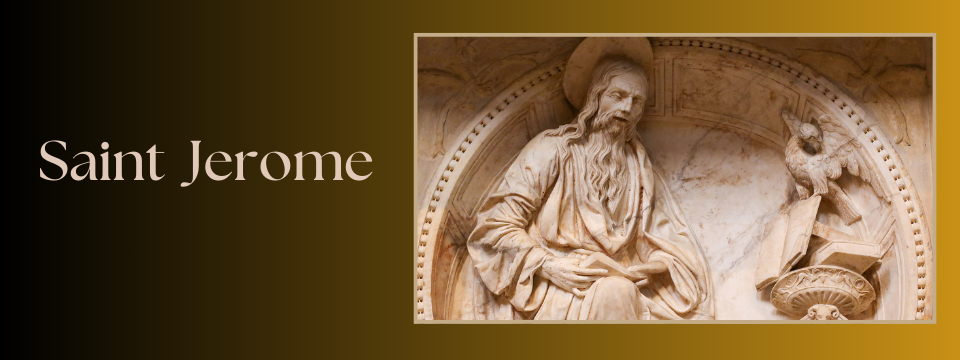
St. Jerome is a Father and Doctor of the Church who is best known for his compiling of the Vulgate version of the Catholic Bible, now the standard edition in use.
He was born about the year 347 at Stidon, near Dalmatia, to wealthy Christian parents. Initially educated at home, his parents soon sent him to Rome to further his intense desire for intellectual learning. There he studied and excelled at grammar, Latin and Greek, rhetoric, and philosophy, and lived a deeply materialistic life alongside his fellow students.
Jerome was baptized in his late teen years, as was the custom at the time, around the time he finished his schooling.
After spending many years in travel and, notably, discovering and investigating his extreme interest in monasticism, Jerome’s life took a sudden turn.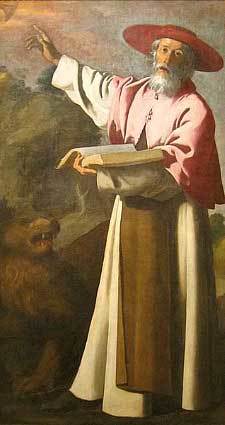
In the spring of 375, he became seriously ill and had a dream that profoundly impacted him, because in it he was accused of being a follower of Cicero – an early Roman philosopher – and not a Christian. Afterwards, Jerome vowed never to read any pagan literature again – not even the classics for pleasure. He separated himself from society and left to become a hermit in the desert so as to atone for his sins and dedicate himself to God.
Having no experience of monasticism and no guide to direct him, Jerome suffered greatly and was often quite ill. He was plagued terribly with temptations of the flesh and would impose harsh penances on himself to repress them. While there, he undertook the learning of Hebrew, as an added penance, and was tutored by a Jewish convert.
When controversy arose among his fellow monks in the desert concerning the bishopric of Antioch, Jerome left to avoid the tension of the position he found himself in.
Having developed a reputation as a great scholar and ascetic, Jerome was ordained to the priesthood by the persuasion of Bishop Paulinus, on the condition that he be allowed to continue his monastic lifestyle and not be obliged to assume pastoral duties.
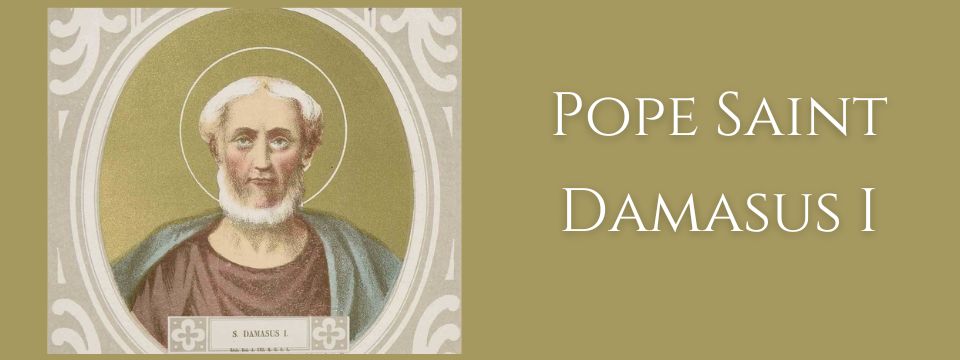
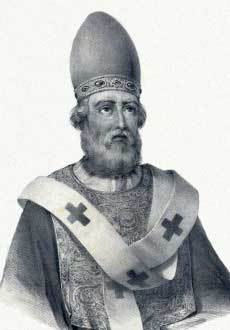
In 382, he was appointed as secretary to Pope Damascus, who urged him to undertake a Latin translation of the Bible from its original Greek and Hebrew origins.
After the death of the Holy Pontiff, Jerome left Rome for the Holy Land with a small group of virgins who were led by his close friend, Paula.
Under his direction, Paula established a monastery for men in Bethlehem and three cloisters for women. Jerome remained at this monastery until his death around A.D. 420, only leaving occasionally for brief trips.
He is the patron saint of librarians and translators.