Winning the heart and soul of South Africa for Mary by spreading the Fatima Message

Winning the heart and soul of South Africa for Mary by spreading the Fatima Message

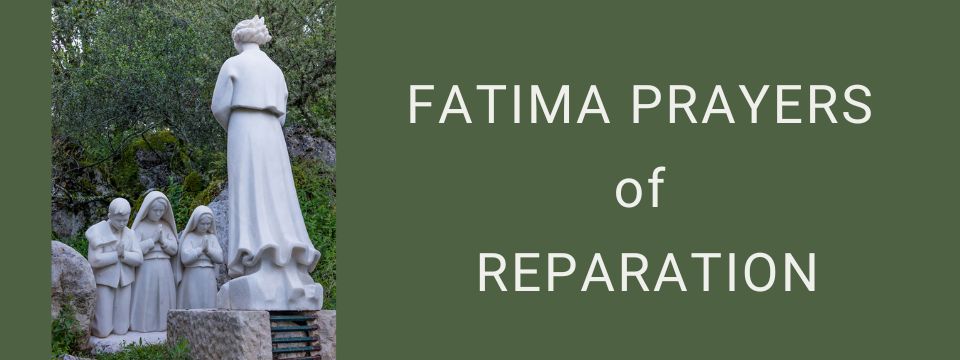
Fatima Prayers of Reparation

These prayers were revealed to the three shepherd children in Fatima during the apparitions of the Angel of Portugal.

Pray them as often as you can. Pray without ceasing.


  • O my Jesus, forgive us our sins, save us from the fires of hell, lead all souls to heaven, especially those in the most need of Thy mercy.


  • My God, I believe, I adore, I trust and I love Thee! I beg pardon for all those that do not believe, do not adore, do not trust and do not love Thee.


  • O Most Holy Trinity, Father, Son and Holy Spirit, I adore Thee profoundly. I offer Thee the most precious Body, Blood, Soul and Divinity of Jesus Christ present in all the tabernacles of the world, in reparation for the outrages, sacrileges and indifferences by which He is offended. By the infinite merits of the Sacred Heart of Jesus and the Immaculate Heart of Mary I beg the conversion of poor sinners.


  • Most Holy Trinity, I adore Thee! My God, my God, I love Thee in the Most Blessed Sacrament.


  • O Jesus, it is for the love of Thee, in reparation for the offences committed against the Immaculate Heart of Mary, and for the conversion of poor sinners.

Eucharistic Miracle in Seefeld, Austria

Though at first glance one would not expect it, the tiny village of Seefeld, today home to little more than 3000 people, was the sight of a spectacular Eucharistic miracle over 600 years ago. 

On 25 March 1384, which was simultaneously Holy Thursday and the Feast of the Annunciation, the knight Oswald Müsler attended Holy Mass in the parish church of St Oswald, Seefeld. 


The Eucharistic Miracle happened on Holy Thursday in 1384 


Müsler was infamous for unjustly imprisoning those travelling through his lands and extorting money from them; those who could not pay would be left to rot away and die. When this fearsome knight arrived on Holy Thursday armed along with his men, the local priest dared not refuse his demand for an especially large host, typically reserved for the priests. 


The Blood Host and the Knight Oswald Müsler 

Instead of kneeling, Müsler demanded the large Host be given to him whilst standing. Immediately as he received communion however, the huge formidable knight sank to his knees as the stone floor beneath his feet gave way like quicksand! Whilst he was falling he desperately attempted to grasp the nearby altar for support, only to find that the hard stone altar melted through his fingers like a knife through hot butter. Utterly helpless, the knight cried out in desperation to God for mercy. Like Goliath, this proud giant was thus humbled by Our Lord. He then begged the same priest whom he had previously threatened to now remove the Host he had unworthily received from his mouth. 

As soon as the priest had removed the Host, the ground suddenly became stable again and the knight regained his footing. Many in the church observed how the Host had now turned bright red, dripping with blood! Deeply humbled by this clear rebuke from our Lord, the knight immediately entered the nearby monastery in Stams (Tyrol) for 2 years of severe penance for his sins before dying a natural death. 

News of the miracle soon spread rapidly throughout the whole realm, and soon a hostel had to be constructed to house the many visiting pilgrims. The knight Parzifal von Weineck also donated the gilded monstrance which still contains the miraculous Host today.

Realizing the Church was too small; the Duke Friedrich IV of Austria therefore commissioned a new church to be constructed. This pilgrimage site was a personal favourite of Holy Roman Emperor Maximilian I and Archduke Ferdinand II of Austria, who also commissioned the special (“Heiligenblutkappelle”) chapel to be built around the bloodstained Host itself. Since that time St Oswald’s church in Seefeld has remained one of the most popular pilgrimage destinations in Austria. The imprints left by the knight on the altar and in the floor can also still be seen when visiting St Oswald’s church today. 

Give honour and glory to God 

The tale of this proud knight being humbled on the celebration also reminds us Catholics how we should view this Lenten season. Our Lord chose to manifest his displeasure and chastise Müsler simultaneously on Holy Thursday and the Feast of the Annunciation for a reason. 

On Holy Thursday we remember our Lord’s emphasis on the importance of humility by his washing of his disciples’ feet. On the feast of the Annunciation we also commemorate the Blessed Virgin’s tremendous humility, docility and submission to the will of God as she declared “Ecce Ancilla Domini, fiat mihi secundum verbum tuum”. We must therefore seek to imitate this humility, since as St. Augustine argued it is the foundation of all virtues; the contrary vice of pride being the root of all sin. In so doing we will give honour and glory to God. 

Furthermore, the Seefeld parish priest’s acquiescence to Oswald Müsler must not be repeated by the clergy of our time. They must learn from our Lord’s rebuke to Müsler, who so callously abused his power by unjustly imprisoning and starving travelling merchants to death. They must not be intimidated by those today who abuse their power and disregard the intrinsic value of human life. Politicians and world leaders today arguably wield far greater power than knights and nobles of old. But do any of them openly abuse their power like Müsler to harm the weak? 

The Inalienable Right to Life


The Catechism of the Catholic Church – CCC, states that the “inalienable right to life of every innocent human individual is a constitutive element of a civil society and its legislation” (CCC: 2273). However, many politicians abuse their power to vote for pro-abortion legislation. Is this not a violation of God’s law to violate this “inalienable right to life” for unborn babies? 

Describing violations of the 5th Commandment, the Catechism unequivocally states that “formal cooperation in an abortion constitutes a grave offense” (CCC: 2272) whilst Canon Law 1398 declares that “a person who procures a completed abortion incurs a latae sententiae excommunication”. Politicians who therefore knowingly help facilitate murder of the unborn may therefore be at risk of ipso facto excommunication, even if the excommunication is not declared publicly. Several of these politicians who publicly, knowingly and persistently support this excommunicable offence against God’s law still attempt to receive Holy Communion. 

However, such politicians are expressly forbidden to do so under Canon Law 915 “those who have been excommunicated or interdicted after the imposition or declaration of the penalty and others obstinately persevering in manifest grave sin are not to be admitted to Holy Communion”. 
 

But I call you to account for His Blood 

But as Christians, are we really allowed to judge the sins of another like this? Whilst only God can see into our hearts, the faithful are indeed also called to correct others from their manifest public sins: “if thou dost not speak to warn the wicked man from his way: that wicked man shall die in his iniquity, but I will require his blood at thy hand” (Ezekiel 33:8). Denying pro-abortion politicians Communion would thereby demonstrate their need to repent like Müsler, whilst also complying with official Church teachings surrounding the necessary preconditions for worthy reception of the Blessed Sacrament. 

Several bishops have also drawn attention to how it serves as a scandal for others when politicians who publicly and persistently violate the official moral teaching of the church are treated by the clergy as though they were in a state of grace. The Catechism also explains how such scandals can easily lead others into sin, since it suggests to the faithful that repentance from grave sins such as abortion is apparently unnecessary (CCC: 2284). The clergy therefore have the pastoral duty to refuse such people Holy Communion to draw attention to the evil being done to innocent life, the “constitutive element” of Christian civilization (CCC: 2273). 


So whoever eats the bread or drinks the cup of the Lord unworthily is guilty of the Body and Blood of the Lord 

(1 Corinthians 11:27) 

Remembering the story of Oswald Müsler, we must not let ourselves be intimidated by those who unjustly abuse their power to harm the weak. Müsler’s formidable worldly strength was shown to be utterly useless in the end when our Lord intervened. 

The clergy should learn from the story of this miracle to resist the Müslers of our time, not least of all for the good of their own souls. St Paul’s warning “Therefore whosoever shall eat this bread, or drink the chalice of the Lord unworthily, shall be guilty of the Body and of the Blood of the Lord” (1 Corinthians 11:27) must never be forgotten. 

Our Lord sees inside all of our souls and knows all our secrets. It is therefore of paramount importance that we are in a state of grace each time we receive Holy Communion, rather than attempting to satisfy prideful desires to appear outwardly pious whilst living a life of grave sin. This is the lesson of Oswald Müsler. 

Why Everyone Needs the First Commandment

…Even Atheists! 

Most people don’t have a problem with some of the Ten Commandments. There are atheists, for example, who will admit that one should not kill, steal or lie. Thus, posting those specific Commandments in public classrooms or buildings would pose no problem. 

The problems begin with the First and most important Commandment, which deals with the honour and worship of God. The Commandment commands: “I am the Lord thy God: thou shalt not have strange gods before me.” 

Non-believers maintain that this Commandment and the two after it impose religious claims upon them and, therefore, should not be publicly displayed. They say they should not be forced to acknowledge a God that they do not believe exists. In a pluralistic society, the First Commandment must go. 

The Need for the First Commandment 

Such reasoning is wrong. Ironically, the First Commandment pertaining to God has non-believers in mind. It has its application for them. Everyone, even atheists, needs the First Commandment if there is to be order in society. 

Indeed, the atheist is more than just a person who doesn’t believe in God. It goes much deeper. Catholic thinker Plinio Corrêa de Oliveira once defined an atheist as “an egalitarian who, to avoid the absurdity of affirming man is God, commits the absurdity of declaring that God does not exist.” 

Thus, atheists reduce the belief in God to a matter of personal choice. They claim believers derive value from believing in any god (with a small “g”), whereas unbelievers rely upon things like science, progress or humanity to satisfy their higher aspirations. Beliefs are different for everyone and must be respected. 

How Atheists Become Supreme Gods 

Since significant minorities don’t believe in God, atheists conclude that the nation must act as if God does not exist. He must be banished from public discourse and squares because God has no real existence outside the creative power of the believer’s imagination. 

By making these claims, atheists can then tranquilly set themselves up as supreme gods above all others without falling into absurdity. They can be termed supreme gods (with a small “g”) because they claim the right to eradicate God (with a capital “G”) by reducing him to a figment of the imagination and, therefore, socially irrelevancy. 

The First Commandment Prevents False Atheist Gods 

Hence comes the need for the First Commandment. It prevents the “absurdity of affirming man is God” by recognizing the One True God and His Law. 

It denounces these absurd atheist “gods” that arbitrarily deny the One True God. It affirms the existence of a God independent of human belief or imaginings. This God is not created. He is who is. He exists regardless of what others think or do not think. He alone is to be adored. 

The First Commandment acknowledges the existence of an almighty and loving God who provides for humanity with His Law found in the Ten Commandments. This law is the foundation for customs, cultures and civilizations that bring order to human existence. 

This God is the only defending force that stands against those who surreptitiously declare themselves gods by claiming God does not exist and imposing their agendas upon all society. 

“If God Did Not Exist, Everything Would Be Possible” 

Indeed, when individuals declare there is no god, the greatest absurdities emerge. Dostoevsky once said, “If God did not exist, everything would be possible.” 

Without God, there could be no objective moral standards based on eternal and unchanging truths. Thus, passions become unbridled, and lust is taken to its extremes. When people make themselves gods, it is impossible to be truly free since they become slaves dominated by every whim and fantasy. 

Without an understanding of the order God established, the universe becomes unintelligible, and humanity is reduced to flotsam in a sea of nonsense without meaning and purpose. 

Without God, reality can be altered. Men can be women, and women can be men. People can identify as anyone and anything and demand that they be recognized as such. There would be no Eternal Truth to serve as an anchor. 

Avoiding the Cruellest Tyrannies 

However, the worst consequences of this world without God are when these false atheist gods take their fatal denials to their final consequences. They promise freedom and deliver tyranny. They demand to be adored. 

Indeed, there is no crueller master than these extreme atheist gods that declare “the absurdity that God does not exist.” 

Throughout history, these strange gods can be found directing the gulags and concentration camps, torture chambers and coliseums, guillotines and terrors. They find their greatest expression in the modern era, where communist regimes, nihilist philosophies and wokism hold sway, devoid of all compassion. 

Wherever unbridled passion reigns, one finds the atheist gods who resent anyone who dares to oppose them. They are ever ready to do everything to suppress and silence those who uphold the Faith. 

Overcoming the Darkness 

The only thing that stops this tyranny is the First Commandment whereby believers invoke a higher law and a higher power. God alone is the only one able to overcome the darkness reigning inside those souls who set themselves up as strange gods. 

Thus, everyone needs the First Commandment. Believers need it to take their love of God to ever-greater heights. 

Yes, even those atheists who desire some order need this Commandment for their own protection lest chaos be unleashed upon the earth. 


Saint Joseph, Martyr of Grandeur

Feast Day 19 March 

To even begin to comprehend the nature of Saint Joseph, Patron of the Universal Church, we must bear in mind two awe-inspiring facts. St. Joseph is the virgin-husband of Our Lady and the guardian-father of Our Lord. 

The husband must be proportional to the wife. Saint Joseph’s spouse is the Blessed Virgin Mary, the most perfect of all creatures, and masterpiece of the Creator’s handiwork.

In her incomparable person, we find the sum of all the virtues of all the angels, and saints, indeed all creation until the end of time. Even these poor considerations, of course, fail to convey adequately the sublime perfection of the Most Holy Mother of God. 

From among all men, God chose one man worthy to love and honour the Mother of His Only-Begotten Son as her husband. He was a husband proportional to his wife in love of God, purity, wisdom, justice — in every virtue. Saint Joseph was that man. 

However there remains something even more incomprehensible. The father must be proportional to his son, and, as we have noted, the Son for Whom God sought an earthly father was none other than His Own. 

There could be but one man fit for such an awesome responsibility, the man God created for precisely this vocation and whose soul He crowned with every virtue. That man, too, was Saint Joseph. 

Saint Joseph is proportional to the Blessed Mother and her Divine Son. What greater homage could we render him? It is beyond our power to imagine the grandeur of Saint Joseph’s exaltation. 

Words cannot express the depth of his union of soul with that of Our Lady and the degree of his intimacy with the Incarnate Word.  

Saint Anthony of Padua is commonly depicted holding the Child Jesus. Because the Divine Child rested in his arms for a few moments, we deem Saint Anthony particularly blessed. Yet how many times did Saint Joseph hold the Christ Child in his arms? 

Saint Joseph’s were the pure lips that taught Jesus and answered His questions. Consider Saint Joseph’s carpenter shop in Nazareth, where a Son learns the trade of his father.

If you can conceive of a man with the purity, humility, and wisdom to govern the Holy Family as its lord, you may begin to appreciate the sublime virtue of Saint Joseph. But how did Saint Joseph’s contemporaries react in the face of this grandeur? Saint Luke provides clear testimony. “And she brought forth her firstborn son, and wrapped him up in swaddling clothes, and laid him in a manger; because there was no room for them in the inn.” — Luke 2:7


These last words reveal a bitter truth. In its petty selfishness, mankind finds it difficult to accept that which is great — much less that which is divine. We may think that people like to deal with important matters. Indeed some do enjoy such things, but in a superficial and selfish manner. What attracts man is not so much grandeur as mediocrity, a mixture of good and evil in which evil predominates. 

So we can understand why the innkeepers of Bethlehem were unwilling to make room for the Holy Family. Saint Joseph and Mary showed them the most tender kindness. Their majesty was unmistakable, even in their poverty. 

However distinction is only acceptable when it is accompanied by wealth, for the latter pardons the former. Moreover, greed incites flattery, which takes the place of respect. Thus, when a poor man of great distinction knocks at the door, there is no room. It would have taken but five minutes to arrange ample accommodation for mediocre rich pilgrims, but there was no room in the inn for Saint Joseph or for his spouse with Child. And even had they known that the Child was the promised Messiah, they still would not have received them. As Donoso Cortes aptly reminds us, The human spirit hungers for absurdity and sin.” 

The Child Jesus resembled Our Lady. She was the prefigure of the Redeemer. Saint Joseph also looked like Him, but there was no room in the inn for the Holy Family. Thus history records the first refusal of the Hebrew people. Our Lord knocks at the doors — at the hearts — of man through the paternal intercession of Saint Joseph and He is refused. 

Saint Joseph, prince of the House of David, the royal family from which would come the Hope of the Nations — knocks at the door and is rejected. But in this rejection lies his glory. Taking another step toward martyrdom, he leads his august spouse to a poor stable, where the Lord of the Universe will be born. 

To this glory would be added many others: the glory of being considered a person of little worth; the glory of taking upon himself the humiliation, ignominy, and opprobrium that was to fall upon Our Lord; or the glory of being scorned by man for the grandeur of his soul. Even to this day; that same glory leads us to implore: 

“Saint Joseph, Martyr of Grandeur, pray for us!”

Click on the link to order this booklet

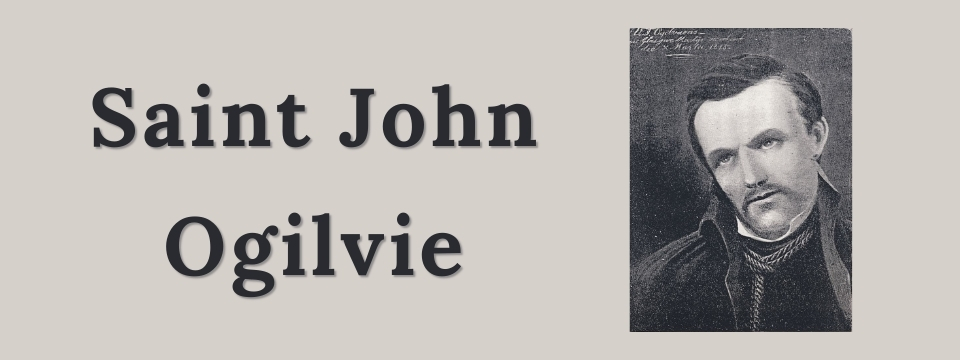
Saint John Ogilvie

Feast day 10 March 

Son of a Scottish laird, John Ogilvie was brought up in a Calvinist family. 

Sent to France to be educated, he ultimately converted to Catholicism. Becoming acquainted with the Jesuit Order, he requested admission, was accepted, and was ordained in 1610 in Paris. 

After meeting two Jesuits who had undertaken clandestine missionary work in Scotland (since 1560 Catholicism was outlawed in the British Isles) he offered himself for the perilous mission. With orders to proceed to Scotland, he travelled under the name of John Watson, horse dealer. 

Landing in Scotland in November of 1613, during nine months he provided spiritual support to clandestine Catholics and reconciled many to the Church in the region of Glasgow and Edinburgh. 

Betrayed, he was imprisoned and suffered various tortures, but nothing could induce him to reveal the names of those he had helped. 

His patience, courage and gaiety aroused the admiration of his persecutors, but, in the end, he was condemned as a traitor who refused to acknowledge the religious supremacy of the king and was hanged in Glasgow. 

John Ogilvie was canonized in 1976, the only Scottish martyr of the Counter-Reformation. 

Our Lady of Nazareth

Feast Day 6 March


The Shrine of Our Lady of Nazareth, known in Portugal as Nossa Senhora da Nazare, is found in the village of Nazare on the Atlantic coast in Portugal. Indeed, the village is named after this miraculous statue of the Blessed Mother and the Christ Child that was brought to the area many centuries ago.

According to tradition, this miraculous image was carved by the hands of Saint Joseph, the foster-father of Christ, while in the very presence of the Infant Jesus and the Mother of God. Later, the faces and hands of the images were painted by Saint Luke the Evangelist. This remarkable image is still preserved in a church where it can be viewed by anyone, and the story surrounding it is a fascinating one. 

It is known that the statue of Our Lady of Nazareth came from the Holy Land where it was one of the oldest images ever venerated by Christians. It was saved from destruction at the hands of the iconoclasts sometime early in the 5th century by a monk named Ciriaco, who gave the statue to Saint Jerome. Saint Jerome later gave it to Saint Augustine in Africa, to protect the statue by removing it from the Holy Land. Saint Augustine then gave it into the safekeeping of the monastery of Cauliniana, near Merida, a monastery on the Iberian Peninsula. 

When the Arabs invaded the Iberian Peninsula in the year 711, King Roderic met them with his Visigothic army at the battle of Guadalete, where he was soundly defeated. 

It is a fact of history that the body of Roderic was never found upon the field of battle, although his horse was found, and it is often assumed by historians that Roderic died that day when he lost his kingdom. According to this legend, however, Roderic was not killed, but survived the battle and disguised himself as a beggar as he travelled north. Alone and unknown, he made his way to the monastery of Cauliniana where he sought shelter for the night. Going to confession, he of necessity revealed his true identity to the friar, Frei Romano. As it turned out, the monks were preparing to leave the monastery in advance of the Arabs, and so Frei Romano asked the king if he could accompany him in his travels. Roderic agreed, and the friar took with him the statue of Our Lady of Nazareth and the relics of Saint Bras and Saint Bartholomew. 

They travelled together until they arrived at a place later named Monte de Saint Bartolomeu in November of the year 714. They made for themselves a hermitage with the friar living in a small cave at the edge of a cliff that overlooked the sea. He placed the image in a niche among the stones upon a pedestal of simple rocks. Roderic went a little ways off by himself to a hill where he also began to live the life of a hermit. After a year, though, King Roderic left the hermitage, and nothing else is said of him in this legend. One wonders if he ever learned of his kinsman Pelayo, who had retreated into the mountains and continued to heroically defy the invaders. 

Before his death, Frei Romano hid the image in his small cave, where it remained undisturbed for some centuries until it was discovered by shepherds, who came there to venerate the statue. Inside that little, ancient sanctuary they had found the renowned and sacred image of Our Lady of Nazareth. Carved of wood, it was unlike any other statue of the Madonna they had ever seen, for it depicts the Blessed Virgin breastfeeding her Divine Child while seated upon a simple bench. When miracles began to frequently occur, it became a major pilgrimage centre. 

Then, in the early morning of September 14th in the year 1182, the mayor of Porto de Mos, Dom Fuas Roupinho, was hunting on his land when he observed a deer. Chasing it up a steep slope on horseback that misty morning, the fog became heavier all of a sudden. The deer, later suspected to be the devil in the guise of a deer, jumped off the edge of the hilltop into the empty void. Despite his efforts to stop his horse, the spirited mount was determined to follow after the deer. Helpless to save himself, the rider suddenly recognized that he was near the sacred grotto where he would often come to pray. Fuas Roupinho cried out to the Blessed Virgin, praying aloud: “Our Lady, Help Me!”  

The horse stopped immediately, as if he were digging his hooves into the rocky cliff above the void. Suspended in an unnatural manner at the edge of the cliff, Fuas Rouphinho knew the drop to be over 100 meters, and surely would mean his death if he had fallen.

He was then able to back slowly away from the edge, looking down to see the evidence of the impossible and unimaginable – for there in the hard stone was the imprint of one of his horse’s hooves. One of those marks can still be seen in the native rock. 

Faus Rouphinho dismounted and went to the grotto to pray and give thanks, subsequently causing a chapel ‘Capela da Memoria,’ or ‘The Chapel of Remembrance,’ to be built very near the spot where his life had been miraculously saved.

When the masons he had hired took apart the primitive altar in the cave, they found an ivory box of sorts that contained the relics of Saint Bras and Saint Bartholomew. There was also an ancient scroll that they carefully removed. 

Opening the scroll, they found that it explained the history of the statue of the Blessed Virgin Mary and her Divine Child, now known as Our Lady of Nazareth, as outlined above. 

The church Santuario de Nossa Senhora da Nazare was later built on the hilltop overlooking Nazare by King Ferdinand I of Portugal in the year 1377. Its construction was necessary due to the large number of pilgrims who continued to come to venerate the image. Over the years it was often rebuilt, or had additions made, especially in the 17th, 18th, and 19th centuries. The profusely decorated and gilded apse displays the statue of Nossa Senhora da Nazare in a lighted niche above the main altar, flanked by twisted columns. 

The first King of Portugal, Don Afonso Henriques, as well as the chief nobles of his court, were among the early pilgrims to the shrine. Many notable figures came to visit Our Lady of Nazareth throughout history, including Vasco de Gama, who came as a pilgrim before setting out for India, and Pedro Alvares Cabral, who later discovered Brazil. St Francis Xavier, the Apostle of the East, went on pilgrimage to Our Lady of Nazareth before later leaving for Goa. 

According to a plaque placed in the chapel in 1623, the image was carved by Saint Joseph in Galilee when Jesus was a baby. Some decades later St Luke the Evangelist painted the faces and hands of the images. It remained in Nazareth until brought by the Greek monk Ciriaco to the Iberian Peninsula. It is believed to be one of the oldest images venerated by Christians. 


Photo courtesy of Georges Jansoone

Our Lady of the Vine

Feast day 10 March

At one time in Viterbo there was a certain man named Mastro Baptist Magnano Iuzzante, who was a very God-fearing devotee of the glorious Virgin Mary. He hired a painter named Monetto in the year 1417 to paint an image on a tile of the most glorious Virgin Mary holding her Son in her arms. Mastro Baptist then lovingly laid the tile on an oak tree that stood at the edge of his vineyard, near the road leading to Bagnaia and along which robbers often awaited to attack unwary travellers. 

The image remained there for about 50 years under cover of the oak’s branches, and after a while only a few women who passed by ever stopped to say a prayer and to admire the beauty of a natural tabernacle that a wild vine, which had embraced the oak, had created. 
 
During this period a hermit of Siena, Pier Domenico Alberti, whose hermitage was at the foot of Palanzana, went around the countryside and the nearby towns of Viterbo, saying, “Among Bagnaia and Viterbo there is a treasure.” 
 
Many people, driven by greed, started digging there but found nothing and asked for an explanation from the hermit. Domenico then brought them under the oak tree chosen by the Virgin and pointed to the real treasure, the Madonna. He told them of the day he had decided to take away the sacred image to his hermitage, and of how it had returned to the oak. 
 
Dominico was not alone in this experience. A devout woman named Bartolomea often walked past the oak tree and stopped each time to pray to the Blessed Virgin. One day she also decided to take the tile to her home. After saying her evening prayers, Bartolomea went to bed, but woke up in the morning to find the image missing. She at first thought that her family had taken it to place it somewhere else, but upon learning that this was not so, she ran to the oak tree and saw what he had already guessed: the tile had miraculously returned to its place amid the tendrils of the vine. 
 
Bartolomea tried again, but always the sacred image returned to the tree. At first, she did not say anything to anyone to avoid being taken for being mad. 
 
Then, in 1467, during the month of August, the whole region was struck by the greatest scourge of those times: the plague. Everywhere there were the bodies of the dead lying in the deserted streets, and there was everywhere great weeping and mourning. Some then remembered the image painted on the humble tile, and, as if driven by an inexplicable force, went to kneel beneath the oak. Nicholas of Tuccia, an historian, said that on one day 30 000 people were there to beg for mercy. 
 
A few days later the plague ceased, and then 40 000 of the faithful came back to thank the Virgin Mary. The people of Viterbo were headed by their bishop Pietro Gennari, and there were many from other regions. 

In early September of the same year another extraordinary event happened. 
 
A good knight of Viterbo had many enemies, as will often happen to a follower of Christ. One day he was surprised by his enemies outside the walls of Viterbo. Alone and unarmed, and having no way to deal with the mortal danger, he fled into the nearby woods. Fatigued and desperate to reach his destination, the knight heard the cries of the enemy draw nearer and nearer. Eventually he arrived at the oak with the sacred image of Mary, where he fell at her feet with great faith and embraced the trunk of the tree, putting his life into the hands of his Heavenly Mother. 
 
The knight’s enemies reached the oak, but were surprised that they could no longer see the knight. They began to look behind every tree and bush, but not one could see him since he had disappeared before their very eyes. Failing to find him after a long time spent in searching, they gave up in disgust. 
 
Then the knight, after thanking the Virgin Mary, returned to Viterbo and told everyone what had happened. Bartolomea heard his tale, and encouraged by his words, she described the miracles to which she had been a witness. They told everyone what had happened to them with so much enthusiasm, faith that devotion that the stories spread like wildfire, and many people, coming from the most diverse regions of Italy, flocked to the feet of the oak to implore help from the Blessed Virgin. 
 
It was decided to build an altar, and then a chapel of planks before Pope Paul II gave the necessary permission to build a small church in 1467. Many popes and saints have been devotees of the image, including St Charles Borromeo, St Paul of the Cross, St Ignatius Loyola, Saint Crispin of Viterbo, and St Maximilian Kolbe, among many others. 
 
On 20 January 1944, during the bombing of Viterbo, a squadron of 12 bombers headed towards the oak, but upon arriving at their destination, inexplicably veered to the right and the bombs dropped did not destroy anything outside of an asylum which was empty. The remains of the bombs, 3 large chunks, are kept behind the altar of the Madonna. 
 
In 1986, Pope John Paul II proclaimed Our Lady of the Oak, Patroness of the new diocese of Viterbo, formed from the union of those of Viterbo, Tuscania, Montefiascone, Acquapendente and Bagnoregio. 
 
Even today the Virgin protects her devotees, and the devotion to the Blessed Virgin of the Oak is very strong. 
 
Every year on the second Sunday of September, the faithful commemorate the “Benefits from the Sacred Image of Our Lady of the Oak, or Our Lady of the Vine.” Many cities and towns, with their brotherhoods, participate in the procession of thanksgiving, called the “Covenant of Love. ” The Mayor of Viterbo, on behalf of all participants, renews the consecration made of old by the whole region back in 1467. 

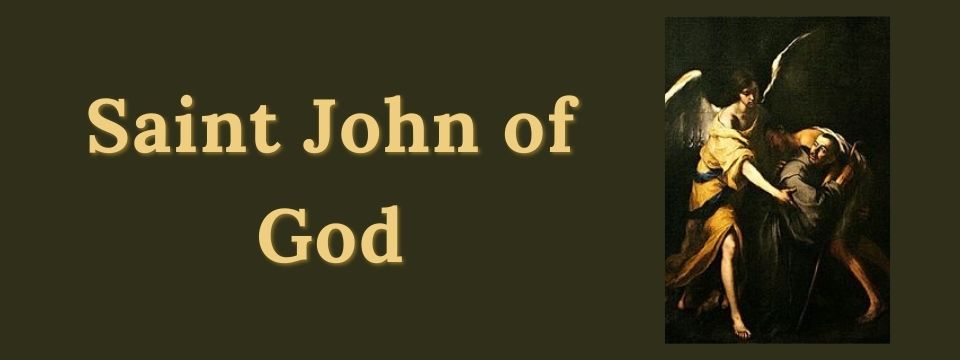
Saint John of God

Feast Day 8 March

John of God was born of pious parents in 1495 in Montemoro Novo in northern Portugal. Obscure circumstances led to him being absconded from his parents into Spain at the age of nine to be raised by a farmer. 

Pleased with his pious character and diligence the farmer insisted that John marry his daughter, whom John viewed as a sister. Unwilling to do so, he enlisted in the army of Emperor Charles V and served in the wars between France and Spain and later against the Turks. 

In the army John took on the loose lifestyle of soldiers for which his upright character would later bitterly reproach him. 

On leaving the army he made a trip to Portugal in an attempt to find his parents. News of his mother’s premature death after his mysterious disappearance saddened him. 

Succeeding years find him engaged in different occupations first in Seville, then Gibraltar and later in Africa, to ransom with his own liberty the Christians held captive by the Moors. At the advice of his confessor, he returned to Spain and began selling religious books and pictures as a form of apostolate. 

Around this time John, who was now about forty, had a vision of the Infant Jesus holding an open pomegranate (in Spanish “Granada”), Who said to him, “John of God, Granada will be your cross.” 

Proceeding to the city of Granada, John was struck to the heart by a sermon of St. John of Avila. Entering a period of intense remorse for his sins, he went about as if deranged beating his breast and calling out for God’s mercy. St. John of Avila convinced him to desist from his lamentations and to take up another method of penance to atone for his past life. 

He then made a pilgrimage to the shrine of Guadeloupe where the Blessed Virgin revealed to him his vocation. On returning to Granada, John of God dedicated his life to the care of the sick and poor. After renting a house, he searched the city for the homeless and afflicted with all sorts of diseases and carried them on his shoulders to shelter. Soon others joined him in the endeavour. 

Though St. John of God never officially founded an order in his lifetime, his work was later constituted into the Order of the Hospitallers of St. John of God. 

John of God died exhausted by his labours on behalf of the abandoned of society and died on his knees before an altar on 8 March 1550 at age fifty-five. The whole of Granada, rich and poor, the powerful and the weak attended his funeral. 

Our Lady of the Star

Feast Day 7 March


In the year 1050 there were two Benedictine monks who lived in the convent of Monte Cassino. They decided to go on pilgrimage, teaching and catechizing all those they met along the way. 

One night they found themselves wandering on the coast of Normandy, France, near a place called Grand Champ. Tired and sleepy, they decided to spend the night on the beach under the stars. Father Rogerio slept on the cool sand and the other monk found himself a place to rest in a small boat nearby. 

As the night went on the tide came up and the little boat was gently drawn out onto the sea. Without realizing it, the monk was going on an adventure in which he would not awaken until he was just off the coast of England. 

In Salisbury, England, everyone was amazed to see the monk in the little boat, convinced that it was a miracle that he had crossed the French Sea in a small boast and lived to see the shores of England. Soon, the monk was made Bishop and his period in office was marvellous to the people because he was a humble man of prayer who sacrificed everything in the name of God. 

The monk who had stayed on the beach, Father Rogerio, knew nothing of what had happened to his friend. All he knew was that he and the boat had disappeared, and giving his concerns into the hands of God, he determined to continue on his journey alone. 

One night not long afterward, Father Rogerio went to sleep and had a dream that would change his life forever. In his dream he saw a great star fall from the sky, burning all the bushes and trees, and heard a voice that said: “Our Lady wants a church built in this place.” 

When he awoke, Father Rogerio looked about himself. He was not injured, but this indeed was the place he had seen in his dream, for everything around him was burned. Father understood that Our Lady really did desire that he should build a church there in her honour. He also felt in his heart the desire to give Mary the title of “Our Lady of the Star,” because of the star he had seen in his dream. 

Due to the poverty of those who inhabited that region, Father Rogerio was only able to build a small altar and a tiny chapel which would be the seed of the great Abbey of Our Lady of the Star of Monteburgo. One day an immense chapel would be built, sheltering not only the Church but a very large convent as well. 

King William, who was the Duke of Normandy and he who had conquered England, learning of the shrine of Our Lady of the Star, sent his private doctor to visit the little chapel to find out for himself how it had all come about. Upon arriving there, the doctor discovered that he was the brother of the monk Rogerio! He listened to his brother’s account of how he had been separated from his friend, and then told about his dream. The doctor believed everything at once, and to Father Rogerio’s surprise, the doctor knew the monk who had crossed the channel in a small boat and informed his brother that his lost friend had become the Bishop of Salisbury! The two brothers excitedly thanked Our Lady for providing this reunion. 

The Bishop of Salisbury, our former friend of the monk Rogerio, asked King William to help his brother in the faith, for they were both blessed by Our Lady on their pilgrimage. 

William the Conqueror, with a glad heart, donated to Father Rogerio the entire region of Monteburg, along with the resources to build a great church and an Abbey there that became a great seminary. The work was finished by the son of King William, King Henry. He, taking the throne, continued the work until its completion. The Abbey of Our Lady of the Star was, for many centuries, a centre of reference of the Church for the whole region. 

Dark centuries ensued, and the church and abbey suffered a decline until in 1842, the Vicar General of Coutances took possession of what was by that time little more than an enclosure of ruins. He turned it over to the Brothers of Mercy, a new order meant to promote Catholic education. The abbey church was rebuilt, but as time went on the Brothers of Mercy also left, and all is now used as part of an agricultural school. As for Our Lady of the Star, it is a story almost completely forgotten, even to Catholics. 

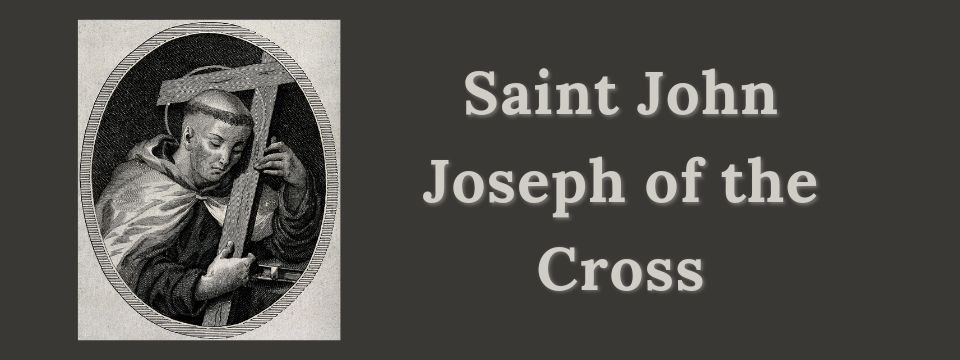
St John Joseph of the Cross

Feast Day 5 March

On 15 August 1654, on the island of Ischia, off the coast of Naples, a little boy was born to an exemplary, well-to-do couple, Joseph, and Laura Calosirto. Baptized the same day, the new arrival was given the name of Carlo Caetano. 

One of seven boys, five of which were to enter religion, Carlo gave early signs of seeking sanctity, which his family recognized and respected. 

At sixteen Carlo had a talk with the superior of the Franciscan Monastery of Santa Lucia del Monte in Naples. Discerning a great vocation, the superior received him despite his youth. The new novice did not disappoint his superiors to the point that at age twenty-one, and not yet a priest, he was appointed superior of a new monastery in Piedmont. 

Though he wished to remain a deacon like his founder, St. Francis of Assisi, his superiors insisted that he be ordained, and so he was in 1677. Despite his youth and innocence, he proved to be an exceptional, insightful confessor. 

Fr. John Joseph spent his life in the service of his order at times as superior, at times as novice master, always a loving, balanced and wise director of souls. 

At one period of great aridity in his life he was consoled by a vision of a departed brother who reassured him as to his condition. After this incident, Fr. John Joseph began to demonstrate the powers of a wonder worker, with miraculous cures and the multiplication of food for the house. 

His fame spread so quickly that when he returned to Ischia to visit his dying mother, his town acclaimed him as a saint. 

In 1722, Fr. John Joseph was the wise and tactful arbiter in a great conflict that arose regarding the management of his order. 

Warned of his death, he talked freely of it to those about him but continued to carry out his duties. On 1 March 1734, he had an apoplectic seizure and died five days later. Almost immediately his tomb became a place of pilgrimage. He was canonized in 1839.