Winning the heart and soul of South Africa for Mary by spreading the Fatima Message

Winning the heart and soul of South Africa for Mary by spreading the Fatima Message

Saint Joseph, Martyr of Grandeur

Feast Day 19 March 

To even begin to comprehend the nature of Saint Joseph, Patron of the Universal Church, we must bear in mind two awe-inspiring facts. St. Joseph is the virgin-husband of Our Lady and the guardian-father of Our Lord. 

The husband must be proportional to the wife. Saint Joseph’s spouse is the Blessed Virgin Mary, the most perfect of all creatures, and masterpiece of the Creator’s handiwork.

In her incomparable person, we find the sum of all the virtues of all the angels, and saints, indeed all creation until the end of time. Even these poor considerations, of course, fail to convey adequately the sublime perfection of the Most Holy Mother of God. 

From among all men, God chose one man worthy to love and honour the Mother of His Only-Begotten Son as her husband. He was a husband proportional to his wife in love of God, purity, wisdom, justice — in every virtue. Saint Joseph was that man. 

However there remains something even more incomprehensible. The father must be proportional to his son, and, as we have noted, the Son for Whom God sought an earthly father was none other than His Own. 

There could be but one man fit for such an awesome responsibility, the man God created for precisely this vocation and whose soul He crowned with every virtue. That man, too, was Saint Joseph. 

Saint Joseph is proportional to the Blessed Mother and her Divine Son. What greater homage could we render him? It is beyond our power to imagine the grandeur of Saint Joseph’s exaltation. 

Words cannot express the depth of his union of soul with that of Our Lady and the degree of his intimacy with the Incarnate Word.  

Saint Anthony of Padua is commonly depicted holding the Child Jesus. Because the Divine Child rested in his arms for a few moments, we deem Saint Anthony particularly blessed. Yet how many times did Saint Joseph hold the Christ Child in his arms? 

Saint Joseph’s were the pure lips that taught Jesus and answered His questions. Consider Saint Joseph’s carpenter shop in Nazareth, where a Son learns the trade of his father.

If you can conceive of a man with the purity, humility, and wisdom to govern the Holy Family as its lord, you may begin to appreciate the sublime virtue of Saint Joseph. But how did Saint Joseph’s contemporaries react in the face of this grandeur? Saint Luke provides clear testimony. “And she brought forth her firstborn son, and wrapped him up in swaddling clothes, and laid him in a manger; because there was no room for them in the inn.” — Luke 2:7


These last words reveal a bitter truth. In its petty selfishness, mankind finds it difficult to accept that which is great — much less that which is divine. We may think that people like to deal with important matters. Indeed some do enjoy such things, but in a superficial and selfish manner. What attracts man is not so much grandeur as mediocrity, a mixture of good and evil in which evil predominates. 

So we can understand why the innkeepers of Bethlehem were unwilling to make room for the Holy Family. Saint Joseph and Mary showed them the most tender kindness. Their majesty was unmistakable, even in their poverty. 

However distinction is only acceptable when it is accompanied by wealth, for the latter pardons the former. Moreover, greed incites flattery, which takes the place of respect. Thus, when a poor man of great distinction knocks at the door, there is no room. It would have taken but five minutes to arrange ample accommodation for mediocre rich pilgrims, but there was no room in the inn for Saint Joseph or for his spouse with Child. And even had they known that the Child was the promised Messiah, they still would not have received them. As Donoso Cortes aptly reminds us, The human spirit hungers for absurdity and sin.” 

The Child Jesus resembled Our Lady. She was the prefigure of the Redeemer. Saint Joseph also looked like Him, but there was no room in the inn for the Holy Family. Thus history records the first refusal of the Hebrew people. Our Lord knocks at the doors — at the hearts — of man through the paternal intercession of Saint Joseph and He is refused. 

Saint Joseph, prince of the House of David, the royal family from which would come the Hope of the Nations — knocks at the door and is rejected. But in this rejection lies his glory. Taking another step toward martyrdom, he leads his august spouse to a poor stable, where the Lord of the Universe will be born. 

To this glory would be added many others: the glory of being considered a person of little worth; the glory of taking upon himself the humiliation, ignominy, and opprobrium that was to fall upon Our Lord; or the glory of being scorned by man for the grandeur of his soul. Even to this day; that same glory leads us to implore: 

“Saint Joseph, Martyr of Grandeur, pray for us!”

Click on the link to order this booklet

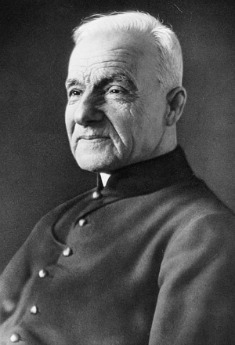
Saint André Bessette

Known as the “Miracle Worker of Mount Royal”.

Feast January 6


André Bessette was born in 1845 in the province of Quebec, Canada, the eighth of ten children. An orphan at twelve, he was taken in by an aunt and uncle. Set to various trades, he was unable to hold a job for very long because of his frail health. For thirteen years he worked at various occupations: shoemaker, baker, blacksmith, and once at a factory in the United States during the Civil War.

St. André Bessette

Photo Credit: commons.wikimedia.org File: Stinson Remick Chapel

From an early age he exhibited signs of a deep spirituality with a marked devotion to Saint Joseph, the foster father of Jesus.

Though he had little education, at twenty-five he applied to the Congregation of the Holy Cross, an order of educators.

After a year’s novitiate his frail health again came between him and permanent admittance, but at Bishop Bourget’s urging, he was received and assigned the humble post of porter at Notre Dame College, Montreal. Later, he would say, “When I joined this community, the superiors showed me the door, and I remained forty years.”

In his small room near the entrance he spent much of the nights on his knees. As he kindly received people, listened to their life’s woes and heard of their physical complaints, he began to lightly rub sick persons with oil from a lamp burning in the college chapel before a statue of St. Joseph.

Word of healings began to spread. “I do not heal,” he said simply, “St. Joseph heals”. A gentle man, he became enraged when people ascribed healings to him.

As the influx of pilgrims to Brother André’s door grew, he was allowed to build a chapel on Mount Royal with money he raised. There he continued his ministry. His reputation grew and soon he was known as the “Miracle Worker of Mount Royal”.

In 1924 construction for St. Joseph’s Oratory began on the side of the mountain near Brother André’s chapel. This shrine, the largest church outside of Rome was funded by Brother André’s supporters around the world.

Brother André died in 1937 at the age of ninety-one. He was beatified in 1982 and canonized in 2010. Pope Benedict XVI said of St. André that he “lived the beatitude of the pure of heart.”