Although we receive the necessary graces for our salvation, we still need special graces to persevere. This is because the process of the decadence of a soul generally follows a pattern. First, one commits acts of ingratitude that cause a retraction of grace. This causes the person in the state of grace to deteriorate slowly and stand in need of exceptional graces. When graces dwindle, one goes from one abuse to the next, until eventually falling into mortal sin.
Devotion to Our Lady is crucial in obtaining the necessary graces to save the soul from this process. We need an intercessor who supplements this gap with requests for additional graces, so that we might have sufficient graces for our salvation.
Our Lady obtains for us the graces necessary to attain salvation. The mere fact that we are devoted to her makes us pleasing to God Who is thus predisposed to answer our requests. However, human nature is so weak that we often abuse grace to such an extent that it is difficult to find those who practice sufficient fidelity to save themselves without Our Lady’s intervention.
One might ask if this means that Our Lady is not the Mediatrix of all graces, but only of extraordinary graces. No, she also obtains the minimum of essential graces for us. However, our malice serves to demonstrate that we cannot persevere in the spiritual life without her full support.
Imagine a friend who is in a “state of grace,” so to speak, in relation to you. In other words, he is a friend who depends completely on your kindness, and generally acts correctly toward you. However, although this friend does not commit grave faults against you, he nevertheless constantly commits small faults such as lack of courtesy, respect or affection. Of course, to the degree that he insists upon doing this, you gradually withdraw your friendship from him.
If he commits a grave fault, it is understandable that you severe your relationship with him.
This is a bit like the image of a sinner who, without losing the state of grace, almost inevitably, falls into mortal sin at a certain moment. To prevent this fall, the intercession of Our Lady is greatly needed. It is not only greatly needed, but indispensable since after a mortal sin, a person has no claim to obtain forgiveness.
Even if he were to repent, it is doubtful that God would give Heaven to a person in this state of soul without subjecting him to grave trials as a punishment for his attitude.
Some people suppose that death comes as an accident, a disaster outside the ways of Providence, and that God has nothing to do with death.
Man walks along the ways of the spiritual life as he so pleases, and then all of a sudden death comes and interrupts God’s plans and the development of his soul. In fact, it is nothing like this at all. No hair drops from our head without God allowing it. Everything is proportional to the orientation of our spiritual life.
In fact, the moment of our death is perfectly chosen with regard to our sins and merits. Without an intercessor with the merits of Our Lady, it would be impossible to remain in the state of grace.
Imagine that a friend commits several small faults toward you, but nothing atrocious. All of a sudden he shows up asking you for a gift. Would you be ready and willing to give it? Depending on the situation, you might refuse any request on his part.
Our spiritual life is not a plateau next to an abyss. It is an inclined ramp, in the middle of which is a line that separates the state of grace from mortal sin. When someone is on the upper part of this ramp, he can go down without falling into mortal sin.
When a person on the upper part of the ramp commits an infidelity, God normally diminishes His graces; and with the dwindling of grace a person can fall into such a state of destitution as to be reduced to strictly indispensable grace.
When one says that venial sin leads to mortal sin, it does not mean that man lacks the sufficient grace not to fall, but that he all too often does not correspond to grace and thus falls. Human nature has a very strong penchant to abuse grace.
However, in each concrete case, man has the will to react. Man can only obtain all the necessary and opportune graces not to fall however, if he has recourse to Our Lady. And that is why we need Our Lady.
This was adapted from a lecture given by Prof. Plinio Corrêa de Oliveira. It has been translated and edited for publication without his revision. –Ed.
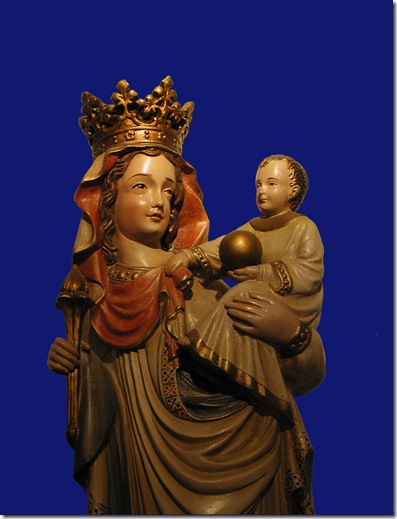
There does not seem to be a great deal of information about Our Lady of Paris; it is an ancient title, and can be traced well back before the 12th Century, when the Cathedral of Notre Dame de Paris (Our Lady of Paris) was begun. Some authorities say that veneration of the Blessed Virgin in Paris can be traced to the first apostles of the city. Since Saint Paul was in Gaul (France) during his travels, it may be assumed that this veneration dates to the first century of the Christian era. And if Mary was venerated in Paris at that early date, it is possible that she was, even then, known as Our Lady of Paris. Briefly, as long as Christian minds can remember, Paris was consecrated to the Virgin Mary, whom the inhabitants always venerated.
It is known that Our Lady of Paris was a church first built by King Childebert in the year 522. About the year 1257, King Saint Louis IX assisted in the construction of a larger church carried on in the same place, built on the foundations which King Philip Augustus had laid in the year 1191. The older church built by King Childebert, which had been dedicated to the Blessed Virgin, was too ruined to be repaired, so Maurice, Bishop of Paris, decided to rebuild it — and at the same time adorn Paris with a Cathedral that would outshine all those which had hitherto been built anywhere.
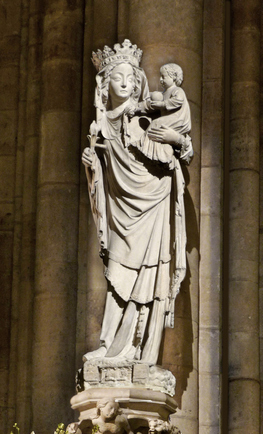
Plans were drawn up during the reign of King Louis VII, and work began on Notre Dame Cathedral in 1162. The cornerstone was laid in the presence of Pope Alexander III. Notre Dame is a huge Gothic cathedral on the Ile de la Cite, with beautiful flying buttresses to support the tremendous height of the walls, which are adorned with stylish gargoyles. It is home to a reliquary which contains Christ’s Crown of Thorns. By the beginning of the fourteenth century, perhaps 1345, the cathedral was finished, virtually as it stands today. Sometime during the building of the Cathedral, a statue of Our Lady was fashioned and installed in a place of honour.
As is typical during times of upheaval, the cathedral along with the statue of Our Lady were desecrated during the French Revolution, and many of the religious artefacts were lost to future generations, although the incredible stain glass windows were not destroyed, including the spectacular “rose window” that can still be seen today.
*from The Woman in Orbit and other sources
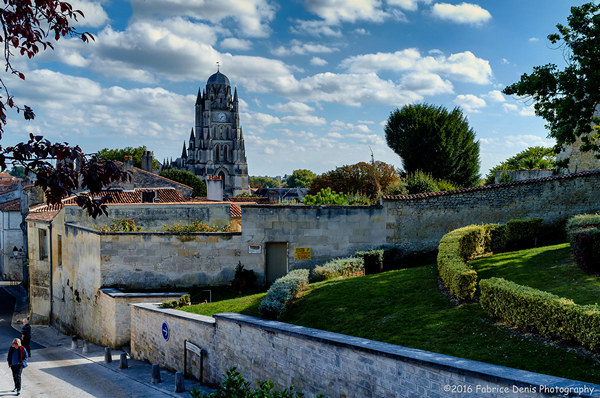
“Saintes” is the English translation for the French word meaning female saints. There is a great deal of history to the Poitou-Charentes region of western France where the town of Saintes is located.
The town of Saintes was originally a thriving settlement in ancient Gaul located along the Charente River. The town became known as Mediolanum Santonum once conquered by the Romans under Julius Caesar, and the remains of the triumphal arch of Germanicus and a large amphitheatre can still be seen there today.
The town takes its name, Saintes, due to a fascinating legend that many still piously believe. According to this tradition, Mary Salome and Mary Jacob, accompanied by other disciples of Jesus Christ, were forced to flee the Holy Land about the year 45 AD. They left taking a boat with no sail, and were miraculously transported across the Mediterranean Sea, making land near the place which became known as Saintes Maries de la Mer.
Long before the arrival of the saints, indeed, since prehistoric times, Saintes Maries de la Mer (Saint Mary’s of the Sea) had been considered a holy place. This tradition was carried on by the Celts and then the Romans. It is recorded that St Eutropius was a bishop there in the 3rd century, and that the first cathedral was reconstructed by no less a personage than Charlemagne. Norman invaders twice burned the town during the 9th century. Richard the Lionheart took refuge there against his father, and King Saint Louis IX defeated the English on the plains before the town. The Cathedral of Saint Peter, built in the 12th century, was severely damaged by the Huguenots in the year 1568. Its bishopric was ended in 1790 due to the oppression of the French Revolution. The church is now reduced to being only an historical monument. 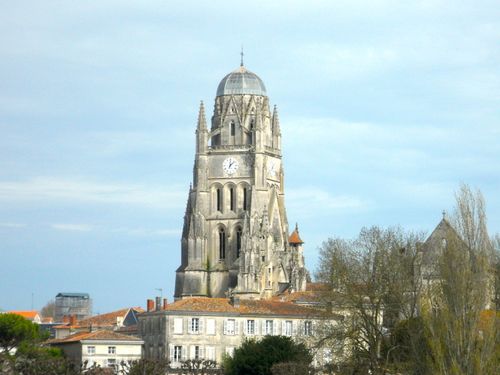
It is recorded, though, that one year long ago, on the octave day of the Purification, the bells in the Cathedral of Saintes, France, rang out most sweetly of themselves. The sacristans, having run to the church, saw what appeared to be several unknown men holding lighted tapers and melodiously chanting hymns in honour of the Blessed Virgin, Our Lady of the Bells, who was venerated in a chapel of this church. Approaching softly, they – the men who had run to the church – begged the last of these men carrying lighted candles, to give them one in proof of the miracle they had witnessed. The light-bearers graciously complied.
This taper, or candle, in remembrance of Our Lady of the Bells, is said to be preserved in that church up to this day.
James Fitzhenry, roman-catholic-saints.com, Marian Calendar
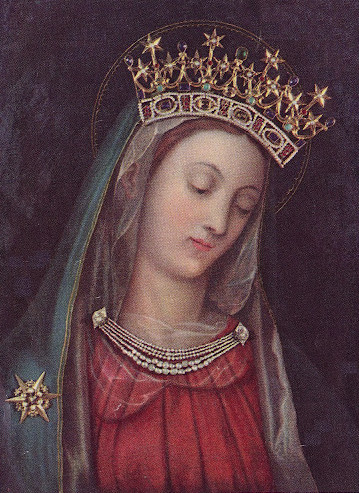
Among the many miraculous images of the Mother of God through which she deigns to grant her favours, there is one in the monastery church of the Carmelites in Vienna, entitled the Mother of Grace, or Our Lady of Grace, also known also as Our Lady of the Bowed Head.
In 1610 a Carmelite, Dominic of Jesus-Mary, found among the votaries of an old altar in the monastery church of Maria della Scala in Rome, an oil painting of the Mother of God, dust-covered and somewhat torn, which grieved him. Taking it into his hands, he shook the dust off it, and kneeling down venerated it with great devotion.
He had the picture renovated and placed it on the shelf in his cell, where he made it the object of his love and supplications in favour of those who came to him in their necessities and afflictions.
One night while he was praying fervently before the picture, he noticed that some dust had settled on it. Having nothing but his coarse woollen handkerchief he dusted it with that and apologized,
“O pure and holiest Virgin, nothing in the whole world is worthy of touching your holy face, but since I have nothing but this coarse handkerchief, deign to accept my good will.”
To his great surprise, the face of the Mother of God appeared to take on life, and smiling sweetly at him, she bowed her head, which thereafter remained inclined.
Fearing he was under an illusion, Dominic became troubled, but Mary assured him that his requests would be heard: he could ask of her with full confidence any favour he might desire. He fell upon his knees and offered himself entirely to the service of Jesus and Mary, and asked for the deliverance of one of is benefactor’s souls in purgatory. Mary told him to offer several Masses and other good works; a short time after when he was again praying before the image, Mary appeared to him bearing the soul of his benefactor to Heaven. Dominic begged that all who venerated Mary in this image of Our Lady of Grace might obtain all they requested. In reply the Virgin gave him this assurance:
“All those who devoutly venerate me in this picture and take refuge to me will have their request granted and I will obtain for them many graces; but especially will I hear their prayers for the relief and deliverance of the souls in purgatory.”
Dominic soon after placed the image into the church of Maria Della Scala so that more devotees of Mary could venerate it. Many wonderful favours were obtained by those who honoured and invoked Mary here. Reproductions were made of Our Lady of Grace and sent to different parts of the world.
After the death of Dominic, the original painting was lent to Prince Maximilian of Bavaria. He gave it to the discalced Carmelites in Munich in 1631; they gave it to Emperor Ferdinand II of Austria and his wife Eleanore. After Ferdinand’s death, Eleanore entered the Carmelite convent in Vienna and took the picture with her. During the succeeding years the image was transferred to various places.
Today it is in the monastery church of Vienna Doabling. On 27 September 1931 it was solemnly crowned by Pope Pius XI – its 300th anniversary of arrival in Vienna.
From: The Woman in Orbit
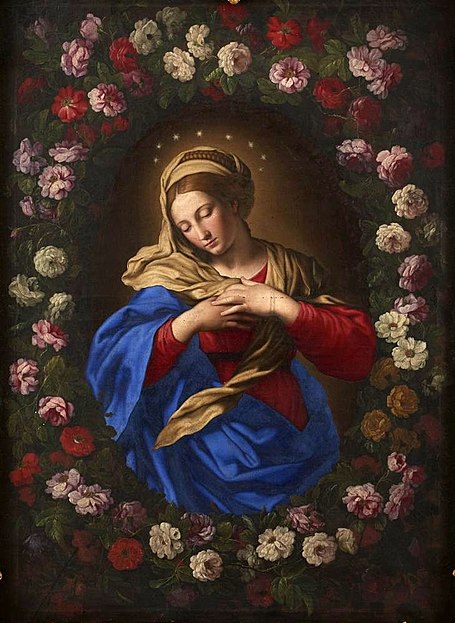
History shows that the rose is the favourite flower of Our Lady herself, the Madonna of the Rose. In her apparition at Guadalupe, she made use of roses as a sign of her presence and even arranged them with her own beautiful hands in the tilma of Juan Diego. At La Salette she wore a profusion of roses in three garlands and had tiny roses around the rim of her slippers. She brought beautiful roses with her at Lourdes, Pontmain, Pellevoisin, Beauraing, and Banneaux. To Sister Josefa Menendez she showed her Immaculate Heart encircled with little white roses. Truly, she could be called the Madonna of the Rose.
Mary’s wedding garment, according to approved revelation, was “richly embroidered with blue, white, violet, and gold roses.” At the Incarnation, while the Angel vanished down the path that led up to Heaven, showers of half-blown roses fell on Mary.
In the Syrian capital Damascus, very familiar to Mary, hundreds of men and women once earned a living working with roses, from which they distilled rosewater and extracted attar and rose syrup. These people carried the scent of roses with them wherever they went. This is a lesson for us: let us become so saturated with the virtues of Mary, the Madonna of the Rose, that we carry their fragrance and attract other souls to our Divine Lord through His Mother, the Mystical Rose, the Madonna of the Rose.
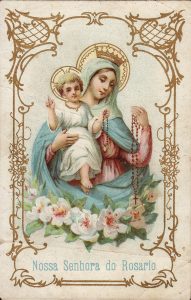
Among the many feasts of Our Lady we find mentioned in an old Latin chronicle: “January 30, Our Lady of the Rose, at Lucca in Italy. Three roses were found in January in the arms of the statue of Our Lady there.”
Cardinal Newman says “Mary is the most beautiful flower ever seen in the spiritual world. It is by the power of God’s grace that from this barren and desolate earth there ever sprung up at all flowers of holiness and glory; and Mary is the Queen of them all. She is the Queen of spiritual flowers; and therefore, is called the Rose, for the rose is called of all flowers the most beautiful. But, moreover, she is the Mystical or Hidden Rose, for mystical means hidden.”
In the stately college of King’s Chapel, in Cambridge, England, one of the most renowned universities, built by Henry VIII in memory of his father, there can be discerned, hidden in one of the Tudor rose-bosses on the walls, a small head of Our Lady which somehow escaped observation at the despoliation of images at the Protestant Deformation. Brother John, a clever carver, was hired to carve all of the roses; knowing of the king’s quarrel with the pope, he secretly carved a tiny head of Mary, half-hidden within the rose petals in the upper tier of decorations, saying, “There you remain, Our Lady of the Rose, even if wicked men try to drive you and your Son from this Church.” His words came true, when the place was stripped of every trace of Faith, the diminutive head of the Mother of God still remained.
But a rose has thorns, and so had the Mystical Rose – the sharpest for herself alone; so she could have compassion on our infirmities. Never did the breath of evil spoil the splendour of this Mystical Rose; never did God’s lovely flower, the Madonna of the Rose, cease to give forth the sweet perfume of love and praise.
“Mystical Rose, thou hast been hailed to shed they fragrance sweet, to flood our desert with thy perfume rare. We beg thee, daily kneeling at thy feet, let fall thy petals for our repose, shower upon us thy aroma, O thou Mystical Rose.”

Click here to send a Rose to Our Lady of Guadalupe in Mexico in February
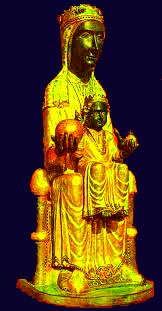
In the year 1514, Our Lady was venerated at a shrine near Montserrat, Spain. Her aid was invoked on behalf of a dumb man who went on pilgrimage there, and the Blessed Virgin miraculously restored his speech. From that time on she was given the title Our Lady of Speech.
Here again the words of the “Memorare” were verified:
“Remember, O most gracious Virgin Mary, that never was it known that anyone who fled to your protection, implored your help or sought your intercession, was left unaided.
Inspired with this confidence, I fly to you, O Virgin of virgins, my Mother; to you do I come, before you I kneel, sinful and sorrowful. O Mother of the Word Incarnate, despise not my petitions, but in your mercy hear and answer me.”
When God was made man, it was she who gave voice to the Word. In the Magnificat, God the Holy Ghost, her mystical spouse, spoke though her. When Christ was a child, she was His voice. When Our Lord was a man, He spoke for himself, while his mother remained silent. After the Ascension, she again became His voice as she guided the infant Church through those perilous times. Over and over again the words of God came through her, for she is His Mediatrix of grace, the link between us and Him.
Vested with the almighty power of her Divine Son, Mary, imitating Him, visits the earth, going about doing good, granting petitions, supplying the needs of those who invoke her, and giving solace, comfort and aid to her children. She is indeed Our Lady of the Word; Mother of the Word Incarnate; “And the Word was made Flesh and dwelt among us,” through her “Fiat.”
As a consequence, even while on earth, His Mother’s word had great influence upon Christ. “They have no wine,” uttered in behalf of the embarrassed newlyweds at Cana, was all that was necessary to bring forth her Sons’ first miracle.
And so, down the ages, Mary hearkens to the words of her Calvary-born children and speaks in their behalf to Jesus. Her intercession, her word, her speech, is never in vain. Let us never cease to invoke this powerful protectress, who wants nothing more than to intercede for us, her children, before the throne of God.
*from The Woman in Orbit

Among shrines dedicated to Our Lady of Victory, that at Prague has become world-famous because it is also the home of the statue of the Infant of Prague.
The story of the shrine is an unusual one. In 1620 the Austrian Emperor Ferdinand II and Prince Maximillian of Bavaria gained a major victory over a coalition of Protestant armies in the battle of the White Mountains near Prague. The previous day, Rev Fr Dominic of Jesus-Maria, a discalced Carmelite, had found in the castle of Strakowicz a picture representing the nativity of Christ. It showed the Blessed Virgin kneeling before her Divine Son, while St Joseph stood behind her holding a lantern. In the background were two shepherds. The Calvinists had shown their fanaticism by piercing the eyes of Mary and her spouse, St Joseph.
Carrying the picture to the camp, the monk held it up and urged the soldiers to restore Mary’s honour. His words decided the hesitation of the generals and gave courage to the men. They adopted Mary’s name as their battle cry and Mary blessed their efforts. In the moment of success, they hailed the painting as Our Lady of Victory and carried it in triumph into Prague, where their leaders adorned it with rich jewels.
In gratitude to God for his great success, and in recognition of the help given by Father Dominic, Ferdinand II founded several Carmelite monasteries, including one at Prague which was solemnly blessed under invocation of Our Lady of Victory.

Before this time, however, Father Dominic had taken the picture of Our Lady of Victory to Rome where it was first venerated in the Basilica of St. Mary Major, then carried – in the presence of Pope Gregory XV – to the church of St Paul near the Carmelite convent, on 8 May 1622. Pope Paul V subsequently changed the name of the church to Our Lady of Victory, and the feast was officially inaugurated.
The original painting was destroyed in a fire in 1833 and has been replaced by a copy. Another copy hangs in the church of Our Lady of Victory in Prague, in a building erected in 1706 replacing the earlier church.
From the Shrine of Our Lady of Victory in Prague, came to the entire world the devotion to the Infant of Prague.

Our need for Mary’s help continues as long as we live, and so long, too, we need her guidance. The struggle between the forces of evil and the forces of good will continue until the end of time. The devil whose intelligence and power exceed those we can command in our own right, has an acute appreciation of the value of our souls bought with a great price. Our sure way to defeat him is to range ourselves under Mary’s banner, to call on her to bring us victory, and to acknowledge her as Our Lady of Victory when she protects us from dangers and brings us triumphant through temptation.
Notes:
*from The Woman in Orbit
Credits:
Image of Infant of Prague: By Fotobanka ČTK, René Fluger; – http://www.pragjesu.info/image-infant-jesus-l.htm, CC BY-SA 3.0, https://commons.wikimedia.org/w/index.php?curid=20428346
Front of the Church: By Ludek – Own work, CC BY-SA 3.0, https://commons.wikimedia.org/w/index.php?curid=1511758
Chancel of the Church: By Balles2601 / Wikimedia Commons / CC BY-SA 4.0, CC BY-SA 4.0, https://commons.wikimedia.org/w/index.php?curid=86612035
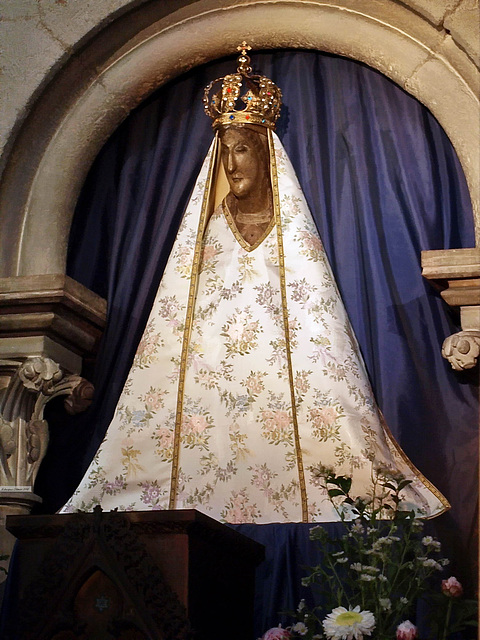
In the fifth century the Abbey of St Etienne of Dijon had a regular chapter which observed the Rule of St Augustine; it was given over to the secular Canons, and later Clement XI made the church the Cathedral of Dijon.
The image of Our Lady of Dijon in Burgundy was formerly named the “Black Virgin,” and “Our Lady of Good Hope.” In the year 1513, Mary miraculously delivered the city of Dijon, the ancient city of the Dukes of Burgundy, from the hands of the Swiss. The German and Swiss forces coming against them totalled 45 000 men, and although Dijon was well stocked for a siege, they only had perhaps 6 000 defenders. There were plenty of arrows, but little gunpowder, and most of the French cannon needed repairs.
The invading force was so sure of success that they there were columns of empty wagons pulled behind the army to bring back the loot they expected to take from the French towns and monasteries. The Monastery at Beze was not spared, as even dead monks were dug up in search of treasure.
The army arrived on 8 September, the solemnity of Our Lady’s Nativity. There were so many men that the defenders saw nothing but a vast sea of shining armour wherever they gazed. The Swiss opened up with heavy cannon fire the next day, yet there were surprisingly few fatalities. When breaches were made in the walls and the enemy attacked, they were repulsed with heavy loss of life.
On Sunday, 11 September, a procession was organized after Mass. The “Black Virgin” was carried through the streets as the French prayed to the Mother of God to spare them from their deadly enemies. The following day a treaty was signed, and the conflict ended unexpectedly. In thanksgiving for this favour, she was titled Our Lady of Dijon, and general procession to her shrine is made every year.
During the French Revolution the church suffered the outrage of being transformed into a forage storage house. Afterward, in atonement to Our Lady for this insult, the faithful of France rebuilt the shrine, and pleaded that the Holy See grant numerous relics and valuable keepsakes to be placed there. Our Blessed Mother responded to the generosity and love of the people by granting favours and cures and extending her God-given miraculous power over the people.
In 1944 the German army occupied the city of Dijon. The people turned to Mary, praying: “Holy Virgin, Compassionate Mother, you who protected our knights of old and who delivered our city from enemy attack, you maintained our ancestors in their times of trouble…Our Lady of Good Hope, pray for us.” On 11 September the Nazi army unexpectedly left Dijon.
*from The Woman in Orbit
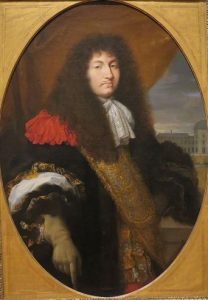
An interesting historical anecdote comes to mind on the question of consecrations and the consequences of failing to act. On 17 June 1689, the Sacred Heart of Jesus manifested to Saint Margaret Mary Alacoque, the great apostle of the Sacred Heart, His command to the King of France (Louis XIV) that the King consecrate France to the Sacred Heart. For 100 years to the day, this seemingly “unimportant” command was ignored. Thus in 1789 did France erupt in a frenzy of bloodshed, a diabolical assault on the Altar and Throne and the ensuing complete disruption of life in France and Europe.
In 1917, Our Lady at Fatima delivered to the world a peace plan. This plan has however in large part been ignored, or shunted sideways. This, despite dire warnings about the threats hanging over humanity for non-compliance, including the prophesied eruption of World War II and the prospect of “annihilation of many nations.” No amount of petitions, reason, appeals or prayers has motivated the last seven popes to honour this request, at least in its fullness.
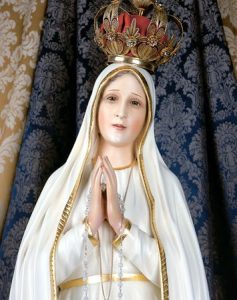
One is reminded of Our Lord’s words when He appeared to Sister Lucy, one of the Fatima seers, regarding the preceding: “Make it known to My ministers given that they follow the example of the King of France in delaying the execution of my command, like him they will follow him into misfortune.”
Successive French Kings failed to obey Our Lord and the reader will recall that during the Terror of the French Revolution, Louis XVI was guillotined on 21 January 1793. In prison, and finally realising the enormity of his predicament and that of his glorious country, he promised to formally consecrate France in a promissory note he wrote in prison, if Our Lord should restore his freedom. It was however too late…