Winning the heart and soul of South Africa for Mary by spreading the Fatima Message

Winning the heart and soul of South Africa for Mary by spreading the Fatima Message

Our Lady of the Vine

Feast day 10 March

At one time in Viterbo there was a certain man named Mastro Baptist Magnano Iuzzante, who was a very God-fearing devotee of the glorious Virgin Mary. He hired a painter named Monetto in the year 1417 to paint an image on a tile of the most glorious Virgin Mary holding her Son in her arms. Mastro Baptist then lovingly laid the tile on an oak tree that stood at the edge of his vineyard, near the road leading to Bagnaia and along which robbers often awaited to attack unwary travellers. 

The image remained there for about 50 years under cover of the oak’s branches, and after a while only a few women who passed by ever stopped to say a prayer and to admire the beauty of a natural tabernacle that a wild vine, which had embraced the oak, had created. 
 
During this period a hermit of Siena, Pier Domenico Alberti, whose hermitage was at the foot of Palanzana, went around the countryside and the nearby towns of Viterbo, saying, “Among Bagnaia and Viterbo there is a treasure.” 
 
Many people, driven by greed, started digging there but found nothing and asked for an explanation from the hermit. Domenico then brought them under the oak tree chosen by the Virgin and pointed to the real treasure, the Madonna. He told them of the day he had decided to take away the sacred image to his hermitage, and of how it had returned to the oak. 
 
Dominico was not alone in this experience. A devout woman named Bartolomea often walked past the oak tree and stopped each time to pray to the Blessed Virgin. One day she also decided to take the tile to her home. After saying her evening prayers, Bartolomea went to bed, but woke up in the morning to find the image missing. She at first thought that her family had taken it to place it somewhere else, but upon learning that this was not so, she ran to the oak tree and saw what he had already guessed: the tile had miraculously returned to its place amid the tendrils of the vine. 
 
Bartolomea tried again, but always the sacred image returned to the tree. At first, she did not say anything to anyone to avoid being taken for being mad. 
 
Then, in 1467, during the month of August, the whole region was struck by the greatest scourge of those times: the plague. Everywhere there were the bodies of the dead lying in the deserted streets, and there was everywhere great weeping and mourning. Some then remembered the image painted on the humble tile, and, as if driven by an inexplicable force, went to kneel beneath the oak. Nicholas of Tuccia, an historian, said that on one day 30 000 people were there to beg for mercy. 
 
A few days later the plague ceased, and then 40 000 of the faithful came back to thank the Virgin Mary. The people of Viterbo were headed by their bishop Pietro Gennari, and there were many from other regions. 

In early September of the same year another extraordinary event happened. 
 
A good knight of Viterbo had many enemies, as will often happen to a follower of Christ. One day he was surprised by his enemies outside the walls of Viterbo. Alone and unarmed, and having no way to deal with the mortal danger, he fled into the nearby woods. Fatigued and desperate to reach his destination, the knight heard the cries of the enemy draw nearer and nearer. Eventually he arrived at the oak with the sacred image of Mary, where he fell at her feet with great faith and embraced the trunk of the tree, putting his life into the hands of his Heavenly Mother. 
 
The knight’s enemies reached the oak, but were surprised that they could no longer see the knight. They began to look behind every tree and bush, but not one could see him since he had disappeared before their very eyes. Failing to find him after a long time spent in searching, they gave up in disgust. 
 
Then the knight, after thanking the Virgin Mary, returned to Viterbo and told everyone what had happened. Bartolomea heard his tale, and encouraged by his words, she described the miracles to which she had been a witness. They told everyone what had happened to them with so much enthusiasm, faith that devotion that the stories spread like wildfire, and many people, coming from the most diverse regions of Italy, flocked to the feet of the oak to implore help from the Blessed Virgin. 
 
It was decided to build an altar, and then a chapel of planks before Pope Paul II gave the necessary permission to build a small church in 1467. Many popes and saints have been devotees of the image, including St Charles Borromeo, St Paul of the Cross, St Ignatius Loyola, Saint Crispin of Viterbo, and St Maximilian Kolbe, among many others. 
 
On 20 January 1944, during the bombing of Viterbo, a squadron of 12 bombers headed towards the oak, but upon arriving at their destination, inexplicably veered to the right and the bombs dropped did not destroy anything outside of an asylum which was empty. The remains of the bombs, 3 large chunks, are kept behind the altar of the Madonna. 
 
In 1986, Pope John Paul II proclaimed Our Lady of the Oak, Patroness of the new diocese of Viterbo, formed from the union of those of Viterbo, Tuscania, Montefiascone, Acquapendente and Bagnoregio. 
 
Even today the Virgin protects her devotees, and the devotion to the Blessed Virgin of the Oak is very strong. 
 
Every year on the second Sunday of September, the faithful commemorate the “Benefits from the Sacred Image of Our Lady of the Oak, or Our Lady of the Vine.” Many cities and towns, with their brotherhoods, participate in the procession of thanksgiving, called the “Covenant of Love. ” The Mayor of Viterbo, on behalf of all participants, renews the consecration made of old by the whole region back in 1467. 
Our Lady Della Croce

Feast Day 1 March


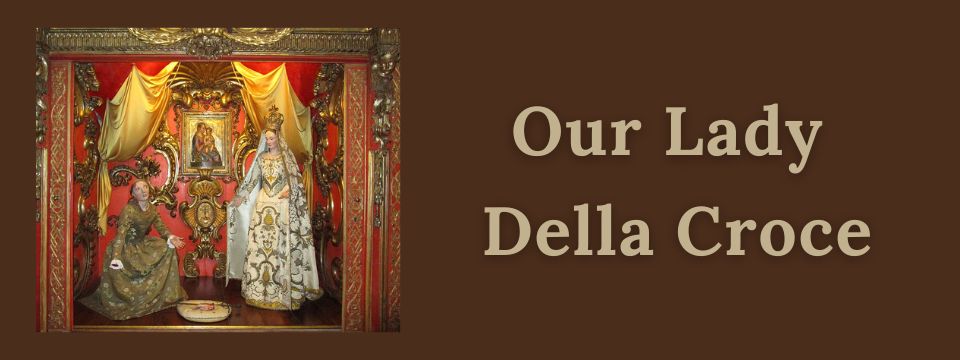
There is a sanctuary of the Madonna on the Bergamo Road, about a mile away from the city of Crema, Italy. The structure is a circular form, with four additions in the shape of a cross, which gave rise to the name: “Holy Mary of the Cross,” or Our Lady Della Croce. The sanctuary is located in a place where, in years gone by, there stood a dense little wood called “Il Novelletto.” 

In the late 15th century, a young woman named Caterina Uberti lived with her brother in the city of Crema. When she arrived at marriageable age, her brother induced her to wed one Bartolomeo Petrobelli; it was an unfortunate arrangement – Caterina was good and pious; Bartolomeo was quite the opposite, tending toward the wicked and corrupt. The marriage was unhappy for Caterina and uncomfortable for Bartolomeo – his rather crude and brutal ways shamed her, while her refined and holy life was a silent reproach to his somewhat scandalous mode of living. 

So, after a year of turmoil, Bartolomeo decided to kill Caterina. Having made up his mind, he lost no time in carrying out his evil design. 

He suggested that they journey to Bergamo and visit his parents; she agreed, and in the late afternoon of April 3, 1490, they mounted their horses and set forth from the city. When they arrived at the wood about a mile from Crema, Bartolomeo left the highway and rode into the forest; Caterina was puzzled, but not knowing what else to do, followed him. When they reached the middle of the wood, Bartolomeo dismounted and made Caterina get down from her horse. 

Then, without warning, he drew his sword, raised it and fiercely brought it down, intending to split her head with one clean cut. Instinctively she drew up her arm to ward off the savage blow, saved her head, but lost her right hand – the poor severed hand hung from the stump of her arm by a strip of skin, and Bartolomeo brutally tore it off and flung it to one side. He then slashed at her like a maniac until she fell to the ground in a pool of blood; thinking her dead, he leaped on his horse and fled. 

Caterina was not dead, nor was she afraid to die, though she felt her time was short. With all her dying heart she wished for the Last Sacraments; so she prayed to the Mother of God, who heard her prayer. A glow of light pushed back the gathering darkness, and a beautiful lady approached her. Reaching down, the Lady, Our Lady Della Croce, took her by the arm and helped her rise – the blood stopped flowing and new life coursed through her mutilated body. 

The Lady bade Caterina follow her, but Caterina asked if she might look for her lost hand. The Lady promised it would be returned to her in due time. Taking Caterina to a hut, she told her these people would help her and then vanished. The kind peasants did all they could for Caterina, and the next morning they placed her on a rude stretcher and tenderly carried her back to Crema. 

As they passed through the wood, one of the men found the severed hand and returned it to Caterina. They took her to the Church of St Benedetto, where the pastor, after hearing the story, anointed Caterina who died there. The story spread rapidly; some believed, others doubted that the Blessed Virgin worked such wonders. 

An eleven-year-old boy, living in Crema plagued with an unhealable abscess on a foot, begged to be taken to the wood to put his foot on the spot where the Lady appeared. His mother and a group of relatives carried him there, and he was instantly cured, all abscess traces gone. 

Many other sick and infirm came also and were cured. The people erected a small chapel on the spot and placed in it a plaster image of Our Lady. More favours followed; many offerings were made by the faithful and in a few years a fitting sanctuary to the Madonna was completed by 1500. Later a fine new statue of Mary was enshrined in the Sanctuary and in 1873 Our Lady Della Croce was crowned with a golden crown by order of the Vatican. 

Our Lady of Light

Feast Day 27 February

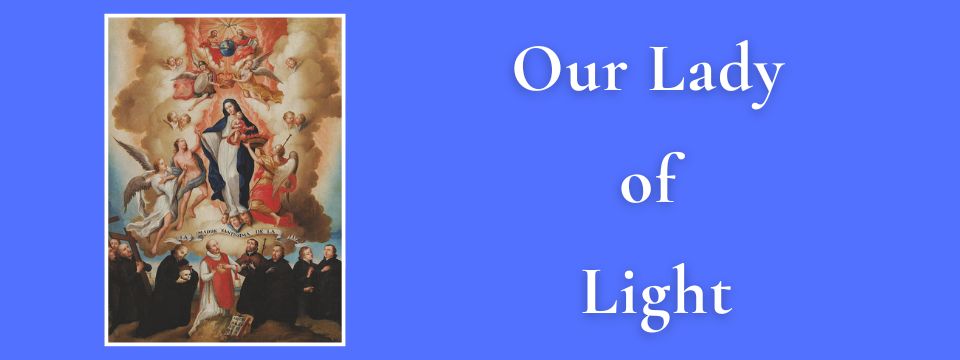
Early in the 18th century, a Jesuit, Father John Genovesi, lived in Palermo, Italy. At the beginning of his missionary career, he placed the souls over which he would have charge under the protection of the Blessed Mother, deciding to take with him to each of his missions an image of Mary. 

Not knowing which image of Our Lady to use, he consulted a pious visionary telling her to ask Our Lady what she desired. One day as this lady knelt in prayer, she beheld approaching her, the Queen of Heaven, surrounded by pomp, majesty, and glory, surpassing anything else she had ever beheld in any of her visions. A torrent of light was shed from the body of the Virgin, which was so clear, that in comparison with it, the sun seemed obscure. Yet, these rays were not painful to the sight; but seemed rather directed to the heart, which they instantly penetrated and filled with sweetness. 

A group of Seraphs hovering in the air were suspended over their Empress and held a triple crown. The virginal body was clothed in a flowing robe, whiter than the snow and more brilliant than the sun. A belt inlaid with precious stones encircled Mary’s beautiful form, and from her graceful shoulders hung a mantle of azure hue. Countless angels surrounded their Queen, but what most enchanted the contemplative soul, was the untold sweetness and grace and benignity shown in the motherly face of Mary. She radiated clemency and love. Our Lady told the pious woman that she wished to be represented as she was now under the title of Most Holy Mother of Light, repeating the words three times. 

The Jesuit hired labourers to begin the work on the picture of Our Lady of Light, however neither the pious lady nor the priest was able to direct it, and the result was that after completion, it did not answer Our Lady’s orders. Our Lady directed the woman to look at the image, and seeing the mistake, she again betook herself to prayer and asked Mary to help her. Mary appeared again, commanding the woman to supervise the work, giving directions, while Mary would aid in an invisible manner. Pleased by the finished work, Mary appeared over it and blessed it with the sign of the cross. 

This wonderful treasure is now in the city of Mexico in the cathedral of Leon, formerly known as the Jesuit Church. The back of the picture bears the authenticity and four signatures, including that of Father Genovesi, SJ. The painting was transferred from Palermo, Sicily, in 1702, and placed on the altar in Leon in 1732. The people of Leon have an innate devotion and great tenderness toward the Mother of God. In 1849 they solemnly promised before the picture to make Our Lady of Light the patroness of Leon. This promise was confirmed by Pope Pius IX; Leo XIII authenticated the crowning of the image of Our Lady of Light in 1902. 


*from The Woman in Orbit 

Saint Angela Merici

Patron Saint of the Sick, Disabled and Physically Challenged People and those Grieving the Loss of Parents

Feast January 27


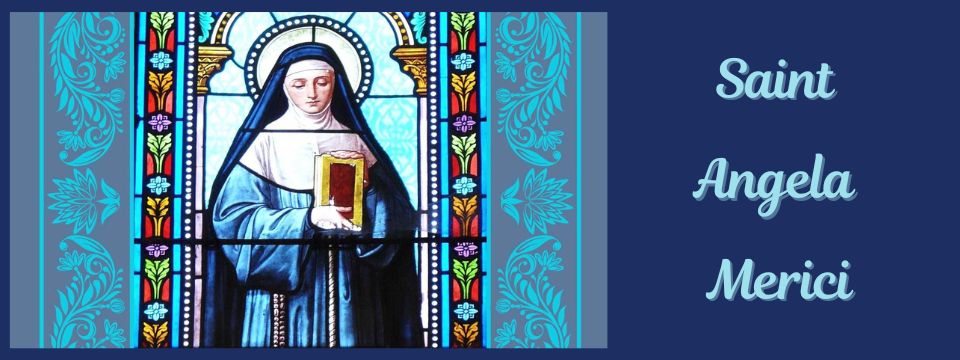
Angela de Merici was born in Desenzano, on the south-western shore of beautiful Lake Garda, in northern Italy.

Left an orphan at the age of ten with an older sister and a brother, they were taken in by an uncle living in the neighbouring town of Salò.

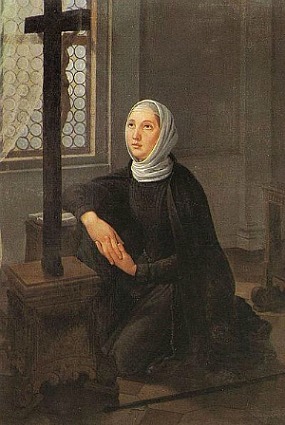
Angela was much distressed when her sister suddenly died without the assistance of the last sacraments. At this time, she had a vision, the first of many in her life, which set her mind at rest as to her sister’s salvation. In gratitude, she made a special consecration of herself to God, joined the Third Order of St. Francis and began to lead a life of great austerity.

After her uncle died when she was twenty, Angela moved back to Desenzano. Convinced of the need to instruct young girls in the Faith, she converted her home into a school.

In a vision, she was shown that she would found a congregation for the instruction of young girls. Angela talked with fellow Franciscan tertiaries and friends who began to help her.

Saint Angela Merici

Though petite in stature, Angela had looks, charm and leadership. Her school thrived and she was approached about starting a similar school in the larger city of Brescia where she came in contact with leading families whom she influenced with her great ideals.

In 1525 on a pilgrimage to Rome, Pope Clement VII, who had heard of her holiness, suggested she found a congregation of nursing sisters in Rome. But Angela who felt called elsewhere and shunned publicity, declined and returned to Brescia.

On 25 November 1535, with twelve other virgins, Angela Merici laid the foundations for her order for the teaching of young women, the first congregation of its kind in the Church. She placed her order under the protection of St. Ursula the patroness of medieval universities and popularly venerated as a leader of women.

To this day her followers are known as the Ursulines.

Angela died only five years after establishing the Ursulines, and was canonized in 1807 by Pope Pius VII.