Winning the heart and soul of South Africa for Mary by spreading the Fatima Message

Winning the heart and soul of South Africa for Mary by spreading the Fatima Message

Saint Anthony, a Mule and the Eucharist

St Anthony and the Mule

Saint Anthony (1195-1231) worked hard to convert those who did not believe in the Real Presence of Jesus in the Eucharist because he genuinely felt sorry for them. He saw that they were depriving themselves of the most precious gift of the Eucharist, and he believed that no one could long survive without this spiritual nourishment.
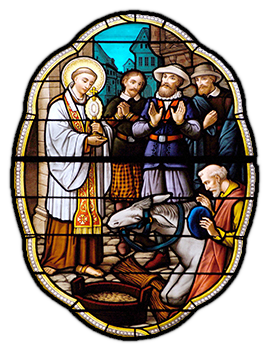
St Anthony and mule Stained glass

Often, he was called to defend the dogmas of our faith to heretics, especially the Albigensians, who were multiplying in the South of France and the North of Italy.

However, theological arguments alone were not enough to convince those minds closed by pride and ignorance. Our Saint presented them with the irresistible argument of miracles.

During his travels through a city called Rimini, Saint Anthony engaged in conversation with a particularly stubborn heretic. This man obstinately refused to admit the mystery of transubstantiation, for he perceived no change in the sacramental species after the words of consecration.

In vain, Anthony presented proofs drawn from both Scripture and Tradition. When his efforts failed before the stubborn obstinacy of his doubter, he decided to alter his strategy.

“You possess,” he told the man, “a mule that you ride often. I will present a consecrated host to it; if it falls on its knee before the Blessed Sacrament, will you recognize the real Presence of the Saviour under His Eucharistic appearance?”

“Certainly,” responded the unbeliever, who felt confident that the outcome of such a proposition would be to the apostle’s detriment.

The two men agreed to meet again in the market square three days later. They then went their separate ways, each to prepare for the spiritual showdown in his own way.

The heretic, in order to insure victory, deprived his beast from all food for the three days. Our saint employed gentler methods, preparing for his assured victory by doubling his accustomed time in prayer.

At the set day and time, Anthony left the Church, carrying a ciborium in his hands. The sceptic arrived leading the famished animal by the bridle.

A considerable crowd had gathered on the square, curious to attend such a remarkable sight. With a smile on his lips, the doubter, believing victory already to be his, set a sack of oats before the animal.

As all watched in breathless anticipation, the hungry animal turned away from the proffered food and turned toward the Sacred Host held high by the Miracle Worker. With a graceful motion uncharacteristic of his breed, the beast of burden bowed low to the ground, giving due reverence to his Creator. It did not straighten or stand up again until it had received permission from the Saint to do so.
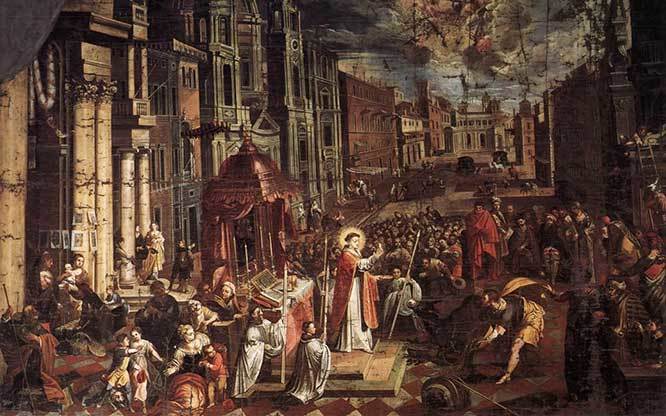
St Anthony miracle mule

It is easy to imagine the effect the miracle produced. A cheer rose up from the assembled crowd, many making the sign of the Cross to seal their belief in what they had just witnessed.

The heretic honoured his word and converted. Several others who had shared his stubborn unbelief also embraced this most marvellous proof of Our Saviour’s True Presence among his creatures.

“I will be with you always, even to the end of the world.” Matthew 28:20

Our Lady of Pellevoisin

Feast Day: 13 February

Pellevoisin is a little village not far from Tours in France. In 1876, a young woman, Estelle Faguette, lay dying from tuberculosis – only five hours to live in the opinion of the doctors. But on 13 February, when all were expecting her death, Our Lady appeared near the sickbed. This occurred on three successive nights, and then, as Our Lady had promised, the sick woman was instantly cured on a Saturday.

Photograph of Estelle Faguette

During the visits, Our Lady of Pellevoisin frequently spoke to Estelle, her theme being that which she so often has expressed during the past hundred years:

“I am all-merciful and have great influence over my Son. What distresses me most is the lack of respect for my Son. Publish my glory.”

For some months after her miraculous cure, Estelle continued to live quietly at Pellevoisin. She was at a loss to find the means of fulfilling the mission entrusted to her by Our Lady. Her heavenly visitor, however, was watching over her, and Estelle was to see her again and receive more minute instructions as to what was required of her. On the feast of Our Lady’s visitation in the same year, 1876, as Estelle was praying in her room, she was granted another vision. Our Lady, robed in white and wearing on her breast a white scapular with the image of the Sacred Heart of Jesus, appeared to her favoured friend. This was the first of a series of wonderful visions enjoyed by Estelle, ten in all. Again and again Mary pointed to the great need for penance and expiation – a return to God.

During one of these apparitions, Our Lady of Pellevoisin, taking her white scapular in her hand, held it before Estelle saying,

“I love this devotion.”

Immediately Estelle knew that her life’s work was to propagate devotion to the Sacred Heart by means of a scapular modelled on Mary’s. On her last appearance, December 8th, Our Lady commanded Estelle to approach her Bishop and give him a copy of the new scapular.

“Tell him to help you with all his power, and that nothing would be more agreeable to me than to see this badge on each one of my children, in reparation for the outrages that my Son suffers in the Sacrament of His Love. See, the graces I pour upon those who wear it with confidence, and who help to make it known.”

The Prelate in question, the Archbishop of Bourges, gave Estelle a favourable hearing and immediately set up a commission to investigate the whole matter. The result of all this was the establishment at Pellevoisin in 1894 by Pope Leo XIII of an Archconfraternity under the title of Mother of Mercy, Our Lady of Pellevoisin. The membership of this Confraternity had gone on increasing year after year, while Pellevoisin itself has become a centre of pilgrimages for thousands of Mary’s friends.

Estelle lived her quiet and peaceful life at Pellevoisin, neither desiring nor receiving any personal credit. She died in 1929. Her miraculous cure was recognized in 1983 by Monsignor Paul Vignancour. Although no formal approval has been granted acknowledging the authenticity of the events at Pellevoisin either by the local bishop at Bourges or by the Holy See, numerous acts of secondary level of approval, including recognition of Mary’s scapular request, have been granted. Pope Leo XIII, by a Motu Proprio, granted indulgences to encourage the pilgrimage to Pellevoisin on 20 December 1892, and on 4 April 1900, The Congregation of Rites issued a decree granting approval to the Scapular of the Sacred Heart.

Photo: By Esves-37240

Our Lady of Argenteuil

The Abbot Orsini wrote: “This priory preserves a portion of the seamless garment of Our Lord.”

In about the year 500, Clovis was the King of the Franks, but he was not yet a Catholic. Years passed as his wife Clotilda prayed for her husband to convert, yet always King Clovis demurred. Then one fateful day Clovis was engaged in a desperate battle, finding himself sorely bested. At the point of ruin, he cried aloud to the Christian God to assist him, promising to forsake his pagan gods if he were granted a miraculous victory.

Looking up to heaven, Clovis cried:

“Jesus Christ, whom Clotilda declares to be the Son of the Living God, who it is said gives aid to the oppressed and victory to those who put their hope in Thee, I beseech the glory of Thy aid! If Thou shalt grant me victory over these enemies and I test that power which people consecrated to Thy name say they have proved concerning Thee, I will believe in Thee and be baptized in Thy name. For I have called upon my gods, but, as I have proved, they are far removed from my aid. So I believe that they have no power, for they do not succour those who serve them. Now I call upon Thee, and I long to believe in Thee – all the more that I may escape my enemies!”

God was pleased to answer Clovis’ petition immediately, for no sooner had he prayed than his enemies fled the field. Clovis won the battle, and he was a man of his word. Hating his former error, Clovis converted to the True Faith.

It is related in the Gospels that Christ’s executioners played dice over this tunic. According to legend, that tunic was found in the fourth century by Saint Helena, the mother of Emperor Constantine. It was then kept at Constantinople until the eighth century.

In the year 800, the Empress Irene of Byzantium offered Charlemagne the Holy Tunic at his coronation as Emperor of the West. The emperor then gave the relic to the priory of Argenteuil when his daughter, Theodrade, became abbess.

In the year 850 the Normans plundered the village of Argenteuil, including the Basilica of Saint Dennis, but the tunic was hidden in a wall before their arrival. When the abbey was rebuilt in 1003, the relic was restored. It was venerated until the 16th century when it was partially burned by Huguenots in 1567.

During the French Revolution the Benedictine priory was destroyed, and the relic then given to a parish church for safekeeping. In 1793, a priest found it necessary to cut it into pieces and bury them in his garden to protect them from profanation. In 1795, after the priest’s imprisonment had ended, the Holy Tunic appeared again and the different fragments were sewn back together.

The Holy Tunic was displayed again in the nineteenth century, and pilgrimages resumed. On the 13th of December in 1983, the parish priest of Saint Dennis discovered the tunic had been stolen. On 2 February 1984, Father Guyard received a phone call from a stranger promising to return the treasure on condition that their names would be kept secret. That same evening the tunic, with its case, was found in the Basilica of Saint Dennis.

The last solemn exposition of the tunic took place during the Easter holiday in 1984. In six days, approximately 80,000 people came to see the tunic.

The Holy Tunic measures nearly 152cm by 91cm in size. The fibres are wool and of a very regular size. It is a soft, lightweight fabric, and the weaving is uniform and regular with a twisted “Z,” made on a primitive loom. The tunic is remarkable for a tunic woven manually, as it is made without any seam, including the sleeves. The dark brown fabric is typical of the clothing in the early centuries of the Christian era. The fabric was dyed brown, using a method widely in practice at the time by people of modest means. The construction and dyeing show the tunic to date from the time of Christ. It is the garment worn by Christ after the Flagellation and along the road to Calvary as He carried His cross. Christ’s blood and sweat thus impregnate the fabric. In 1985 a test was done showing the blood was type AB. Pollen common to Palestine have also been found in the fabric.

as seen on Roman Catholic Saints

Die Anima Christi

Siel van Christus, heilig my.
Liggaam van Christus, verlos my.
Bloed van Christus, lawe my.
Water uit die sy van Christus, reinig my.
Lyding van Christus, versterk my.
O goeie Jesus, verhoor my.
Binne u wonde: Verberg my.
Laat nie toe dat ek ooit van U geskei word nie.
Van die bose vyand: Beskerm my.
En roep my in my sterwensuur
en beveel my om na U te kom,
dat ek U met u heiliges
vir ewig mag loof. Amen.

Gebed ter ere van die Sewe Smarte van die Heilige Maagd Maria

In die Naam van die Vader en van die Seun en van die Heilige Gees. Amen.

V. O God, kom my te hulp

R. O Here, haas om my te help!

Eer aan die Vader en aan die Seun en aan die Heilige Gees, soos dit in die begin was, so ook nou en altyd tot in alle ewigheid. Amen.

  1. O Moeder van Smarte, met u het ek medelyde oor die hartseer wat u tere hart gely het tydens die profesie van die bejaarde Heilige Simeon. O dierbare Moeder, smeek deur hierdie u geteisterde hart vir my die deugd van nederigheid en die Gawe van die Vrees vir God. Bid een Wees Gegroet Maria.
  2. O Moeder van Smarte, met u het ek medelyde vanweë die ontstellende vrese wat u liefdevolle hart verduur het tydens die vlug na Egipte en tydens u verblyf daar. O dierbare Moeder, deur hierdie angstige hart smeek vir my die deugd van vrygewigheid, veral vir die armes, en die Gawe van Vroomheid. Bid een Wees Gegroet Maria.
  3. O Moeder van Smarte, met u het ek medelyde vanweë die angs wat u bekommerde hart verduur het deur die verlies van u geliefde Kind Jesus. O dierbare Moeder, smeek deur hierdie uiters ontstelde hart vir my die deugd van kuisheid en die Gawe van Kennis. Bid een Wees Gegroet Maria.
  4. O Moeder van Smarte, met u het ek medelyde vanweë die verskrikking waarmee u moeders hart getref is toe u Jesus ontmoet terwyl Hy die kruis dra. O dierbare Moeder, smeek deur hierdie uiters onderdrukte hart vir my die deugd van geduld en die Gawe van Sterkte. Bid een Wees Gegroet Maria.
  5. O Moeder van Smarte, met u het ek medelyde vanweë die martelaarskap wat u grootmoedige hart gemartel het by die doodsangstiging van Jesus. O dierbare Moeder, smeek deur hierdie u gemartelde hart vir my die deugd van matigheid en die Gawe van Raad. Bid een Wees Gegroet Maria.
  6. O Moeder van Smarte, met u het ek medelyde oor die angs wat u teer hart toegedien het deur die aanskouing van die lans wat die sy van Jesus oopgemaak en Sy Allerliefste Hart deursteek het. O dierbare Moeder, smeek vir my die deugd van broederliefde en die Gawe van Begrip deur hierdie plaasvervangende deursteking van u eie hart. Bid een Wees Gegroet Maria.
  7. O Moeder van Smarte, met u het ek medelyde vanweë die angs van die siel wat u mees liefdevolle hart getref het by die begrafnis van Jesus. O dierbare Moeder, deur hierdie uiterste marteling wat u belaste hart gevul het, smeek vir my die deugd van ywer en die Gawe van Wysheid. Bid een Wees Gegroet Maria.

V. Bid vir ons, O Mees Bedroefde Maagd!
R. Dat ons die beloftes van Christus waardig gemaak mag word.

Kom ons bid.

O Here Jesus Christus, ons smeek U dat die mees Geseënde Maagd Maria, wie se siel deur die Swaard van Smart in die uur van U Passie deursteek is, ons advokaat mag wees by die troon van U Barmhartigheid, nou en in die uur van ons dood. Deur U, Jesus Christus, Verlosser van die Wêreld, wat saam met die Vader en die Heilige Gees lewe en heers, wêreld sonder einde. Amen.


Die Sewe Genade …

… verleen deur Onse Liewe Vrou aan siele wat Haar daagliks eer deur sewe Wees Gegroet Maria’s te bid en oor haar trane en smarte te mediteer.


Hierdie beloftes is aan St Birgitta van Swede onthul deur Onse Liewe Vrou.

  1. Ek sal vrede aan hulle gesinne gee.
  2. Hulle sal ingelig word oor die goddelike verborgenhede.
  3. Ek sal hulle in hul pyn vertroos en ek sal hulle in hul werk vergesel.
  4. Ek sal hulle soveel gee as wat hulle vra, solank dit nie die Aanbiddelike Wil van my Goddelike Seun of die heiligmaking van hulle siele weerstaan ​​nie.
  5. Ek sal hulle verdedig in hul geestelike gevegte met die helse vyand en ek sal hulle op elke oomblik van hul lewens beskerm.
  6. Ek sal hulle sigbaar help op die oomblik van hul dood, hulle sal die gesig van hul Moeder sien.
  7. Ek het (hierdie genade) van my Goddelike Seun verkry sodat diegene wat hierdie toewyding aan my trane en smarte versprei, direk uit hierdie aardse lewe na ewige geluk geneem sal word, aangesien al hulle sondes vergewe sal word en my Seun hulle ewige troos en vreugde sal wees.

Die Memorare Gebed van St Bernard

Gedenk O vrome Maagd Maria,
dit het nog nooit gebeur
dat enigiemand wat u om beskerming,
hulp of bemiddeling gesmeek het,
sonder enige bystand gelaat is nie.
Besiel met hierdie vertroue,
vlug ek tot u, O Maagd bo alle maagde, my Moeder.
Tot u kom ek, voor u kniel ek in sonde en verdriet.
O Moeder van die Vleesgeworde Woord, verag nie my smekinge nie, maar verhoor my in u genade. Amen.

Die Magnificat

My hart besing die grootheid van die Here,
my gees het hom in God, my redder, verbly,
omdat Hy gunstig op sy diensmeisie in haar geringheid gelet het.
Kyk, van nou af sal alle geslagte my geseënd noem,
want Hy het groot dinge aan my gedoen,
Hy wat almagtig is:
Heilig is sy Naam;
en sy troue liefde vir dié wat Hom vereer
bly van geslag tot geslag bestaan.
Kragtige dade het Hy met sy arm verrig,
hoogmoediges in hul eiewaan het Hy verstrooi,
maghebbers het hy onttroon
en geringes verhoog.
Behoeftiges het Hy met goeie gawes versadig
en rykes met leë hande weggestuur.
Sy dienaar Israel het Hy te hulp gekom
gedagtig aan die troue liefde wat Hy beloof het aan ons voorouers,
Abraham en sy nageslag, vir altyd.
Eer aan die Vader en aan die Seun en aan die Heilige Gees,
soos dit in die begin was, so ook nou en altyd,
tot in alle ewigheid. Amen.

Die Angelus Gebed

V. Die Engel van die Here het aan Maria die boodskap gebring.

A. En sy het ontvang van die Heilige Gees. Wees gegroet Maria…

V. Aanskou die diensmaagd van die Here.

A. Laat dit met my gaan volgens u woord. Wees gegroet Maria…

V. En die Woord het vlees geword.

A. En het onder ons gewoon. Wees gegroet Maria…

V. Bid vir ons, heilige Moeder van God.

A. Dat ons die beloftes van Christus waardig mag word.

V. Laat ons bid: Ons smeek U, Here, stort u genade in ons harte uit, sodat ons wat deur die boodskap van die Engel die menswording van Christus, u Seun, leer ken het, deur sy lyding en kruis tot die heerlikheid van die opstanding gebring mag word. Deur dieselfde Christus, onse Here. Amen.

Koningin van die Hemel Regina Caeli Gebed


V. Koningin van die Hemel, verheug u, halleluja!
R. Want Hy, wat u waardig was om te dra, halleluja!
V. Het opgestaan soos Hy gesê het, halleluja!
R. Bid vir ons tot God, halleluja!
V. Verheug en verbly u, Maagd Maria, halleluja!
R. Want die Here het waarlik opgestaan, halleluja!


V. Laat ons bid: God onse Vader, deur die opstanding van u Seun, onse Here Jesus Christus, het U die wêreld met groot blydskap geseën. Ons smeek U: laat ons, deur die gebede van sy moeder, die Maagd Maria, die vreugde van die ewige lewe verkry. Ons bid dit deur onse Here Jesus Christus, u Seun, wat met U en die Heilige Gees, leef en regeer, één God, vir ewig en altyd. Amen.