Winning the heart and soul of South Africa for Mary by spreading the Fatima Message

Winning the heart and soul of South Africa for Mary by spreading the Fatima Message

Quotes from Saints about the Holy Souls in Purgatory

“I come to tell you that they suffer in Purgatory, that they weep, and that they demand with urgent cries the help of your prayers and your good works. I seem to hear them crying from the depths of those fires which devour them: ‘Tell our loved ones, tell our children, tell all our relatives how great the evils are which they are making us suffer. We throw ourselves at their feet to implore the help of their prayers. Ah! Tell them that since we have been separated from them, we have been here burning in the flames!’” – St. John Vianney

“It is definite that only a few chosen ones do not go to Purgatory and the sufferings there that one must endure exceed our imagination.” – St. John Vianney

“I do not think that apart from the felicity of Heaven, there can be a joy comparable to that experienced by the souls in Purgatory. An incessant communication from God renders their joy more vivid from day to day: and this communication becomes more and more intimate, to the extent that it consumes the obstacles still existing in the soul… On the other hand, they endure pain so intense, that no tongue is able to describe it. Nor is any mind capable of comprehending the smallest spark of that consuming fire, unless God should show it to him by a special grace.” – St. Catherine of Siena

“The more one longs for a thing, the more painful does deprivation of it become. And because after this life, the desire for God, the Supreme Good, is intense in the souls of the just (because this impetus toward Him is not hampered by the weight of the body, and that time of enjoyment of the Perfect Good would have come) had there been no obstacle; the soul suffers enormously from the delay.” – St. Thomas Aquinas

“If only you knew with what great longing these holy souls yearn for relief from their suffering. Ingratitude has never entered Heaven.” – St. Margaret Mary

“The fire of Purgatory is the same as the fire of Hell; the difference between them is that the fire of Purgatory is not everlasting.” – St. John Vianney

“He who saves a soul saves his own and satisfies for a multitude of sins.” – St. James the Apostle

“If, during life, we have been kind to the suffering souls in purgatory, God will see that help be not denied us after death.” – St. Paul of the Cross

“By assisting them we shall not only give great pleasure to God, but will acquire also great merit for ourselves. And, in return for our suffrages, these blessed souls will not neglect to obtain for us many graces from God, but particularly the grace of eternal life. I hold for certain that a soul delivered from Purgatory by the suffrages of a Christian, when she enters paradise, will not fail to say to God: ‘Lord, do not suffer to be lost that person who has liberated me from the prison of Purgatory, and has brought me to the enjoyment of Thy glory sooner than I have deserved.’” – St. Alphonsus Maria de Liguori

“My love urges Me to release the poor souls. If a beneficent king leaves his guilty friend in prison for justice’s sake, he awaits with longing for one of his nobles to plead for the prisoner and to offer something for his release. Then the king joyfully sets him free. Similarly, I accept with highest pleasure what is offered to Me for the poor souls, for I long inexpressibly to have near Me those for whom I paid so great a price. By the prayers of thy loving soul, I am induced to free a prisoner from purgatory as often as thou dost move thy tongue to utter a word of prayer!” – Our Lord to St. Gertrude

“If it were but known how great is the power of the good souls in Purgatory with the Heart of God, and if we knew all the graces we can obtain through their intercession, they would not be so much forgotten. We must, therefore, pray much for them, that they may pray much for us.” – St. John Vianney

“Let us help and commemorate them. If Job’s sons were purified by their father’s sacrifice (Job 1:5), why would we doubt that our offerings for the dead bring them some consolation? Let us not hesitate to help those who have died and to offer our prayers for them.” – St. John Chrysostom

“The practice of recommending to God the souls in Purgatory, that He may mitigate the great pains which they suffer, and that He may soon bring them to His glory, is most pleasing to the Lord and most profitable to us. For these blessed souls are His eternal spouses, and most grateful are they to those who obtain their deliverance from prison, or even a mitigation of their torments. When, therefore, they arrive in Heaven, they will be sure to remember all who have prayed for them.” – St. Alphonsus Maria de Liguori

“As we enter Heaven, we will see them, so many of them, coming towards us and thanking us. We will ask who they are, and they will say ‘a poor soul you prayed for in purgatory.’” – Ven. Fulton Sheen

“We must empty Purgatory with our prayers.” – St. Pio of Pietrelcina

“No one is barred from heaven. Whoever wants to enter heaven may do so because God is merciful. Our Lord will welcome us into glory with His arms wide open. The Almighty is pure however, and if a person is conscious of the least trace of imperfection and at the same time understands that Purgatory is ordained to do away with such impediments, the soul enters this place of perfection gladly to accept so great a mercy of God. The worst suffering of these suffering souls is to have sinned against Divine Goodness and not to have been purified in this life.” – St. Catherine of Genoa

“With Charity towards the dead we practice all the works of charity. The Church encourages us to aid the souls in purgatory, who in turn will reward us abundantly when they come into their glory.” – St. Francis de Sales

“Each one will be presented to the Judge exactly as he was when he departed this life. Yet there must be a cleansing fire before judgement because of some minor faults that may remain to be purged away.” – Pope St. Gregory the Great

“In our prayers, let us not forget sinners and the poor souls in Purgatory especially our poor relatives.” – St. Bernadette

Our Lady of Kibeho: The only approved Marian apparition in Africa

Immaculee Ilibagiza survived the Rwandan genocide in 1994. She enjoys international fame today as a motivational speaker and proponent of the power of prayer, devotion to Our Lady and the Rosary. Her traumatic experience, holed up in a small bathroom with several other women for some three months, is painstakingly revealed in her best-seller “Left to Tell: Discovering God Amidst the Rwandan Holocaust,” where she documented her survival of the merciless slaughter that swept Rwanda in 1994. She attributes her survival to her firm Faith.

In her books and public appearances, Immaculee relates the appearance of Our Lady at Kibeho in 1981. As is so often the case with apparitions of Our Lady, there is always an appeal to pray the Rosary. As Immaculee attests, Our Lady requested that people pray the rosary “from the heart…”  About 10 years later Rwanda was plunged into an apocalyptic blood-letting that sent shock waves around the world. Was Our Lady preparing her children to face that aborning catastrophe? 

One of the seers was given the chaplet of the seven sorrows to help her spread it to the whole world, a devotion which is steadily gaining more ground.

The local Bishop, Augustin Misago of Gikongoro, where Kibeho is situated approved public devotion to the apparitions in 1988. It was not however until 2001 that he and the Holy See declared the testimonies of three witnesses authentic, regarding apparitions that began in 1981 and that continued in “the months that followed” through 1983. This was after the genocide, an event which also obviously led major credibility to the apparitions of Our Lady.

Interestingly, Our Lady of Kibeho is the only Vatican-approved apparition in Africa!

The Ordinary, His Excellency, Bishop Augustin Misago issued a declaration on June 29, 2001, regarding the Revelations in Kibeho. In it, he declared:

  1. It is true that the Mother of God appeared in Kibeho on the day of November 28, 1981 and during the following months. There are more well-founded reasons to believe in this than to deny it. For this reason, only three visionaries from the beginning of the revelations deserve to be recognized as authentic, namely Alphonsine Mumureke, Nathalie Mukamazimpaka, and Marie Claire Mukangano. The Virgin Mary appeared to them dedicated as “Nynia wa Jambo,” meaning “Mother of the Word,” which is a synonym for “Umubyeyi w’Imana,” which means “Mother of God,” as she explained it. The visionaries maintain that they saw her sometimes with hands folded, then other times unfolded.

He summed up the main points of the message thus:

  1. An urgent appeal to the repentance and conversion of hearts:

“Repent, repent, repent!”, “Convert while there is still time.”

  1. An assessment of the moral state of the world:

“The world conducts itself very badly,” “The world hastens to its ruin, it will fall into the abyss,” in other words, it is plunged into innumerable and unrelenting disasters. “The world is rebellious against God, it commits too many sins, it has neither love nor peace.” “If you do not repent and do not convert your hearts, you will fall into the abyss.”

  1. The deep sorrow of the Mother of God:

The visionaries claim to have seen Mary crying on August 15, 1982. The Mother of God was very saddened because of people’s unbelief and lack of repentance. She complained of our bad way of life, which is characterized by the slackness of customs, the likeness of evil, and continuous disobedience to God’s Commandments.

  1. “Faith and unbelief will come unseen”

These mysterious words were repeatedly spoken by Mary to Alfonsine at the beginning of the revelations. She was asked to repeat them to the other people.

  1. The suffering that saves:

This subject is among the most important among the revelations in Kibeho, particularly for Natalie Mukamazimpaka. Suffering, which is unavoidable in this life, is necessary for Christians to attain eternal glory. On May 15, 1982, Mary said to her visionaries, especially to Natalie, “No one will reach heaven without suffering,” or, “A child of Mary does not reject suffering.” Suffering is both a means of compensating for the sins of the world and participating in Jesus’ and Mary’s sufferings for the salvation of the world. The visionaries were invited through this address to live very specifically, accepting suffering through faith in love, mortifying themselves and denying themselves pleasures for the conversion of the world. Thus, Kibeho is a reminder of the role of the cross in the life of a Christian and the Church.

  1. “Pray always and single-heartedly”

People are not praying, and those who do pray, do not pray as they should. Mary begs the visionaries to pray in abundance for the whole world, to teach others to pray, and to pray for those who do not pray themselves. Mary begs us to pray with greater zeal and purity of heart.

  1. Marian devotion – expressed through sincere and regular praying of the rosary.
  2. The Rosary to the Seven Sorrows of the Mother of God:

The visionary Marie Claire Mukangano claims to have received revelations regarding this rosary. This rosary pleases the Mother of God. It was once well known, but now it has now been forgotten. The Mother of God of Kibeho desires for it to be renewed and spread in the Church. However, this prayer does not replace the Holy Rosary.

  1. Mary desires that a chapel be built for her – as a sign of the remembrance of her revelations in Kibeho. This subject appears in the revelations of January 16, 1982 and recurs many times in the course of the year with new supplements.
  2. Pray always for the Church, when many troubles are upon it in the times to come. Thus Mary said to Alfonsine on August 15, 1983 and November 28, 1983.

According to the alleged visionaries, Mary’s address in Kibeho “is not directed to only one person nor does it concern only the current time; it is directed to everyone in the entire world.”

The analysis of the conversations with the visionaries makes it clear that in their view, the Mother of God did not come to Kibeho with new teaching, but to remind us with full clarity of that which we had forgotten. She came to awaken us, to shake our consciences, to warn us, to remind us of our responsibilities as children of God, to lead us onto the right path, and to motivate us to correct our lives. In short, she came for the sake of our spiritual renewal and salvation. Mary, who is our mother, cannot abandon her children to their destruction. Even more saddening is the blindness and the hardening of our hearts.”

Lastly, he wrote:

I could not finish this declaration without giving a few practical tips regarding your behaviour in relation to the revelations in Kibeho.

  1. First I will to recall that in the Church of God and in the life of every Christian, the Bible – the Word of God – is and should remain the highest standard of our faith and our human action. I warmly recommend to each person to love the Word of God contained in the Holy Scriptures and to ceaselessly ponder it in order to better live according to it in faithfulness to the teaching of the Church. There we have everything necessary to know and practice to be a good Christian, and in this way merit entry into the heavenly kingdom. Consequently, it is not a good thing for the words of those who consider themselves visionaries, even if they are officially recognized, to be treated equally with the words of the Holy Scriptures.
  2. In Christian faith and prayer, one should be watchful in order to ensure priority to Jesus Christ, the only mediator between God and men (1 Tim 2:5-6). It is about him that the Holy Scriptures speak: “And there is salvation in no one else, for there is no other name under heaven given among men by which we must be saved” (Acts 4:12). No creation can be placed above Jesus Christ – the only Saviour of the world.
  3. In this context, I find it suitable to strongly emphasize the meaning of the bond that should exist between Marian devotion and an ever greater attachment to Jesus. Mary leads us to Him, for He is “the Way, the Truth, and the Life,” and “No one comes to the Father except through Him” (John 14:6).
  4. Our Christian life cannot be limited by such practices. It must also manifest itself in deeds expressing our love to our neighbours and in building around ourselves the kingdom of God, “the kingdom of truth and life, the kingdom of light and grace, the kingdom of love, justice, and peace” (preface from the celebration of Christ the King). The one who prays should commit without reluctance in serving his brothers. The life of a Christian should be in accordance with his faith. Nothing would be more in opposition to true Marian devotion than a Christian life that neglects the demands of truth, justice, peace, and love. This is true also for married and family life in accordance with the Gospel.
  5. I ask that the Rosary to the Seven Sorrows of the Mother of God become a part of the practices promoted in the sanctuary in Kibeho and elsewhere. Wherever this rosary is not yet well known, may Christians be taught it in the same way as the Holy Rosary. I ask my friends and benefactors the favour of helping us in seeking ways and means that allow for the acquisition and spread of this rosary at affordable prices to the faithful. It is forbidden to spread and pray other kinds of rosaries without written permission from the bishop of the place.
  6. As I have already said in my Address on September 15, 1996 regard the revelations in Kibeho, we must learn to be attached to what is most important in our Christian life. What the Mother of God of Kibeho expects from us first is not to build her a lavish sanctuary of brick or beautifully hewn stone. Rather, she expects spiritual temples to be created in our hearts by cleansing them of all filth and banishing all lust and dishonesty, hate and violence, pride and deceit in its many forms, vengeance, and all murderous ideas. What the Mother of God expects from us immediately is that we zealously accept the address directed to us by the intercession of her visionaries. This address is an urgent call to repentance and conversion, to a changed way of thinking, to a denial of everything that distances us from Christ. The address obligates us to a rediscovery of the Gospel of brotherly love and to giving proof of greater zeal in prayer and obedience to God’s commandments.

I give these recommendations to promote authentic Marian devotion in relation to the revelations in Kibeho and to preserve them from obscurity and distortion. I ask you to faithfully abide by them in the spirit of faith, trust, humility, and obedience, following the Virgin Mary as our example.

In this spirit, I beg the Lord to grant all of you His blessings in abundance.

Gikongoro, June 29, 2001

On the Feast of Saints Peter and Paul the Apostles

On the ninth anniversary of my pastoral work,

Augustin Misago, Bishop of Gikongoro, Rwanda

*****************************************************************************

For all practical purposes, the message of Our Lady at Kibeho repeats and reinforces the essentials of Fatima. Prayer, penance and amendment of life… Without conversion, we can expect only difficulties and trouble. This is the consistent and ever-more urgent message of a loving mother with her eye on her straying children.

Our Lady of La Salette

On 19 September 1846, Our Blessed Mother appeared in south-eastern France to two children, Maximin Giraud and Melanie Mathieu, who were taking care of a few cows on the slope of a mountain which rises above the village of La Salette. Their attention was drawn to a globe of light a short distance away. While they gazed, the globe opened and they saw a woman seated on some stones which surrounded the bed of a dried stream. Her elbows rested on her knees, her face was buried in her hands, and she wept.

The children were frightened and did not know what to do, when the Lady arose and in the sweetest of tones, said:

“Come near, my children; do not be afraid. I am here to tell you great news.”

The children obeyed and when they were close, they saw that the woman’s countenance was of rare beauty, though her eyes were filled with tears. They saw that her shoes were sparkling white, the buckles on them were square and golden. Encircling the soles were tiny roses which did not crush as she stood on the tips of the blades of grass. Her apron was golden and it reached to the bottom of her full white dress. Her arms folded before her were concealed within broad straight sleeves which reached beyond her fingertips. Along the border of her plain white kerchief crossed on her breast, ran many-colored roses both large and small, and besides these was a flat, thin gold chain about an inch in breadth.

The face of Our Lady of La Salette was so resplendent with light that the noon-day sun lost its brightness for the children; her complexion was a pale white such as those who have been bowed down with suffering. Her beauty was radiant, so dazzling, so scintillating, that Melanie was frequently rubbing her eyes, thinking that by so doing she might see the better, while Maximin could see her face but vaguely. Her headdress was white and above it, a royal diadem wreathed with roses of many hues glittered, while on her bosom rested a golden crucifix, with the pincers and hammer of the Passion. Her majestic beauty was ravishing; her face exceedingly beautiful – yet profoundly sad. It was not earthly.

Mary, Our Lady of La Salette, stood with her head bent toward the children. Her mien and her manner were reassuring and kind, but also sorrowful. They listened to her voice; a voice far sweeter than the sweetest melody:

“If my people do not submit, I shall be forced to let go the hand of my Son. It is so strong, so heavy, that I can no longer withhold it. How long a time do I suffer for you! If I would not have my Son abandon you, I am compelled to pray to Him without ceasing. And as to you, you take no heed of it. However much you pray, however much you do, you shall never recompense the pains I have taken for you.”

Then Our Lady of La Salette told them that the two things which at that time pained her Son most were the neglect of Sunday observance and blasphemous language. She foretold a great famine, and asked the children to make known her message. She walked off a bit, lifted her gaze toward heaven and vanished. Next day a miraculous spring was present where Mary had stood.


*from The Woman in Orbit

Proposed New Marriage Bill in South Africa Raises Concerns

Government has proposed a new Marriage Law which will amalgamate all the existing Laws governing marriage and other unions. Family Action South Africa has made a submission which is the third one in the last few years.

Please go here to read the proposed new Bill. We were reasonably hopeful of having the deadline of 31st August extended but this has not been conceded. Thus then, even at this late hour we have once more added our voice to those of countless others concerned at the changes envisaged to the traditional concept of marriage. Perhaps an opportunity will come around again for further submissions prior to presentation before Parliament and God willing, we shall then take up the cudgels again!

Please feel free to submit something of your own or to use parts of our submission should you feel moved to do so. But above all, let us continue to pray!

The email addresses of the persons to whom commentary should be forwarded are:

Moses.malakate@dha.gov.za                                                                                                         

Agnes.molefe@dha.gov.za


See here below the Family Action SA Submission to Department of Home Affairs on 31 August 2023

RE: DRAFT BILL ON THE ENVISAGED NEW MARRIAGE ACT

Dear Mr Malakate and Ms Molefe

Family Action South Africa is an organisation firmly committed to the defence and nurturing of the family institution. It fulfils its mission through campaigns, mailings, lobbying, advocacy and the like. Our basic contention is that a strong family institution is the bedrock of an upright, morally strong and God-fearing society. Most of contemporary society’s social ills can be attributed to the constant whittling away of the family institution through so many evils –  amongst which we can name abortion, pornography, drugs, alcohol, sexual promiscuity etc. etc…

It is within the perspective of the vital needs of the family, that we have read and noted the draft Bill, which amongst other things, provides for the amalgamation of the various laws governing marriage and other unions.

Ideally, this Bill should be scrapped in its entirety as current legislation (without critical analysis here), is adequate. There is no compelling need to synthesise the three Laws governing marriage and other relationships, especially when the amalgamation reduces the traditional concept of marriage to merely “one amongst other unions,” abolishing at the same time, husband-wife terminology for that which is gender-neutral! This essentially demeans and degrades marriage as God ordained it.

Knowing that the scrapping of this Bill is highly unlikely, and that raising a host of objections will be futile, we will limit our concerns regarding the envisaged Marriage Act, to two areas.

The first involves the very nature, and traditional definition of Marriage.

We refer here to the immemorial understanding of marriage, especially as defined and practised in the Christian world. In this sense, marriage has always been understood as the monogamous and lifelong union of two persons of the opposite sex (one man and one woman), the primary purpose of which is the begetting of children. Such a conception of marriage has in large part played a fundamental and indispensable role in guaranteeing a stable and ordered society.

The family institution, defined at times as the “mother cell of society,” is the vital organism and glue which holds society together. Wherever it is subject to the assault of the multiple fronts of anti-family legislation now so prevalent in the world, the resulting societal collapse and dysfunctionality has been catastrophic. Our country is no different. For this reason, and to avert sliding further down this slope, it is vitally important that marriage not be re-defined to include the politically correct and disordered partnerships which are, or can be ably catered for under the existing provisions contained in the Civil Union Amendment Act. Such partnerships are a corollary of the state of our society and their definitions and inclusions expand at the same pace as the sexual revolution advances. Marriage, on the contrary, as traditionally defined, leaves little scope for confusion and ambiguity!

So first and foremost, we would earnestly plead, in the interests of the health and well-being of the family institution, and hence our country, that the definition as contained in the original Marriage Act be upheld and not sacrificed at the woke altar to please activists and vociferous minorities!       

 Secondly, it is our well-grounded fear that this vital Marriage definition will not be upheld in the new proposed Bill. Consequently, it is of major concern to us that the draft bill fails to explicitly provide for marriage officers to freely and legally refuse to solemnise unions that violate their consciences, regardless whether this stems from moral, religious or any other personal conviction.

It is, from our perspective, indispensable therefore, that a clause explicitly providing for “conscientious objection” on the grounds alluded to above, be included as an integral part of any final Bill which comes before Parliament.

The role and primary purpose of the State should be to facilitate good order and the well-being of the Nation and its inhabitants, by fostering in its laws and policies, eternal and perennial truths for the ideal functioning of civil society. There is no finer institution for the accomplishment of this end than the traditional family model, which in reality, precedes the State.

There are many types of potential unions, especially where a liberal, irreligious and egalitarian climate entertains and fosters everything contrary to the rights of Almighty God, Natural Law and solid immemorial traditions. These various unions, so contrary to “Marriage” as outlined above and traditionally understood, should not be considered for inclusion under a “marriage” definition.  There are obviously legal ramifications for such unions and accordingly, their legal regulation can be catered for elsewhere. There can be no such thing as “Marriage Equality!”

To touch on polygamy – the fact that it exists should not be reason to entrench it, and facilitate even further its extension. Polygamy should be rather tolerated as an existing, temporary “wrong,” – a violation of Biblical precepts – and all just and charitable means employed to gradually rid society of it; through preaching, moral suasion, prayers etc.  Its very existence complicates all discussion around marriage. In accommodating a future for polygamy, is it now to be made a right for all – removed from its narrow current acceptability in customary traditional male African society? Nowhere is it recognized as a positive element in a country’s national fabric!  

The principle should be considered, that if one wants to embrace a relationship that is not of the highest, noblest and finest traditions, one cannot expect to have such unions finely regulated, legally accommodated and mishaps catered for, in the same way that the State should afford protection to man-woman family relationships, whose contribution to the good of society is incontestable! Numerous are the studies which prove the great value to a Nation – both economically and sociologically – of those unions embracing the traditional concept of marriage and family! In our country, evidence of the contrary position is daily before our eyes!

Your sincerely

Bernard Tuffin(Mr)

President

Family Action South Africa

10 Steps for a Successful Rally


STEP 1:

Find the right spot; a public place where people can see you. For example: a town square, a busy intersection, an entrance to a mall, etc.


STEP 2:

Prepare an invitation (a sample invitation will be provided).


STEP 3:

Call the police advising of the rally, and if a permit is necessary, ask what steps need to be taken to obtain one.


STEP 4:

Print copies of the invitation and distribute them to friends and family, at school, church and other venues.


STEP 5:

Call your family and friends and tell them about the rally so they can join you. Let them know the time and place to meet.


STEP 6:

Load rally supplies in your car on the morning of your rally. Print supply list.


STEP 7:

Go to rally site at least 30 minutes early.


STEP 8:

Start rally punctually at 12:00 noon.


STEP 9:

Take pictures during your rally.


STEP 10:

Send pictures and reports to SANOL via either:

Rally Captain report – click here to fill in AFTER your rally

  • Upload up to 3 of your best photos
  • Upload 1 short video (optional)
  • Upload your attendance sheets
  • No need to WhatsApp, post or email reports – Just fill in this quick and easy online form.

E-mail: sanol@sanol.co.za or
WhatsApp: 064 621 7948 or 076 701 8097


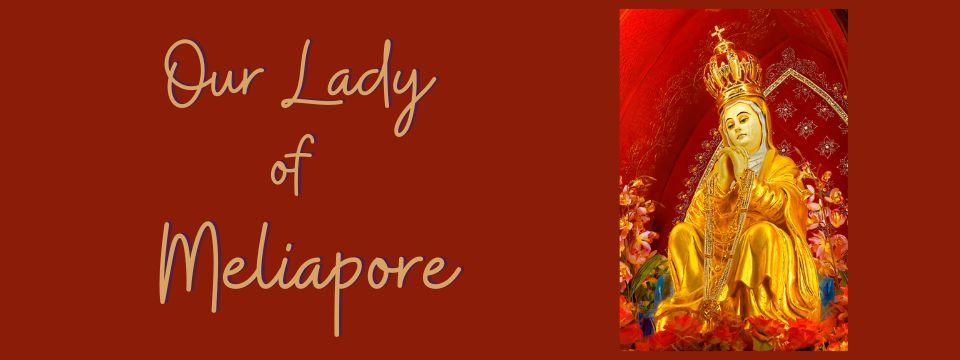
Our Lady of Meliapore


Feast Day: 26 June

This is the shrine in the East Indies, where Saint Francis Xavier often retired to pray during his eleven years with the people of India. The Blessed Virgin Mary was Francis’ constant source of strength and inspiration. The image before which Saint Francis used to pray is called Mylai Matha in Tamil, or Our Lady of Mylapore in English. It is an ancient statue about one metre tall, Our Lady of Meliapore can still be venerated at the church.

The church of Saint Thomas of Mylapore – spelled somewhat differently from the above – contains Mary’s shrine. According to tradition, the Apostle Saint Thomas came to India in 52 AD. Due to his success making converts to the True Faith, he was persecuted and finally martyred in the year 72 AD. Saint Thomas is buried at the shrine of Our Lady of Meliapore, and there are relics of Saint Francis Xavier.

There was a church known to be in Mylapore going back to the 1st century, and built by St Thomas. According to tradition, there was a huge log that had washed down the river to a place where it blocked the water and caused massive flooding. The local king was at a loss to remove the blockage, but having heard that St Thomas was a miracle worker, asked him for his assistance. Saint Thomas prayed and then touched the log, which made it so light that the king’s men were suddenly able to easily pull it from the river. The king, in thanksgiving, gave the massive log to St Thomas, who used the wood he obtained from it to construct his church.

The famed traveller Marco Polo visited the shrine in 1292, and a visitor known only as “Joseph” in 1501 thought the church comparable to the Church of Saint John and Saint Paul in Venice, but by the time the Portuguese came in 1517 the shrine was nothing but ruins.

The good people knew that they were Christians, and nothing more; but they had Mary as their Mother, and she cleared the way into their hearts for the zealous Francis to sow the seed of Christ’s Gospel. It was at Mary’s shrine that Francis obtained the miraculous favours to raise people from the dead, cure the sick, convert sinners and bring to Christ thousands of souls. Regardless of where his journeying took him, Francis always returned to his “Lady of the Wayside;” at Miliapore.

Our Lady of Meliapore was his most beloved Mother and from her he received consolation and strength, spiritual delights second only to the joys of Paradise.

The spirit of Francis is still at this shrine, and Mary continues to bestow upon her children miraculous graces and blessings.


*from The Woman in Orbit and other sources

Acts of Faith, Hope and Charity

Act of Faith

O my God, I firmly believe that Thou art one God in three Divine Persons, the Father, the Son, and the Holy Spirit. I believe that Thy Divine Son became man and died for our sins, and that He will come to judge the living and the dead. I believe these and all the truths which the Holy Catholic Church teaches, because Thou hast revealed them, Who canst neither deceive nor be deceived. Amen.

Act of Hope

O my God, relying on Thy almighty power and infinite mercy and promises, I hope to obtain pardon of my sins, the help of Thy grace, and life everlasting, through the merits of Jesus Christ, my Lord and Redeemer. Amen.

Act of Charity (Love)

O my God, I love Thee above all things, with my whole heart and soul, because Thou art all good and worthy of all my love. I love my neighbour as myself for the love of Thee. I forgive all who have injured me, and ask pardon of all whom I have injured. Amen.


The Scapular – A Powerful Weapon against the Devil

Abbé Francis Trochu, in his book, The Cure D’Ars, relates a story of a young lady who, having decided to consecrate her life to religion, sought the holy pastor of Ars, Saint John Vianney, for a general confession.

When she finished relating her sins, St. John Vianney asked her if she was not forgetting something. The girl, upon recollecting her thoughts, could not recall anything else. The holy priest then proceeded to refresh her memory.

He asked her if she remembered a certain dance where she encountered a handsome young man with whom she desired to dance, but who, in turn, only danced with the other girls, passing her up.

Surprised, again she replied in the affirmative, that such was indeed true. The Cure D’Ars then asked her if she remembered how downcast she had felt at the snub, and how, upon leaving the ballroom, she had glanced back once more and had seen the young man dancing with a girl, but this time there were two small blue lights under his feet.

Again she agreed and confirmed that in fact she had seen the two blue lights under the youth’s feet, but that, finding them strange, she could not account for them.

Saint John Vianney then explained to her that the young man was in fact the Devil in human form, and that the only reason why he would not dance with her was because she was wearing the holy Scapular of Our Lady of Mount Carmel.