Winning the heart and soul of South Africa for Mary by spreading the Fatima Message

Winning the heart and soul of South Africa for Mary by spreading the Fatima Message

Our Lady of Almudena

A Lesson in Confidence


The chronicles tell of an amazing miracle that took place in Madrid during the eleventh century. Tradition has it that when King Alphonse VI reconquered Madrid from the Moors, he immediately sought to purify the old church of Santa Maria, which they had desecrated (the Moors had probably turned it into a mosque).

The faithful were afflicted because they could not find the statue of the Virgin that had been there before the Moorish domination. It was a special statue that had been brought to Madrid by the Apostle Saint James. Thus, the people and clergy organized a procession around the city, in which they begged the Lord to find the statue.

The pious procession went around the city walls as people chanted and fervently recited prayers asking God in His Divine Mercy to show them where the statue was hidden. As the procession passed by a certain place, the desired miracle happened. Part of the wall collapsed, and they found the Virgin’s statue that had been hidden there for more than three hundred years. It was illuminated by the two lamps which past Christians had placed there before closing off the niche where it was hidden.

Hence the statue was given the name Our Lady of Almudena since almudena means market or barn. The miracle happened near the Moors’ market or grain silo.

The Virgin Mary is regarded as a patroness of Madrid, Spain, under this title. The Cathedral of Madrid is dedicated to the Virgin under this title, and the feast day, 9 November, is a major holiday in Madrid.

*   *   *

Prof. Plinio Corrêa de Oliveira makes the following commentary about this marvellous story:

The story is so clear and beautiful that it dispenses retelling. Our Lady wonderfully rewarded two things: first, the faith of those crusader warriors who found the statue. They made great efforts to find the statue by processing around the city. They confided in the value of prayer. Secondly, they understood the importance of returning the statue to her place to make proper reparation. The reason for the procession was to undo the Moors’ work, making reparation for the sin they had committed by their occupation.

Our Lady also marvellously rewarded the faith of those who had hidden her statue centuries before. They were Catholic Visigoths facing the approaching Moors. Realizing that escape with the statue was impossible, they walled her up. Then, the Moors at least could not defile the statue.

Notice how they put lighted lamps near the statue before walling her up. This gesture is very beautiful since it shows they did not want to wall up the statue without a tribute. Those lamps represented their hopes that the statue would be venerated once again. Thus, the walled-up place was like a little chapel.

A miracle confirmed their hopes. This most beautiful miracle of confidence consisted of the lamps that burned for 300 years. They continued to burn when the statue was found in the wall. It is a miracle as great as the multiplication of loaves in the Gospel. Its marvellous message is that one can expect such things from Our Lady. Although things may appear defeated and crushed, something irreversibly victorious remains in them.

These lamps represent confidence. Wherever confidence exists, expect the possibility of resurrection, restoration and new victories. Our Lady works miracles even in the most hostile circumstances. Nothing is impossible for those who confide in her.

This confidence is very important for the spiritual life. Those who confide against all hope can expect all things. There is reason to confide even when surrounded by the worst conditions that cause discouragement. Our Lady will reward this confidence. Ultimately, Our Lady never lets anyone down or breaks her word. She keeps the flames alive until it is time for her to give extraordinary graces.

This confidence must be maintained during all efforts for the cause of the Counter-Revolution. A phrase from Scripture says that “The remnant shall return.” It means that the remnant of faithful Catholics will return even after being utterly defeated and crushed. In trusting souls, two lamps must continuously burn next to this confidence. They are the lamps of the conviction of the irreversibility of the Immaculate Heart of Mary’s Reign.

As she promised at Fatima, “Finally, my Immaculate Heart will triumph.”

The preceding article is taken from an informal lecture Professor Plinio Corrêa de Oliveira gave on May 19, 1967. It has been translated and adapted for publication without his revision.
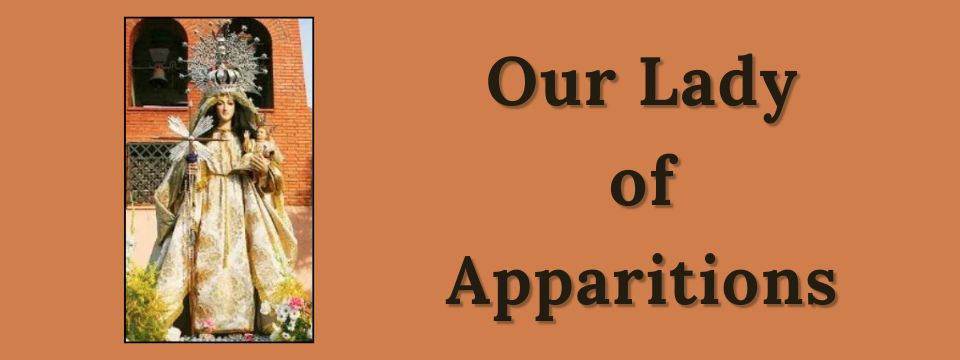
Our Lady of Apparitions

Feast Day 2 March

The Abbot Orsini wrote: “Our Lady of Apparitions, at Madrid, so called because, in the year 1449, the Blessed Virgin appeared during eight following days to a young woman named Yves, and ordered her to build a church in her honour, on the spot where she should find a cross planted to Our Lady.” 

Cubas de la Sagra is a municipality in Spain in the province and autonomous community of Madrid. The approved apparitions of Our Lady in 1449 that occurred there are now almost inexplicably unknown, barely mentioned in passing, or treated as a legend in some books if even recognized as a point on some ancient map. It is true that the hosts of Napoleon looted and destroyed the sanctuary and monastery built there, and that the war in 1936 did not leave one stone upon another, but the memory of what happened there in 1449 must not be forgotten, at least by Catholics. 

In the year 1449, Cubas was only a village with a simple church dedicated to Saint Andrew. The population of Cubas, however, lived quite forgetful of their duties to God, and their sins were so many that it seemed even to them that the hand of God must be hovering over the land, ready to punish them. 

The Chronicles speak then of a young girl of 12 named Ines, (sometimes Yves or Agnes) who was but of humble birth. Still, there was something about her that made her different from other girls her age. She fasted, confessed regularly, and prayed daily the 15 mysteries of the Rosary. Perhaps her deep faith and religiosity may explain what happened next. 

On Monday, 3 March 1449, Ines was tending pigs on the outskirts of town in a place called Cecilia, when at noon a woman appeared, a lady bright and beautiful dressed in cloth of gold. She was surrounded by light, and asked Ines what she was doing there. Ines stated that she was tending the pigs. The Lady then said that the people were no longer keeping the fasts, and told Ines the necessity of fasting. The lady said that the people of Cubas must change their ways, confess, and cease their debauchery and offenses against God, or He would soon punish them. There would be a great pestilence that would come upon them from which many would die. Perhaps knowing the hardheartedness of the people, Ines asked if she, too, or her mother and father, would die of this pestilence. She was told only that it would be as God desired. The lady then disappeared. 

At first Ines did not tell anyone of the incident, for she thought no one would believe what had happened. 

On Tuesday, 4 March, Ines was again tending the pigs, this time near the stream of Torrejon. At about the same time of day, at noon, just as the day before, the Lady reappeared. She asked Ines if she had told the people what she had been told to say, but Ines answered that she dared not to, for she suspected that she would not be believed. The Lady then commanded Ines to warn the people, and that if they did not believe, she would give her a sign. Ines asked the Lady who she was, but she said she would not tell yet before once again disappearing. Finally, Ines decided to tell her father, Alfonso Martinez, who did not give any importance to the events recounted by his daughter, but thought it a children’s story, a story invented in the imagination of a young girl. He told Ines to be quiet when she tried to tell anyone about the warning. 

On Friday, 7 March, Ines was keeping the pigs in New Prado, when the Lady reappeared again as before. She asked Ines if she had told what she had been commanded to say. Ines answered that she had told her mother and father, and many others. The Lady told Ines to publish what she had said to all the people without any fear or trepidation. 

When Ines went home at the end of the day she told her parents what had happened. Her father told her she was lying and to “shut up,” but her mother encouraged Ines, saying, “Well, still, say it.” 

By Sunday, 9 March, word had spread. A priest, Juan Gonzalez, with some other men, when to Ines’ home and talked to her parents. Afterwards, the priest went to say Mass. Ines went out with the pigs, accompanied by her brother John, to a place called The Ciroleda. Ines’ father left them and went to Mass. The Ciroleda was a watery meadow that the pigs liked. Ines left her brother after a time looking for one of the pigs that had slipped away, and soon lost sight of her brother. All by herself, she knelt on the soft earth, asking the lady to return, even though she was afraid. 

The Lady appeared again as before, telling Ines to rise. “Lady, who are you?” Ines asked. “I am the Virgin Mary,” the lady answered, and approaching Ines, took her right hand and squeezed her fingers and thumb together, making some kind of a sign. She then told Ines to go to the church and show the sign to the people as they left Mass. Ines told her brother to watch after the pigs, and went to the church, arriving just as Mass was letting out. She was crying, and went to kneel before the altar of Mary. There, she told everyone what had happened. 

I cannot decipher what the sign was in Ines’ hand, but whatever it was, the people examined her hand and many believed. The following day the priest led the notables of the town and the faithful in a procession to the place of the last apparitions, carrying a wooden cross. When they arrived, Ines walked forward alone with the cross. The Virgin Mary herself took the cross, telling Ines to have a church built there in her honour. 

The cross was permanently placed where the Virgin, Our Lady of Apparitions, had been last seen, and many miracles occurred there, including 11 people who were brought back to life. A church was begun shortly after the apparitions of the Virgin were approved. It stood for nearly five centuries, when it was destroyed in the 1936 fire, caused during the Civil War. Many of the nuns were martyred. In 1949 the reconstruction was completed in part by the Regiones Devastadas, who placed the current cross in the same place where the first had been. 

According to tradition, Ines ended her life in the monastery of Santa Maria de la Cruz after having children and being widowed. It is said that anyone who goes to visit the place, with faith, receives special graces, and that miracles still occur there.