Winning the heart and soul of South Africa for Mary by spreading the Fatima Message

Winning the heart and soul of South Africa for Mary by spreading the Fatima Message

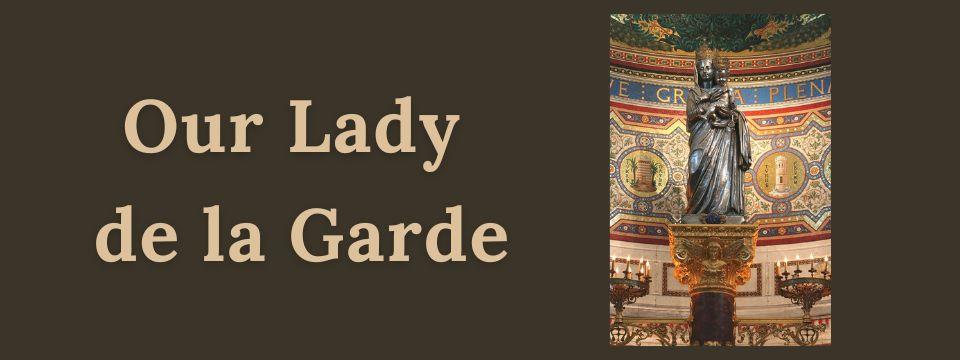
Our Lady de la Garde

Feast day 4 March

Late one afternoon during the thirteenth century, a solitary French fisherman was fishing off the harbour of Marseille. Before he became aware of it, a terrific storm burst upon him. His boat tossed around like a shell, and filled with water faster than he could bail it out. His rudder was lost; his mast snapped. Cutting himself free from the rigging with a knife, he had saved himself temporarily from certain drowning. Still, everything looked hopeless, and he felt he could never get back to the harbour. The fisherman thought of the family he would never see again and cast a despairing look at the city, the huge rock standing like a sentinel or guard on the mountain which overtopped the city and harbour. 

Dimly through the gloom he suddenly saw a solitary figure of a lady, dressed in white, standing firmly on the very top of the rock. She seemed to be extending her hand as if she would help him to the shelter and safety of the harbour. At once it came to him that the Lady so calmly defying the wind and rain could only be the Blessed Mother, so he prayed to her to help him. 

Almost immediately his boat ceased its wild tossing, righted itself and pushed by a friendly gust of wind, raced into the calm water of the harbour until it drove onto the shore at the very foot of the mountain. Stepping onto the shore, the fisherman fell to his knees and poured out his thanks to the Blessed Virgin and then hurried home to his worried family. 

The story of his rescue through the assistance of Our Lady quickly spread throughout the port. It was remembered that other sailors, on numerous occasions during severe storms, had also seen the figure of the Lady on top of the rock. Always when she had appeared, the angry seas had calmed, and their crafts had ridden safely into the shelter. 

Soon everyone came to believe that the rock was the spot on which the Blessed Virgin, Our Lady of Guard, would appear whenever her help was desperately required. In thanksgiving to her the sailors of Marseille, between 1213-1218, erected a chapel on top of the rock. In it they enshrined a lovely statue of Our Lady. 

Around 1544, the chapel was replaced by a large church and the statue transferred to it. Sometime during the French Revolution, the statue of Our Lady of Guard was destroyed, but during the 1830’s a new statue was dedicated. That Mary did not confine her help only to sailors was proved in the year 1832 when a severe epidemic of cholera struck Marseilles; the people decided to appeal to Mary. Forming a procession, they climbed the mountain, removed the statue from the chapel, brought it down, and solemnly carried it through the streets of the city. Almost immediately the epidemic waned, and in a few days vanished. So they called Mary, Our Lady of Help – the sailors called her Our Lady of Mariners. 

Some years later, as the fame of the shrine on top of the mountain spread, with more and more people coming up to pay their respects. The shrine acquired still another name, a name more reflective of who Our Lady truly is for all who call upon her – Notre Dame de la Guarde – Our Lady of Guard, or Guardian. 

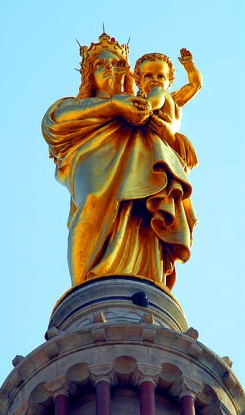
In Marseilles today, the hill of Notre Dame de la Garde is topped by a beautiful basilica, at an altitude of 550 feet, which was built in 1864. This commanding site, however, has been occupied by a chapel since the year 1214. The interior has a multitude of sailors’ votive offerings, and model ships are hung in all parts of it in sign of thanksgiving for all the mariners who have been assisted by their heavenly mother. A golden statue of the Virgin and Child suitably dominates the city from its place on top of the western tower. 


*from The Woman in Orbit 

Photo by Robert Valette 
 

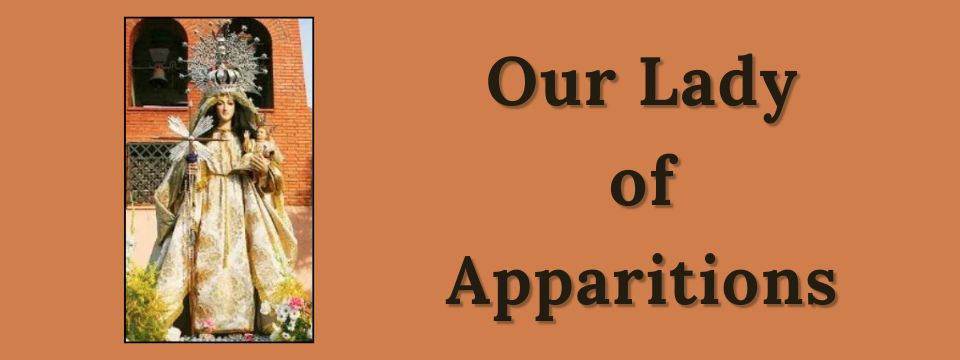
Our Lady of Apparitions

Feast Day 2 March

The Abbot Orsini wrote: “Our Lady of Apparitions, at Madrid, so called because, in the year 1449, the Blessed Virgin appeared during eight following days to a young woman named Yves, and ordered her to build a church in her honour, on the spot where she should find a cross planted to Our Lady.” 

Cubas de la Sagra is a municipality in Spain in the province and autonomous community of Madrid. The approved apparitions of Our Lady in 1449 that occurred there are now almost inexplicably unknown, barely mentioned in passing, or treated as a legend in some books if even recognized as a point on some ancient map. It is true that the hosts of Napoleon looted and destroyed the sanctuary and monastery built there, and that the war in 1936 did not leave one stone upon another, but the memory of what happened there in 1449 must not be forgotten, at least by Catholics. 

In the year 1449, Cubas was only a village with a simple church dedicated to Saint Andrew. The population of Cubas, however, lived quite forgetful of their duties to God, and their sins were so many that it seemed even to them that the hand of God must be hovering over the land, ready to punish them. 

The Chronicles speak then of a young girl of 12 named Ines, (sometimes Yves or Agnes) who was but of humble birth. Still, there was something about her that made her different from other girls her age. She fasted, confessed regularly, and prayed daily the 15 mysteries of the Rosary. Perhaps her deep faith and religiosity may explain what happened next. 

On Monday, 3 March 1449, Ines was tending pigs on the outskirts of town in a place called Cecilia, when at noon a woman appeared, a lady bright and beautiful dressed in cloth of gold. She was surrounded by light, and asked Ines what she was doing there. Ines stated that she was tending the pigs. The Lady then said that the people were no longer keeping the fasts, and told Ines the necessity of fasting. The lady said that the people of Cubas must change their ways, confess, and cease their debauchery and offenses against God, or He would soon punish them. There would be a great pestilence that would come upon them from which many would die. Perhaps knowing the hardheartedness of the people, Ines asked if she, too, or her mother and father, would die of this pestilence. She was told only that it would be as God desired. The lady then disappeared. 

At first Ines did not tell anyone of the incident, for she thought no one would believe what had happened. 

On Tuesday, 4 March, Ines was again tending the pigs, this time near the stream of Torrejon. At about the same time of day, at noon, just as the day before, the Lady reappeared. She asked Ines if she had told the people what she had been told to say, but Ines answered that she dared not to, for she suspected that she would not be believed. The Lady then commanded Ines to warn the people, and that if they did not believe, she would give her a sign. Ines asked the Lady who she was, but she said she would not tell yet before once again disappearing. Finally, Ines decided to tell her father, Alfonso Martinez, who did not give any importance to the events recounted by his daughter, but thought it a children’s story, a story invented in the imagination of a young girl. He told Ines to be quiet when she tried to tell anyone about the warning. 

On Friday, 7 March, Ines was keeping the pigs in New Prado, when the Lady reappeared again as before. She asked Ines if she had told what she had been commanded to say. Ines answered that she had told her mother and father, and many others. The Lady told Ines to publish what she had said to all the people without any fear or trepidation. 

When Ines went home at the end of the day she told her parents what had happened. Her father told her she was lying and to “shut up,” but her mother encouraged Ines, saying, “Well, still, say it.” 

By Sunday, 9 March, word had spread. A priest, Juan Gonzalez, with some other men, when to Ines’ home and talked to her parents. Afterwards, the priest went to say Mass. Ines went out with the pigs, accompanied by her brother John, to a place called The Ciroleda. Ines’ father left them and went to Mass. The Ciroleda was a watery meadow that the pigs liked. Ines left her brother after a time looking for one of the pigs that had slipped away, and soon lost sight of her brother. All by herself, she knelt on the soft earth, asking the lady to return, even though she was afraid. 

The Lady appeared again as before, telling Ines to rise. “Lady, who are you?” Ines asked. “I am the Virgin Mary,” the lady answered, and approaching Ines, took her right hand and squeezed her fingers and thumb together, making some kind of a sign. She then told Ines to go to the church and show the sign to the people as they left Mass. Ines told her brother to watch after the pigs, and went to the church, arriving just as Mass was letting out. She was crying, and went to kneel before the altar of Mary. There, she told everyone what had happened. 

I cannot decipher what the sign was in Ines’ hand, but whatever it was, the people examined her hand and many believed. The following day the priest led the notables of the town and the faithful in a procession to the place of the last apparitions, carrying a wooden cross. When they arrived, Ines walked forward alone with the cross. The Virgin Mary herself took the cross, telling Ines to have a church built there in her honour. 

The cross was permanently placed where the Virgin, Our Lady of Apparitions, had been last seen, and many miracles occurred there, including 11 people who were brought back to life. A church was begun shortly after the apparitions of the Virgin were approved. It stood for nearly five centuries, when it was destroyed in the 1936 fire, caused during the Civil War. Many of the nuns were martyred. In 1949 the reconstruction was completed in part by the Regiones Devastadas, who placed the current cross in the same place where the first had been. 

According to tradition, Ines ended her life in the monastery of Santa Maria de la Cruz after having children and being widowed. It is said that anyone who goes to visit the place, with faith, receives special graces, and that miracles still occur there. 


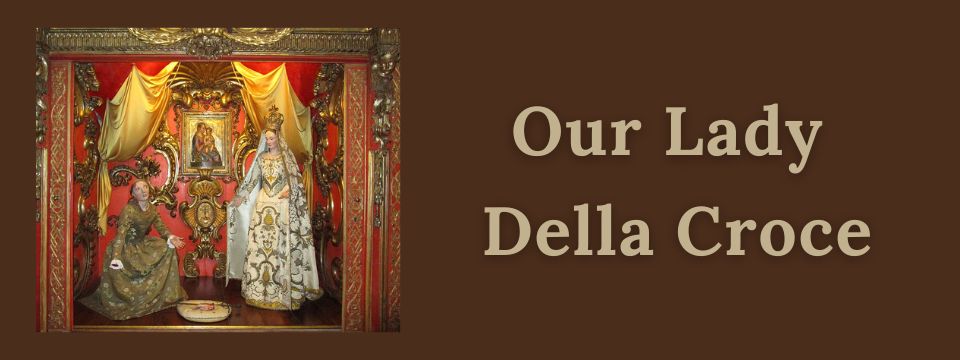
Our Lady Della Croce

Feast Day 1 March


There is a sanctuary of the Madonna on the Bergamo Road, about a mile away from the city of Crema, Italy. The structure is a circular form, with four additions in the shape of a cross, which gave rise to the name: “Holy Mary of the Cross,” or Our Lady Della Croce. The sanctuary is located in a place where, in years gone by, there stood a dense little wood called “Il Novelletto.” 

In the late 15th century, a young woman named Caterina Uberti lived with her brother in the city of Crema. When she arrived at marriageable age, her brother induced her to wed one Bartolomeo Petrobelli; it was an unfortunate arrangement – Caterina was good and pious; Bartolomeo was quite the opposite, tending toward the wicked and corrupt. The marriage was unhappy for Caterina and uncomfortable for Bartolomeo – his rather crude and brutal ways shamed her, while her refined and holy life was a silent reproach to his somewhat scandalous mode of living. 

So, after a year of turmoil, Bartolomeo decided to kill Caterina. Having made up his mind, he lost no time in carrying out his evil design. 

He suggested that they journey to Bergamo and visit his parents; she agreed, and in the late afternoon of April 3, 1490, they mounted their horses and set forth from the city. When they arrived at the wood about a mile from Crema, Bartolomeo left the highway and rode into the forest; Caterina was puzzled, but not knowing what else to do, followed him. When they reached the middle of the wood, Bartolomeo dismounted and made Caterina get down from her horse. 

Then, without warning, he drew his sword, raised it and fiercely brought it down, intending to split her head with one clean cut. Instinctively she drew up her arm to ward off the savage blow, saved her head, but lost her right hand – the poor severed hand hung from the stump of her arm by a strip of skin, and Bartolomeo brutally tore it off and flung it to one side. He then slashed at her like a maniac until she fell to the ground in a pool of blood; thinking her dead, he leaped on his horse and fled. 

Caterina was not dead, nor was she afraid to die, though she felt her time was short. With all her dying heart she wished for the Last Sacraments; so she prayed to the Mother of God, who heard her prayer. A glow of light pushed back the gathering darkness, and a beautiful lady approached her. Reaching down, the Lady, Our Lady Della Croce, took her by the arm and helped her rise – the blood stopped flowing and new life coursed through her mutilated body. 

The Lady bade Caterina follow her, but Caterina asked if she might look for her lost hand. The Lady promised it would be returned to her in due time. Taking Caterina to a hut, she told her these people would help her and then vanished. The kind peasants did all they could for Caterina, and the next morning they placed her on a rude stretcher and tenderly carried her back to Crema. 

As they passed through the wood, one of the men found the severed hand and returned it to Caterina. They took her to the Church of St Benedetto, where the pastor, after hearing the story, anointed Caterina who died there. The story spread rapidly; some believed, others doubted that the Blessed Virgin worked such wonders. 

An eleven-year-old boy, living in Crema plagued with an unhealable abscess on a foot, begged to be taken to the wood to put his foot on the spot where the Lady appeared. His mother and a group of relatives carried him there, and he was instantly cured, all abscess traces gone. 

Many other sick and infirm came also and were cured. The people erected a small chapel on the spot and placed in it a plaster image of Our Lady. More favours followed; many offerings were made by the faithful and in a few years a fitting sanctuary to the Madonna was completed by 1500. Later a fine new statue of Mary was enshrined in the Sanctuary and in 1873 Our Lady Della Croce was crowned with a golden crown by order of the Vatican. 

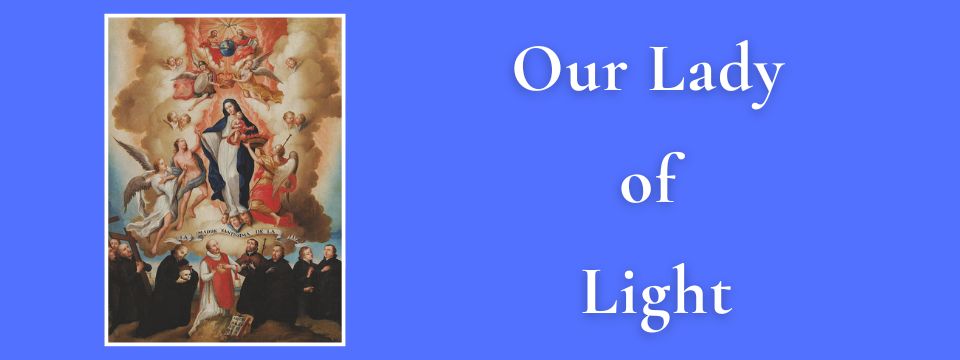
Our Lady of Light

Feast Day 27 February

Early in the 18th century, a Jesuit, Father John Genovesi, lived in Palermo, Italy. At the beginning of his missionary career, he placed the souls over which he would have charge under the protection of the Blessed Mother, deciding to take with him to each of his missions an image of Mary. 

Not knowing which image of Our Lady to use, he consulted a pious visionary telling her to ask Our Lady what she desired. One day as this lady knelt in prayer, she beheld approaching her, the Queen of Heaven, surrounded by pomp, majesty, and glory, surpassing anything else she had ever beheld in any of her visions. A torrent of light was shed from the body of the Virgin, which was so clear, that in comparison with it, the sun seemed obscure. Yet, these rays were not painful to the sight; but seemed rather directed to the heart, which they instantly penetrated and filled with sweetness. 

A group of Seraphs hovering in the air were suspended over their Empress and held a triple crown. The virginal body was clothed in a flowing robe, whiter than the snow and more brilliant than the sun. A belt inlaid with precious stones encircled Mary’s beautiful form, and from her graceful shoulders hung a mantle of azure hue. Countless angels surrounded their Queen, but what most enchanted the contemplative soul, was the untold sweetness and grace and benignity shown in the motherly face of Mary. She radiated clemency and love. Our Lady told the pious woman that she wished to be represented as she was now under the title of Most Holy Mother of Light, repeating the words three times. 

The Jesuit hired labourers to begin the work on the picture of Our Lady of Light, however neither the pious lady nor the priest was able to direct it, and the result was that after completion, it did not answer Our Lady’s orders. Our Lady directed the woman to look at the image, and seeing the mistake, she again betook herself to prayer and asked Mary to help her. Mary appeared again, commanding the woman to supervise the work, giving directions, while Mary would aid in an invisible manner. Pleased by the finished work, Mary appeared over it and blessed it with the sign of the cross. 

This wonderful treasure is now in the city of Mexico in the cathedral of Leon, formerly known as the Jesuit Church. The back of the picture bears the authenticity and four signatures, including that of Father Genovesi, SJ. The painting was transferred from Palermo, Sicily, in 1702, and placed on the altar in Leon in 1732. The people of Leon have an innate devotion and great tenderness toward the Mother of God. In 1849 they solemnly promised before the picture to make Our Lady of Light the patroness of Leon. This promise was confirmed by Pope Pius IX; Leo XIII authenticated the crowning of the image of Our Lady of Light in 1902. 


*from The Woman in Orbit 

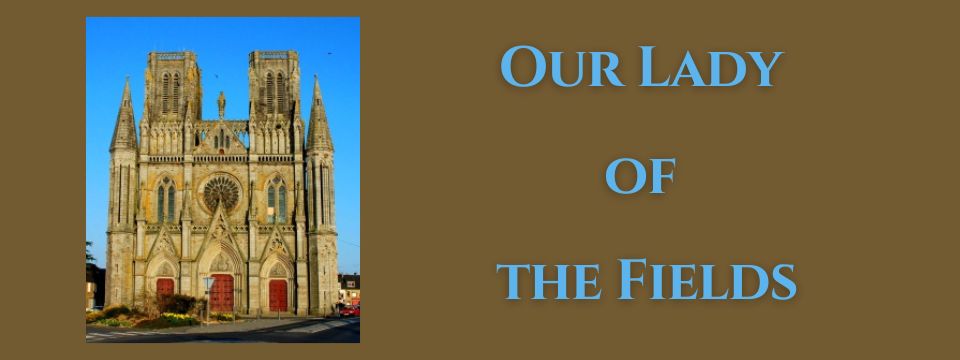
Our Lady of the Fields

 Feast Day 26 February

The title of Our Lady of the Fields, or Notre-Dame des Champs, and the devotion to Mary as such, takes us back to the earliest days of Catholic life in France. 

Our Lady des Champs, at Paris, was dedicated in ancient times to Ceres. Saint Denis, to whom we owe a great deal of our traditional devotion to Mary, was the first Bishop of Paris. According to tradition he drove the demons from the Temple of Ceres, the pagan goddess of agriculture, and placed therein an image of the Madonna modelled after Saint Luke’s famous painting. The Temple was henceforth dedicated to the Blessed Virgin, whom Parisians have honoured for centuries under the title of Our Lady of the Fields. It is said that a picture of the Blessed Virgin is still to be seen there, on a small stone, a foot square, which was made after that which Saint Denis brought to France. 

This house, which is a Benedictine priory, was afterwards occupied by the Carmelites, who were received there in the year 604, and founded by Catherine, Princess of Longueville. It was the first occupied by those nuns in France; the mother Ann of Jesus, the companion of Saint Teresa, was its first superior. 

If the Blessed Virgin were a goddess, she would be a very human goddess – simple and approachable, forgetful of her privileges and of her beauty. Her constant humility adds to her charm. Saint Denis knew this well. He found her so gloriously beautiful that he gave to her the place in the temple – and in the hearts of the people – formerly held by the pagan goddess. 

“I am the Flower of the Fields,” the Holy Ghost has the Blessed Virgin say. A flower of the fields has a simple beauty that charms us even more because it blossoms by itself without care or cultivation. Our Savior Himself marvelled at such a flower and of it He spoke these words of praise that have been repeated through the centuries: “See how the lilies of the field grow; they neither toil nor spin, yet I say to you that not even Solomon in all his glory was arrayed like one of these.” 

But lilies soon fade, and roses are hardly open before they begin to shed their petals before the wind. The beauty of Mary is less perishable; it remains ever fresh and unchanged in the valley of our exile. 


*from The Woman in Orbit and other sources

Photo courtesy of www.all-free-photos.com


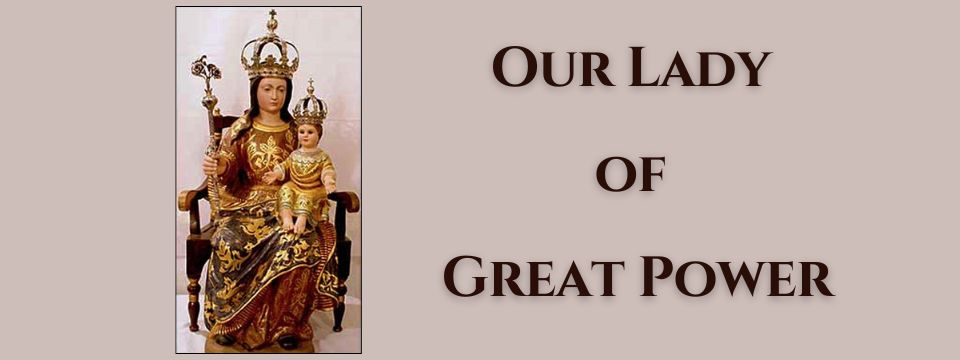
Our Lady of Great Power

Feast day 25 February


Our Lady of Great Power is little known in America, unless among the pupils of the Ursulines in Quebec. Generations of these, however, have dwelt within the walls of the Old Monastery for two centuries and more, since the arrival of the statue in the last years of the 17th century. 

In the annals of the Ursulines of the Sacred Heart at Perigueux, France, where the statue was solemnly crowned, we find the origin of the devotion. The devotion to Our Lady of Great Power began in the monastery of Issoudun. There a holy Ursuline nun, Mother Saint Peter, was inspired during her prayer to invoke Our Lady under this title. She spoke of her inspiration to her sisters and her Superiors. The devotion was adopted with enthusiasm, and very soon it was decided that a statue be sculptured and a chapel built, dedicated to Our Lady of Great Power; she would henceforth be chosen as first and principal Superior of the Monastery. 

The feast of the dedication took place 25 February 1673, and was celebrated with great pomp, as the chronicle testifies: 

“After High Mass two ecclesiastics carried the statue to the entry of the monastery where the nuns, in solemn procession, received it. It was placed on a richly decorated litter, and to the chanting of hymns, psalms and canticles, it was brought to the prepared chapel.” 

“When the same statue was raised on its pedestal, the superior laid the keys of the monastery, the seals and constitutions at Our Lady’s feet, begging her, in the name of the community, to accept the gift of all hearts, and of the entire monastery and to allow them to look on her as their Superior forever. Each rendered homage while hymns and canticles of thanksgiving were sung in Mary’s honour.” 

Ever after, when a superior was elected, the ceremony was renewed and is still renewed in each Ursuline community every year on a principal feast of the Blessed Virgin; though homage is rendered only every three years, after the election or nomination of superiors. 

The statue of Our Lady of Great Power was carried off and profaned during the dark days of the French Revolution. It was found and returned to the monastery at Perigueux; and the devotion continued fervently until 1892, when the bishop of Perigueux, in the name of the Sovereign Pontiff, placed a richly jewelled crown on the head of the Mother and the Child, and ratified the numberless and signal favours obtained through Our Lady of Great Power. 

Through the Ursulines in Quebec, the devotion soon spread through the New World. Before the altar in Quebec hangs the famous votive light promised to be kept burning as a token of thanks for favours granted to Mother Saint Agatha (Madeleine de Repentigny). Relatives and descendants of this holy nun have kept the lamp burning. One relative, Miss Anthon, had a new lamp made, an artistic gem, the work of the celebrated ecclesiastical goldsmith Calliat of Lyon, France. 

*from The Woman in Orbit 


As seen on https://www.roman-catholic-saints.com/our-lady-of-great-power.html


Plague in Rome 591

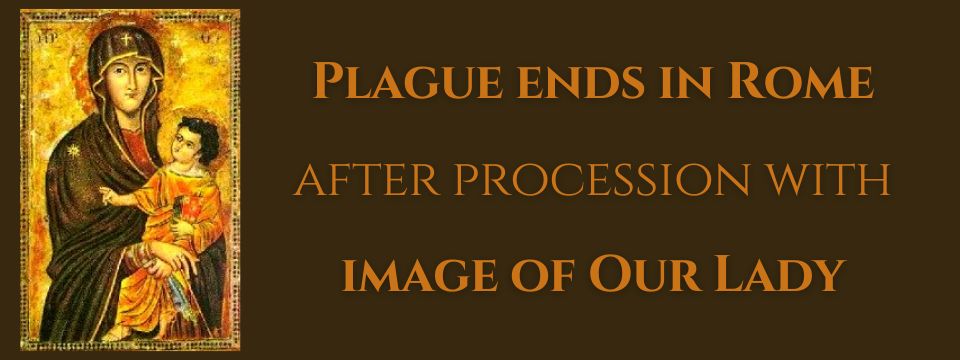
The Abbot Orsini wrote: “On this day, in the year 591, St. Gregory the Great, having had the picture of Our Lady, which was painted by St. Luke, carried in procession, the plague ceased at Rome.”

The miseries that afflicted Rome in the year 591 were substantial. The Gothic War between the Byzantine Empire and the Goths had substantially depopulated Italy, so much so that a Germanic tribe of Lombards had entered the peninsula and established their own kingdom. They were pagans and Arians who did not respect Catholics, burning the famous Benedictine monastery of Monte Cassino and pillaging the land at will.

The instability and warfare caused famine in large regions, though Rome was still able to obtain grain by sea. Then came earthquakes and flooding to further the suffering, and from this plague Rome was not immune. The banks of the Tiber overflowed, and when the waters did not recede, all of the low-lying lands became swamps that brought death and plague. The disease struck with such rapidity that the victim would often die shortly after realizing he had contracted the disease, although there were some who sickened but recovered. Our custom of saying, “God Bless you,” to someone who sneezes came about at this time, for sneezing was one of the signs that someone had contracted the disease.

Even the Roman Pontiff died of the plague on 7 February 590. His successor was Pope Saint Gregory the Great, who was both a humble and pious man. It would be an understatement to say he did not want the honour of being the next pope, but he did do everything in his power to try to save his people. He understood that the plague was a chastisement from God, and encouraged the faithful to repent of their sins and pray for deliverance while he and the religious cared for the people of Rome.

Finally, Saint Gregory called for a procession to take place at dawn on April 25th. On that day the faithful first assembled in their groups throughout Rome and then walked through the streets of the city praying and singing as they approached the church of Saint Mary Major. The plague was so potent at that time that eighty people collapsed and died as they walked toward the meeting place.

Pope Saint Gregory met them upon their arrival, joining them in prayer as he took his place with them holding aloft the miraculous image of Our Lady painted by Saint Luke the Evangelist. As the procession neared the Vatican the participants all saw Saint Michael the archangel standing upon the cupola of Hadrian’s mausoleum as he sheathed his flaming sword. It was a sign that the chastisement had come to an end, and at once the heaviness in the air abated and the air itself seemed to freshen and clear. Indeed, at that moment the plague ended as the faithful rejoiced and lifted up their voices to thank the Mother of God.

“Regina Coeli laetare, Alleluia! (Queen of heaven, rejoice, Alleluia!)

Quia quem meruisti portare, Alleluia! (Son whom you merited to bear, Alleluia!)

Resurrexit sicut dixit, Alleluia! (He has risen as He said, Alleluia!)


As seen on https://www.roman-catholic-saints.com/plague-in-rome.html

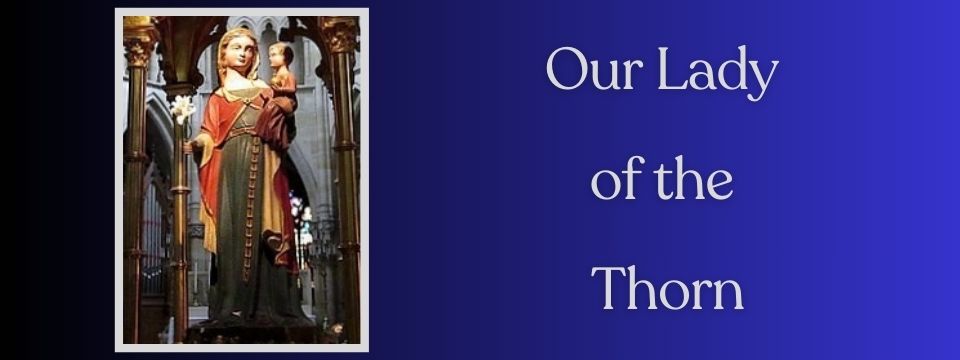
Our Lady of the Thorn

Feast Day 16 February

On the night of the Feast of the Annunciation, March 24 in the year 1400, some shepherds tending their flocks were attracted by a bright light coming from the Chapel of Saint John the Baptist near Chalons, France. As they approached the light they saw that it was actually a thorn bush fully engulfed in flames, and they discovered a statue of the Blessed Virgin standing unharmed in the midst of the flames. In fact, though the fire burned brightly, the branches and leaves of the thorn bush were unaffected by the flames.

The miracle continued all that night and into the next day, and news of the miracle spread quickly. Mobs of people crowded around the burning bush that was so reminiscent of the one witnessed by Moses on Mount Horeb. The Bishop of Chalons, Charles of Poiters, also witnessed the burning bush and the miraculous statue – both still unaffected by the fire.

When the flames finally did die down, the bishop reverently took the statue and carried it in his own hands to the nearby Chapel of Saint John. On the very site of the miracle, construction of a church was begun for the enshrinement of the miraculous statue. Since the church was built so rapidly – in a little over 24 years – a charming local legend claims that angels continued the work at night after the labourers had left for home.

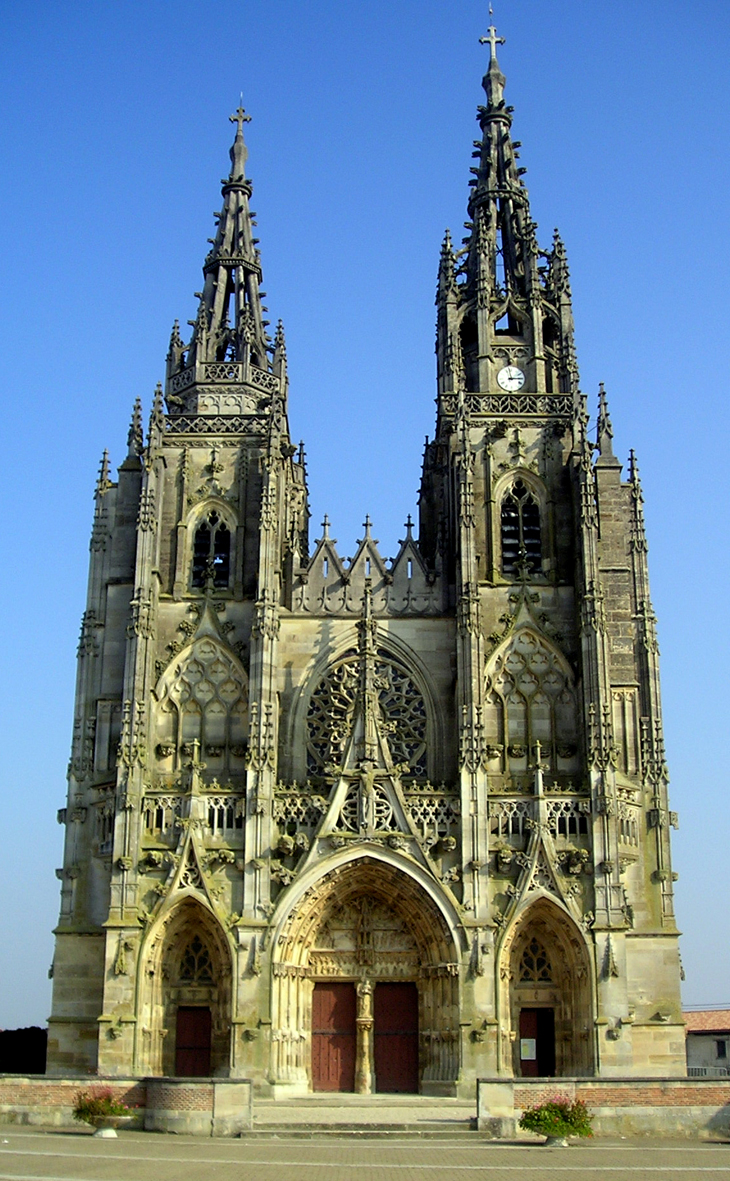
Our Lady of the Thorn (Notre Dame de l’ Epine) became a place of pilgrimage very rapidly. Today, a minor basilica, the shrine proved to be so beautiful that the people considered it a worthy place to venerate the Blessed Virgin. The flamboyant Gothic church boasts majestic great doors, a splendid rosette decorating the principle entrance and two chiselled stone spires, rises high and imposing on the plain in Champagne.

During the terrible French Revolution, the statue of Our Lady of Thorns was removed from the main altar and hidden for safekeeping. After it had ended, the statue was brought back out for veneration.

Many healings have also been reported at the shrine, many verified by physicians. The beautiful church of Our Lady of the Thorn has been recognized by several popes, including Pope Calixtis III, Pius II, and Gregory XV. Pope Leo XIII ordered the solemn coronation of the miraculous statue, saying, “Yes, Our Lady of the Thorn will be crowned in my name. Prepare for her a diadem worthy of the Mother of God and the people whom she protects…”

It is a place of grandeur where Christian souls can expand in adoration of the Son of God, and many are the pilgrims of all descriptions who have visited the shrine over the years, including Saint Joan of Arc in 1429.


As seen on https://www.roman-catholic-saints.com/our-lady-of-the-thorn.html

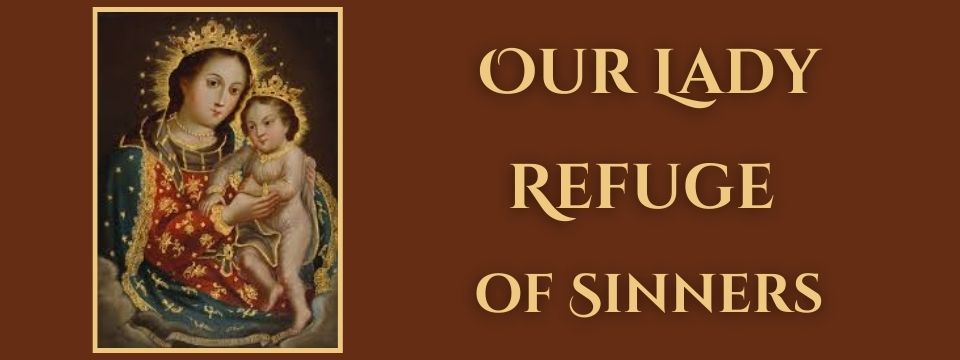
Our Lady Refuge of Sinners

Feast Day 16 January


The worst evil that can befall us is unquestionably SIN, which makes us an object of abhorrence in the sight of God.

God’s infinite mercy has not only prepared for us a potent remedy against sin in the merits of Jesus Christ, our Saviour, but it has also given us poor sinners a secure refuge in the assistance of Mary, Our Lady refuge of sinners. In the Old Law there were cities of refuge to which the guilty could flee for safety; in the New Law, Mary’s mantle is for us that citadel of refuge for sinful souls. How can the Divine Wrath strike us, if we are covered by the mantle of Mary, the chosen daughter and the honoured Mother of God?

Our Lady refuge of sinners is thus not merely a pledge of our safety, but by her unrivalled sanctity, she is as earnest of pardon for all sinners who have recourse to her intercession. She not only disarms the just anger of God roused by our sins, but also obtains for her true clients sincere and heartfelt conversion. All we need do is turn toward her with Faith, to obtain Divine Clemency and the means to rise from the mire of sin.

To be cleansed from sin and to be admitted again into the friendship of God is a grace beyond compare; but to be kept free from fresh falls is even more important, as our salvation depends entirely upon final perseverance. Mary, by her intercession, helps us detest past sins and faults; and keeps us from renewed relapses.

Through God’s permission we are tempted in all sorts of ways; but Mary’s watchful assistance helps us put Satan to flight while she suggests to us, through our Angel Guardian, all manner of good thoughts and holy aspirations.

More than ever at the hour of death, Mary shelters her devoted children, driving the Tempter far from us, and encouraging us to fight valiantly to the last gasp.

“Holy Mary, Mother of God, pray for us SINNERS, now and at the hour of our death. Amen.”

St. Bonaventure has aptly said: “You embrace with maternal affection a sinner who is even despised by the whole world, nor do you cease your embrace until you have reconciled him with his judge.”

In the Old Testament we find many figures of Mary as the refuge of sinners, like Ruth who “gleaned the ears of corn after the reapers.” St. Bonaventure draws this comparison:

“As Ruth found grace in the eyes of Booz, so Mary found Grace before God. The reapers are the gleaners in the vineyard of the Lord, the missionaries, preachers and confessors who endeavour to gain souls to God. But there are obstinate and hardened souls who do not allow themselves to be gained; these can be saved only through the powerful intercession of Mary. There is no sinner so corrupt and sunk in vice that Mary will despise and reject him. If such a one seeks help with her, she will most certainly reconcile him with Jesus and obtain pardon for him.”


*from The Woman in Orbit and other sources as seen on https://www.roman-catholic-saints.com/our-lady-refuge-of-sinners.html

Our Lady of Conquest

Feast Day 12 January


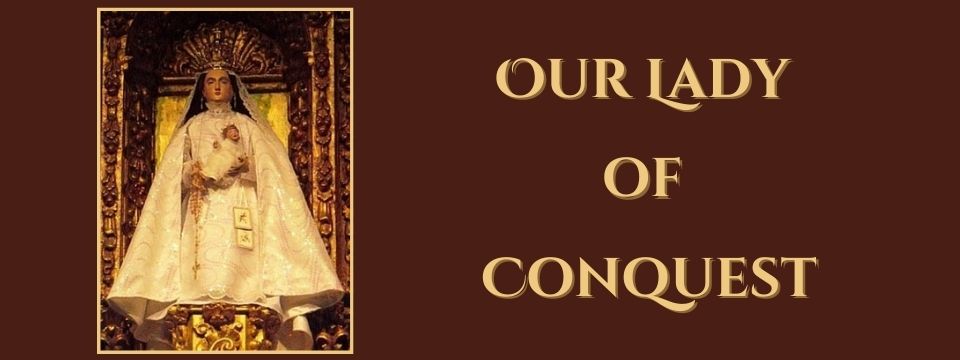
In the North Chapel of the beautiful cathedral of Santa Fe stands a little statue (scarcely one metre tall) of Our Lady holding the Child Jesus. It was skilfully carved by loving hands in Spain. Mary is clad in a richly embroidered dress, topped by a jewelled crown. Her regal countenance wears a serene, detached expression that is strangely impressive. This is Our Lady of Conquest, or La Conquistadora.

The statue of Our Lady of Conquest came to the new world in the care of the Franciscan missionary Fray Alonso da Venevides. She was installed with great ceremony in a church in Santa Fe. Over the ensuing decades, as often happens, the men living in the region did not practice their religion as they should. Mary appeared in a vision to a young girl, warning her that the colony would be overrun due to the loss of reverence for priests and the Faith.

In the year 1680 the local Indians rose up and attacked the Spanish. Twenty-one priests were killed, and the colonists completely driven out of the region. The statue was rescued from the burning church and taken back to Mexico with the colonists who escaped the wrath of the Indians.

It was not until the year 1691 that Don Diego de Vargas was sent by the King of Spain to attempt the resettlement of the city of Santa Fe. Like so many Spanish heroes who had accomplished seemingly impossible deeds during their lifetimes, he was as fervent a Catholic as he was a capable knight. Don Diego de Vargas carried with him the statue of Our Lady as he re-entered New Mexico. Although he had only a small force, he was able to peacefully negotiate a peace with the various Indian nations. He attributed his success to “the Sovereign Queen, Most Blessed Mary.” He is said to have vowed to build a chapel for her and hold a yearly procession if she would grant him a speedy and blood-less victory over the Indian, which she did.

Upon reaching his goal, however, the Indians refused to allow the Spanish colonists to return to Santa Fe. The Spanish under Don Diego were few in number, and they were forced to fight a numerically superior force.

The colonists prayed the rosary before the statue of the Blessed Virgin as the men engaged the Indians in battle. The fighting lasted all day, and it was not until evening when they reclaimed the city. Once again, Mary was credited for the victory, and to show her sovereignty, Don Diego placed an officer’s baton in her hand.

The shrine symbolizes a spirit of deep-rooted Faith and devotion which characterized the “Conquistadores” of this land. There is still a great deal of devotion shown to Mary at the Cathedral of St. Francis that includes processions, fiestas and other celebrations.

The statue was formally crowned by Cardinal Francis Spellman and in 1960 received a Papal Coronation.


As seen on https://www.roman-catholic-saints.com/our-lady-of-conquest.html