Winning the heart and soul of South Africa for Mary by spreading the Fatima Message

Winning the heart and soul of South Africa for Mary by spreading the Fatima Message

Saint Raymond of Peñafort

Patron Saint of Canon Lawyers

Feast 7 January


Raymond of Peñafort was born in 1175 in Spain and was a relative of the king of Aragon.

By the age of twenty he was already a teacher of philosophy, and in his early thirties earned a doctorate in both Canon and Civil Law.

St Raymond of Peñafort

At forty-one he joined the Dominican Order and was later called to Rome to be confessor to Pope Gregory IX.

At the Pontiff’s instance Raymond compiled all the laws and decrees of the popes and the Church Councils. For this work he is known as the patron of canon lawyers.

At the age of sixty, he was appointed Archbishop of Tarragona, but resigned within two years after becoming ill.

He was thunderstruck when he was elected the third Superior General of the Dominicans. As such, he visited all the Dominicans on foot and reorganized their constitutions.

With King James of Aragon and St. Peter Nolasco he founded the Order of Our Lady of Ransom dedicated to rescuing Christian prisoners from their Muslim captors.

St. Raymond is often pictured sailing over water using his cloak as a sail.

When accompanying King James to the island of Majorca, the latter, despite his qualities, was giving scandal. At the saint’s rebuke, the king promised to send the woman away but did not follow through on his word. On hearing of the saint’s threat to leave the island, the king forbade every captain in Majorca to grant him passage.

Laying his cloak upon the waves and holding one end of it over a staff, the saint prayed, made the sign of the cross, stepped onto his cloak and sailed for six hours back to the Spanish mainland – which fact converted the king.

Raymond of Peñafort crossing the water on his cloak

St. Raymond was known as a great devotee of Our Lady, an ascetic, contemplative, lawyer, preacher, opposer of heresies and apostle to Muslims.

He died in 1275 at the age of one hundred.


Four sentences from the lessons of his Office will suffice for his praise and for our imitation:

  1. Fame, far from dazzling him, inspired him with an ever more lowly opinion of himself.
  2. By his obedience, he always held himself in readiness to act on the least sign from his superiors.
  3. He practiced poverty most exactly, as a short path to salvation.
  4. Prayer was his nourishment and, if he lacked time for it, he understood how to steal it.

He is invoked in the Liturgy as the special minister of the sacrament of penance (1275).

Prayer

Saint Raymond, obtain for me grace to guard carefully the grace of absolution and to remember the counsel given me in confession.

Practice

Do nothing, and avoid even a look, which may seem to approve of scandal or evil words.


Saint André Bessette

Known as the “Miracle Worker of Mount Royal”.

Feast January 6


André Bessette was born in 1845 in the province of Quebec, Canada, the eighth of ten children. An orphan at twelve, he was taken in by an aunt and uncle. Set to various trades, he was unable to hold a job for very long because of his frail health. For thirteen years he worked at various occupations: shoemaker, baker, blacksmith, and once at a factory in the United States during the Civil War.

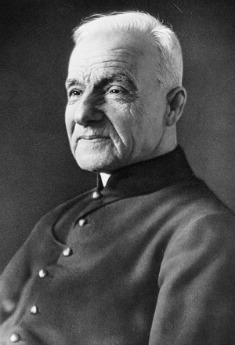
St. André Bessette

Photo Credit: commons.wikimedia.org File: Stinson Remick Chapel

From an early age he exhibited signs of a deep spirituality with a marked devotion to Saint Joseph, the foster father of Jesus.

Though he had little education, at twenty-five he applied to the Congregation of the Holy Cross, an order of educators.

After a year’s novitiate his frail health again came between him and permanent admittance, but at Bishop Bourget’s urging, he was received and assigned the humble post of porter at Notre Dame College, Montreal. Later, he would say, “When I joined this community, the superiors showed me the door, and I remained forty years.”

In his small room near the entrance he spent much of the nights on his knees. As he kindly received people, listened to their life’s woes and heard of their physical complaints, he began to lightly rub sick persons with oil from a lamp burning in the college chapel before a statue of St. Joseph.

Word of healings began to spread. “I do not heal,” he said simply, “St. Joseph heals”. A gentle man, he became enraged when people ascribed healings to him.

As the influx of pilgrims to Brother André’s door grew, he was allowed to build a chapel on Mount Royal with money he raised. There he continued his ministry. His reputation grew and soon he was known as the “Miracle Worker of Mount Royal”.

In 1924 construction for St. Joseph’s Oratory began on the side of the mountain near Brother André’s chapel. This shrine, the largest church outside of Rome was funded by Brother André’s supporters around the world.

Brother André died in 1937 at the age of ninety-one. He was beatified in 1982 and canonized in 2010. Pope Benedict XVI said of St. André that he “lived the beatitude of the pure of heart.”

Saint John Neumann

Patron Saint of Sick Children and of Immigrants

Feast 5 January

John Nepomucene Neumann was born on 28 March 1811 in Prachatitz, in the Kingdom of Bohemia, then part of the Austrian Empire, now in the Czech Republic. He received the sacrament of Baptism the same day.

He entered the seminary in 1831 and was ready to be ordained in 1835 when the bishop temporarily suspended ordinations due to an excess of priests in the country.

As a seminarian, John had been deeply inspired by the accounts of the missionaries among the German immigrants in North America, particularly by those of Father Barraga, who later became the first Bishop of Marquette.

At the invitation of Bishop John DuBois of the diocese of New York, young Neumann sailed to the New World where he was ordained in what is now the old St. Patrick’s Cathedral in New York City.

Until the age of twenty-nine, the young priest dedicated himself to missionary work in New York. At this time, with the permission of Bishop DuBois, he joined the Redemptorist Order becoming its first member to profess religious vows in America.

In 1852 Fr. John Neumann was consecrated the fourth Bishop of Philadelphia. His ease with languages, of which he would come to know as many as eight, endeared him to the many immigrants arriving in the city.

Saint John Neumann - Missionary

He not only tended to immigrants in his native German, but speaking fluent Italian as well, he personally ministered to Italian newcomers in his private chapel, and went on to establish the first ethnic church for Italians in the country.

For the Irish, he studied enough Gaelic to be able to hear the confessions of those who spoke no English, an act of charity which the Irish government officially recognized by a posthumous award.

Gifted with great organizing ability, he drew into the city many teaching communities.

He was the first bishop in the country to organize a diocesan school system, and during his tenure increased the schools in his diocese from one to one hundred.

His apostolic endeavours encompassed every facet of spiritual need: schools, catechesis, and apologetics, in short, all that involved the spiritual guidance of souls, their sacramental nourishment and their zealous defence against error.

He instituted the first Forty Hours devotion throughout his vast diocese, from whence it was taken up by others, spreading beyond the confines of the American continent.

Intensely devoted to the Virgin Mother of God, the “little bishop”, as he was sometimes affectionately referred to, was called upon for a singular privilege in her honour.

Painting of the Immaculate Conception
Our Lady of the Immaculate Conception

On 8 December 1854 when Pope Pius IX read the declaration defining the dogma of The Immaculate Conception, John Neumann held the book from which the pope read.

Thus, his 1.58m frame became the podium upon which rested the illustrious document describing the future patroness of the United States: The Immaculate Conception.

His efforts to expand Catholicism in America were not without opposition. On at least two occasions he wrote to Rome asking to be relieved of his bishopric but Blessed Pius IX insisted that he continue. And, like the Divine Master he so faithfully served, he persevered “until all [his] strength was exhausted, until the insupportable weight of the wood [of the cross] hurled [him] to the ground”.

While running errands on 5 January 1860, Bishop John Neumann collapsed and died in the streets of Philadelphia from a stroke. He was forty-eight.

He was beatified by Pope Paul VI on 13 October 1963 and canonized by the same pope on 19 June 1977. His remains rest in the church of St. Peter the Apostle in Philadelphia where they are venerated by countless devotees.

Our Lady of Sichem

Feast Day 3 January

The shrine in Brabant in the duchy of Louvain, is a replacement of the one below Mount Garizim, Israel. Hadrian restored the temple on Mount Garizim and dedicated it to Jupiter. A small Christian community settled there; and on several occasions they suffered greatly at the hands of the Samaritians. In 474 the emperor, to avenge an unjust attack on the sect, gave Mount Garizim to the Christians, who built on it a church dedicated to the Blessed Virgin.

After the Mohammedan conquest, Christianity practically disappeared from the district. The French made amends by erecting a shrine to Mary in the duchy of Louvain. The ancient statue of Our Lady of Sichem, or as Our Lady of ‘Montaigu’, which is the title more commonly used today, has been venerated in Belgium from very early times. The Mother of God rewarded the faithful magnanimously for their pious attention.

According to legend, a shepherd boy originally found the statue of Our Lady after it had apparently fallen from a niche cut in an old oak tree. The statue was mysteriously too heavy for him to lift alone, so he ran to find his master, and have him return to help him replace the statue in its place in the old oak.

It is said that in 1306 the Blessed Virgin Mary moved the hearts of the people by causing four drops of blood to flow from the eyes of the statue dedicated to her. This revived the faith of the people and increased their fervour.

A small chapel was built beneath the tree, which was rebuilt in 1602, and the dedication of Our Lady of Sichem took place in the year 1604 by the Archbishop of Mechlin, Mathias Hovius.

From that time forward there were many miracles as Our Lady seemed to demonstrate her appreciation by granting many favours. The statue was soon venerated as miraculous, and there have been many pilgrimages to the site during the centuries, continuing even until this day.


As seen on: https://www.roman-catholic-saints.com/our-lady-of-sichem.html

Saint Basil the Great & Saint Gregory Nazianzen

Saint Basil the Great & Saint Gregory Nazianzen

Patron Saint of Hospital Administrators
(St. Basil the Great)

Feast 2 January


On 2 January, the Church honours Saints Basil the Great and Gregory Nazianzen, two friends who were pillars of orthodoxy during a period of chaos and confusion, namely the time in which the Church faced the far-reaching heresy of Arianism, which denied the divinity of Christ – an ordeal the Church has never forgotten.

These two friends steered the barc of St. Peter safely through the dangerous and stormy seas of heresy.


Saint Basil

St. Basil was born in Caesarea in Cappadocia – today, south-eastern Turkey – in the year 329 A.D. He was born into a family of saints: his grandfather died a martyr in the Roman persecution, and his grandmother, mother, sister and two brothers are all canonized saints.

Basil was becoming famous as a teacher when he decided to leave the world. He lived for a while as a hermit then founded what was probably the first monastery in Asia Minor. His monastic principles have influenced Eastern monasticism to this day. He was a gifted orator, and his writings place him among the great teachers of the Church.

In 370 he was made Bishop of Caesarea. He opposed the Emperor Valens when the latter pressured him to remain silent and admit heretics to Holy Communion. In the end, the Emperor backed down.

When the great St. Athanasius of Alexandria died in 373, the mantle of defender of the Faith against Arianism fell to Basil. He was misunderstood, misinterpreted, and falsely accused of ambition and heresy.

Seventy-two years after his death, the Council of Chalcedon, in recognition of his great sanctity and his heroic defence of the Faith during his life, called him “the great Basil, minister of grace who has expounded the truth to the whole earth.” He died on 1 January 379.


St. Gregory Nazianzen

St. Gregory Nazianzen was born in 330 and received baptism at the age of thirty. For a while he joined St. Basil as a hermit, and was later ordained to the priesthood.

Consecrated Bishop of Constantinople in 381, he presided over the Second Ecumenical Council of Constantinople which defined the Nicene Creed, and which is recited every Sunday throughout the Catholic Church.

With St. Basil, he valiantly opposed Arianism and rebuilt the Faith in Constantinople at the cost of much personal persecution.

He is famous for his sermons on the Holy Trinity. St. Gregory’s last days were spent in austerity and solitude. He died on 25 January in the year 389 or 390.

Blessed Margaret Colonna

Feast Day – December 30

A member of the princely Roman family of the Colonna, Margaret was born in Rome, the capital of Christendom, in 1210. Very early in life she lost both her parents. She was then placed under the guardianship of her two brothers, John and James. When she had grown to womanhood, her older brother insisted that she enter a brilliant marriage. But Margaret, whose name signifies pearl, held her virginity in such high regard that she was willing to sacrifice all the glamour of the world in order to retain it. She firmly refused to yield to her brother’s plan, declaring that she would be espoused to none other than the immortal Spouse of souls. Her younger brother championed her resolution.

With two maids, Margaret withdrew to a quiet country house belonging to her family and situated in the mountains near Palestrina. There the group devoted themselves to practices of piety and penance, as well as to works of charity. They wore coarse garments, similar to those of the Poor Clares, and mapped out their daily routine as far as possible according to the strict rule of that order.

In her new life, Margaret’s relatives caused her many trials and annoyances. But she considered them as marks of the love of her Divine Bridegroom seeking in this way to disengage her heart from the world, so that she might belong to Him alone. And Christ our Lord actually appeared to her at this time and placed a crown of lilies on her head and a ring upon her finger.

In order to secure the merit of obedience, Blessed Margaret Colonna and her companions meant to join the Poor Clares of Assisi, who had already offered to receive them. But a grievous illness attacked Margaret and prevented her plan. Somewhat restored to health, she consulted her younger brother James in Rome, who had meanwhile become a priest and cardinal. At his suggestion, and with the approval of Pope Urban IV, Margaret turned the country house on the quiet mountain near Palestrina into a Poor Clare convent where she and several like-mined young women observed the rule of St. Clare as well as her continued infirmity permitted it. Almighty God rewarded her pious zeal with many consolations.

Also favours of another kind were not wanting. Our Lord gave her an opportunity to taste a little of the sufferings H had endured. A wound opened in her right side and kept growing wider and deeper, causing her untold suffering during the last seven years of her life. She thanked God for this favour up to the last day of her life. When that day came, she said before receiving Holy Viaticum:

“I thank Thee, dear Lord, for having permitted my body to become weak and infirm, so that I could the more freely return my soul to Thee.”

Assisted in her last moments by her brother James, and the prayers of her sisters, Blessed Margaret Colonna surrendered her soul into the hands of God on December 30, 1284.

Later, when the convent of Palestrina was transferred to Rome the sisters took with them the precious remains of their mother and foundress Blessed Margaret Colonna and had them entombed in their new convent of St. Sylvester. Innumerable miracles occurred at the grave of this holy virgin. In 1847 Pope Pius IX gave renewed approval to the veneration paid to her for centuries.


From: Franciscan Book of Saints by Marion Habig, OFM as seen on www.roman-catholic-saints.com

Saint Lucy

Patron Saint of the Blind, Italy, and Syracuse

Feast Day 13 December

Saint Lucy was descended of a noble family of Syracuse, which was then regarded as the principal city of Sicily. She lost her father in her infancy; but Eutychia, her mother, took care to educate her properly, and to instruct her well in the doctrines of our holy faith. When our saint arrived at a proper age, her mother began to think of giving her in marriage, but Lucy, who had consecrated her virginity to Jesus Christ, awaited only a favourable opportunity to reveal her resolution to her mother.

The opportunity soon presented itself. Eutychia was afflicted for many years with a flux of blood, without being able to find any effectual remedy. Saint Lucy therefore, persuaded her to repair to the tomb of Saint Agatha, martyred a half century before in Catania, where the Lord was pleased to work many miracles, and there to implore her cure. When they arrived at Catania, they prostrated themselves in prayer before the sepulchre of Saint Agatha, where Lucy, perhaps from fatigue of the journey, was overpowered with sleep.

The blessed martyr appeared to her, and as we read in the Roman Breviary, said: “Lucy! Why dost thou demand through my intercession that which, by thy faith, thou canst thyself obtain for thy mother?”

She then assured Lucy that God would work the desired cure, and that, for having preserved her virginity inviolate, God would reward her in Syracuse with the same glory she herself had received in Catania.

Saint Lucy, animated by this vision, was the more confirmed in her resolution of remaining always consecrated to Jesus Christ, and told her mother to speak to her no more of marriage, but to distribute her fortune among the poor. Eutychia answered, that at her death she would bequeath all to her, and that she might do with it as she pleased; but Saint Lucy replied, that gratitude for her miraculous cure ought to induce her willingly to deprive herself during life of that which, at her death, she should necessarily leave behind.

The mother consented, and when they returned to Syracuse, they commenced to sell their property, and to distribute the proceeds among the poor. Saint Lucy’s suitor perceiving this, complained to Eutychia; but he found that his representations were totally ineffectual, and, in his rage, accused her before the governor, Paschasius, as being a Christian, contrary to the edicts of Diocletian and Maximian.
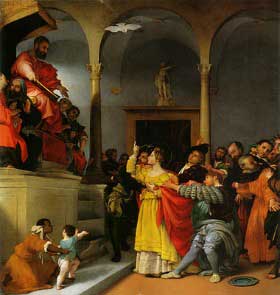
The saint was accordingly arrested and brought before the governor, who endeavoured to persuade her to sacrifice to the idols; but Saint Lucy replied, that the sacrifice most agreeable to God was the relief of the poor, in which she was actually engaged and that she was prepared to sacrifice even her life.

Paschasius replied that she ought to obey the emperor, as he did; but the saint answered: “Day and night I meditate upon the divine law; and if thou art anxious to please the emperor, I am anxious to please my God; therefore, it is that I have consecrated to him my virginity.”

Paschasius in his rage told her that she was impurity itself.

The saint replied: “No, thou art impurity, since thou dost endeavour to corrupt Christian souls, alienating them from God, to serve the devil, – wrongly preferring, as thou dost, the goods of this world to those of heaven.”

Paschasius; “Torments shall stop thy mouth.”

Lucy: “Words shall never be wanting to the servants of God, since the Lord hath promised that the Holy Ghost shall speak through them.”

Paschasius: “Then the Holy Ghost is within thee?”

Lucy: “St Paul hath said, that those who live chastely and piously are the temples of the Holy Ghost.”

“Since this is the case,” said the tyrant, “I will cause thee to be brought to an infamous place, in order that the Holy Ghost may leave thee.”

The saint replied: “The body receives no stain when the will is averse to sin; on the contrary, the violence you meditate would double my crown.”

The governor then threatened the most horrid tortures, in case she continued obstinate.

The saint intrepidly exclaimed: “Behold my body ready to suffer every torture! Why dost thou delay? Begin the execution of that which the devil, thy father, prompts thee.”

Paschasius, maddened with rage, ordered that she should instantly be brought to the place of infamy, in order that she might first lose the honour of virginity, and then be deprived of life.

The guards endeavoured to execute this command, but found that God had rendered her so immovable that all their exertions were insufficient to drag her from the spot.

Paschasius in astonishment exclaimed: “What incantation is this?”

The saint replied: “This is not an incantation, but the power of God. Why dost thou fatigue thyself? Dost thou not manifestly perceive that I am the temple of the Lord?”

Paschasius, more confused and infuriated than ever, ordered a great fire to be kindled round the saint that she might be burned.

Saint Lucy, nothing daunted, said to the tyrant: “I will pray to the Lord Jesus Christ that the fire may not injure me, in order that the faithful may witness the divine power, and that the infidels may be confused.”

The friends of Paschasius, unwilling that the people should witness any further miracle, advised him to have her beheaded; but after having been tortured in many other ways, her throat was pierced with the point of a sword.

The saint did not expire immediately; she threw herself on her knees, offered her death to God; and having foretold that peace would soon be restored to the Church, consummated her martyrdom in the year 303 or 304. Her name is inserted in the Canon of the Mass.*

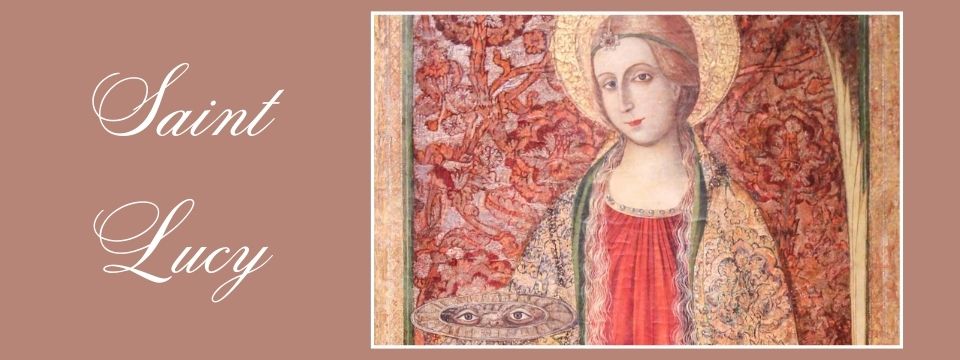
She is portrayed holding a pair of eyes on a platter. Some accounts say that her eyes were tortured, others that she gouged them out to discourage her suitor. In any case, she is particularly invoked for ailments of the eyes, or eyesight problems.

The emblem of eyes on a cup or plate apparently reflects popular devotion to her as protector of sight, because of her name, Lucia (from the Latin word “lux” which means “light”).


*from Saint Alphonsus

As seen on: https://www.roman-catholic-saints.com/saint-lucy.html

Saint Juan Diego Cuauhtlatoatzin

Patron Saint of Indigenous People

Feast December 9

Early Life

Juan Diego was born in Cuautlitlán – today part of Mexico City – in the year 1474 and given the name “Cuauhtlatoatzin” or “Eagle that speaks”. He was a gifted member of the Chichimeca people, one of the more culturally advanced indigenous groups living in the Anáhuac Valley.

In 1524, at fifty years of age, Juan Diego was baptized with his wife Maria Lucia by one of the first Franciscan missionaries to arrive in Mexico, Fray Pedro de Gante. His religious fervour, his simple artlessness, and his respectful but gracious demeanour are among his defining characteristics.

It is said that after their baptism, he and his wife, inspired by a sermon on the virtue of chastity, mutually decided to embrace this evangelical counsel by living celibately afterwards.

After the 1529 death of his wife, Juan Diego moved to be near his aged uncle Juan Bernardino in Tolpetlac. Thereafter, the pious widower was in the habit of walking to the Franciscan mission at Tlatelolco for religious instruction and to perform his religious duties. His frequent journeys took him close by the hill at Tepeyac.

The Apparition

At daybreak on Saturday, December 9, 1531, Juan Diego was on his way to morning Mass as usual, when he suddenly heard the exquisite sound of many birds singing. The beautiful melody came from higher up the hill, and thinking himself transported to heaven, his whole being attracted by the sound, he let it draw him up the Tepeyac.


When the birdsongs suddenly ceased, he heard his name called in his native Náhuatl language and he beheld a beautiful young maiden. She called him to come closer and Juan Diego, “filled with admiration for the way her perfect grandeur exceeded all imagination,” prostrated himself in her presence. With unutterable sweetness, she revealed her identity to him “… the ever-virgin Mary, Mother of the true God who gives life and maintains its existence. He created all things. He is in all places. He is Lord of Heaven and Earth.” She asked him to go to the bishop in Mexico City, Don Fray Juan de Zumárraga, and to request in her name that a shrine be built at Tepeyac, where she promised to pour out abundant graces upon those who invoked her.

After some difficulty in gaining admission to the bishop, the humble messenger recounted the marvels he had witnessed and delivered the lady’s message. However, the prelate’s response was discouraging and Juan Diego left downcast and disappointed.

The Queen of Heaven was waiting for him at the top of Tepeyac on his return that evening, and casting himself down he told her of his heart’s sorrow at meeting with incredulity on the part of the bishop and adds: “I beg you, my Lady, Queen, my little girl, to have one of the nobles who are held in esteem, one who is known, respected, honoured, [have him] carry, take your dear breath, your dear word, so that he will be believed. Because I am really [just] a man from the country, I am a [porter’s] rope … a man of no importance: I myself need to be led, carried on someone’s back. That place you are sending me to is a place where I’m not used to going or spending any time in, my little Virgin, my Youngest Daughter, my Lady, Little girl.”

With great gentleness, she tells him that he is the one that must carry out this commission. And Juan Diego promises that he will return to the bishop the following day with her request.

Despite the obstacles posed by the bishop’s attendants, Juan Diego was again admitted into his presence. Don Juan de Zumárraga questioned the Indian kneeling before him thoroughly but remained unmoved by the man’s account. Not on his word alone would he believe, he told him, a sign must be given to prove that the apparition was indeed from heaven.

Undaunted by the prelate’s request, he returns to Tepeyac to convey it to Our Lady, who asks him to return in the morning that she might give it to him. During the night, however, Juan Diego’s sick uncle worsens and it is clear that he is dying. Shortly after midnight, his nephew sets off for Tlatilolco to summon one of the priests that he might confess and prepare for death.

The miraculous image of Our Lady of Guadalupe, given to St. Juan Diego.


Not wanting to meet the beautiful Lady, who would surely want to send him to the bishop with the “proof” he had requested, he hurried along, set on his task. But the Queen of Heaven came down to meet him and gently chiding him she asked, “What is happening, youngest and dearest of all my sons? Where are you going, where are you headed?” Humbling himself before her, he told her of his uncle’s grave illness and his need for a priest to assist him. She assured him that the illness was not grave and that he had nothing to fear on that account. Her solicitude filled him with joy and consolation: “Am I not here, I, who am your mother? Are you not under my shadow and protection? Am I not the source of your joy? Are you not in the hollow of my mantle, in the crossing of my arms? Do you need something more? Let nothing else worry you, disturb you; do not let your uncle’s illness pressure you with grief, because he will not die of it now. You may be certain that he is already well…” And, as they later found out, his uncle became well at that very moment.

The Sign

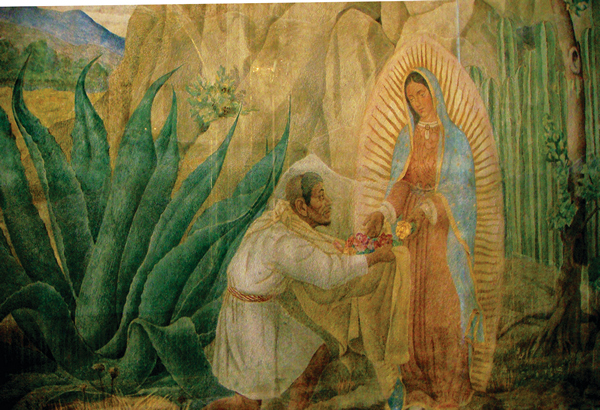
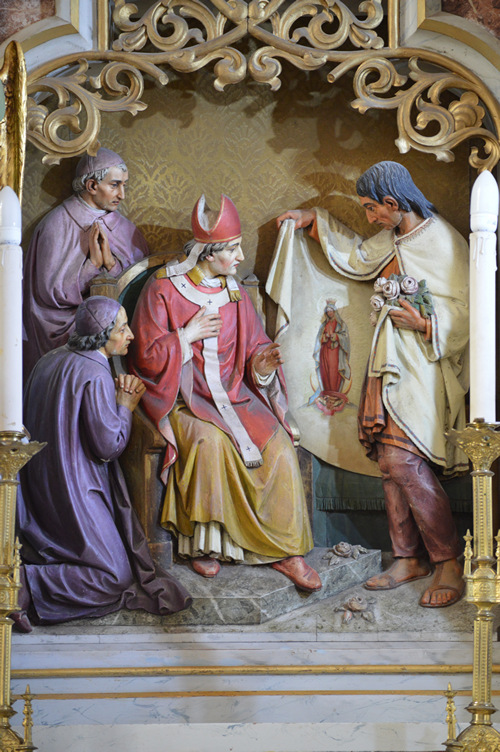
Full of confidence, Juan Diego begged her to send him immediately to the bishop with the sign she had promised. The Blessed Mother told him to climb the hill and to pick the flowers that he would find there. He obeyed, and although it was winter time and the frost at that time of year was very harsh, he found flowers of many kinds, in full bloom. Astonished, he cut and gathered the fragrant blossoms and took them to Our Lady who carefully arranged them in his mantle – the rough-woven “tilma” worn by his people – and told him to take them to the bishop as “proof”. When he opened his tilma to show the bishop the profusion of blooms, the flowers fell to the ground, and there remained impressed upon his cloak an image of the Blessed Mother, the apparition at Tepeyac.

With the Bishop’s permission, Juan Diego lived the rest of his life as a hermit in a small hut near the chapel where the miraculous image was placed for veneration. Here he cared for the church and the first pilgrims who came to pray to the Mother of Jesus.

Death and Beatification

He died in 1548 and was buried in the first chapel dedicated to the Virgin of Guadalupe. He was beatified on 6 May 1990 by Pope John Paul II in the Basilica of Santa Maria de Guadalupe in Mexico City and canonized by him on 31 July 2002. His feast day is on December 9th.


Saint Cecilia

St Cecilia banner

Patron Saint of Musicians

Feast Day 22 November


Cecilia was a devout Christian maiden of noble Roman birth who lived during the early part of the third century.

At a very young age, she secretly dedicated herself to God, resolving to remain a virgin to her death. She fasted and prayed often, and wore a coarse shift under her clothes as a perpetual penance.

St Cecilia

Although she had consecrated her body to the Lord, Cecilia’s father wished her to marry. She obeyed and married Valerian, the man her father had chosen for her. However, on the night they were married, Cecilia said to her new husband,

“I have a secret to tell you. You must know that I have an angel of God watching over me. If you touch me in the way of marriage, he will be angry and you will suffer; but if you respect my maidenhood he will love you as he loves me.”

Sceptical of his new wife and her religion, Valerian demanded to be shown the angel. Cecilia told him:

“If you believe in the living and one true God and receive the water of baptism, then you shall see the angel.”

The young man agreed, and sought out Bishop Urban who baptized him. Upon his return, Valerian found Cecilia in prayer with a crown of roses and lilies on her head. He saw that beside her stood an angel, who immediately crowned him as well.

Soon after, Valerian’s brother, Tiburtius, found them praying in the chapel. He saw the crowns of flowers on their heads and the angel standing near and he, too, converted. From that time, the two brothers devoted themselves to the work of God. They were arrested and after refusing to pay homage to false idols, were tortured and killed.

Knowing that the two were married, officials visited Cecilia and tried to persuade her to worship the false idols. Instead, her holiness converted the officials who came to her door, and she was instead ordered to appear before Almachius, the provost of Rome. The provost entreated her to denounce Christ, and when she refused, condemned her to death.

They barred her in her home and fed her furnace seven times the normal amount, an act that would have suffocated any other. However, after a day and a night spent in the fatal conditions, Cecilia still lived.

Almachius then sent a soldier to her house to behead her. The executioner struck her three times on the neck and still could not smite her head from her body.

By law he could not do so a fourth time and he left her to die. During the three days of her agony, Cecilia gave all that she had to the poor, continually preached the faith, and all those who were converted by her words and example she sent to Pope Urban to be baptized.

St Cecilia
Photo by: Claude Valette


St. Urban and his deacons buried her among the bishops in the catacomb of St. Callixtus along the Apian Way. As she had requested, her house was transformed into a church by the Holy Pontiff and it has remained in the service of the Church until this day.

St. Cecilia is known as the patroness of musicians because it is said that during the three days in which she lay dying, the crowd that had gathered could hear angels singing.

Ct Cecilia

Saint Bruno

Patron Saint of those who Suffer from Demonic Possession

Feast 6 October


Bruno, of a prominent family of Cologne, was born in this ancient city around the year 1030. A promising scholar, he studied at the cathedral school of Rheims, and was ordained to the priesthood in his native Cologne.

In 1056 he became a professor of grammar and theology at his former school in Rheims where he taught brilliantly for eighteen years. Many eminent scholars and philosophers studied under him and did him honour throughout Europe, including Eudes de Châtillon, later Pope Urban II, who convoked the First Crusade.

In 1076, he was appointed chancellor of the diocese, and was about to be elected as Archbishop of Rheims when he announced he was retiring into solitude. At first, Bruno placed himself under the direction of Robert of Molesmes, who later was instrumental in the founding of the Abbey of Citeaux.

Later, given land by St. Hugh, the Bishop of Grenoble, he and six other followers settled in the mountainous reaches of Chartreuse where they first build an oratory surrounded by individual cells. Such was the origin of the Order of the Carthusians, which takes its name from Chartreuse.

A great admirer of the Order’s founder, Bishop Hugh made his spiritual retreats at the Chartreuse where he took Bruno for his spiritual father.

Hearing of his sanctity, and personally acquainted with his prudence and knowledge, his former pupil, now Pope Urban II, summoned Bruno to Rome. Although this presented a great trial for the saint, he obeyed, leaving one of his disciples, Landuin, as prior of the Chartreuse.

In Rome Bruno served the Holy Pontiff in various capacities, including helping in the preparation of several synods with the aim of reforming the clergy. Pressed by the pope to accept the archbishopric of Reggio in Calabria, Bruno earnestly excused himself, begging to be allowed to live in solitude. Pope Urban II finally consented that he retire into Calabria, but not so far off as Chartreuse.

With the help of a noble friend, Count Roger, Bruno settled in the valley of La Torre with a few new disciples from Rome. Here he embraced the life of solitude with more joy and fervour than ever. It was here also, that Landuin visited him on behalf of the monks of the Chartreuse. They wished to consult their founder as to the manner in which their monastery should follow more faithfully in the spirit of its founder. Bruno instructed, comforted and urged them to perseverance and blessed them.

As he felt death approaching in 1101, Bruno gathered his monks about him and made a public confession of his life, and a profession of faith, which was lovingly preserved by his spiritual sons. He resigned his soul to God on 6 October in the year 1101.

His disciples praised his three chief virtues–his great spirit of prayer, an extreme mortification, and a filial devotion to the Blessed Virgin. Both the churches built by him in the desert were dedicated to the Blessed Virgin: Our Lady of Casalibus in Dauphiné, Our Lady Della Torre in Calabria; and, faithful to his inspirations, the Carthusian Statutes proclaim the Mother of God the first and chief patron of all the houses of the order, whoever may be their particular patron.

St. Bruno was buried in the little cemetery of the hermitage of St. Mary, and many miracles were worked at his tomb.

According to Carthusian custom, which shuns all form of publicity, Bruno was never formally canonized. Nevertheless, in 1514, the Order obtained permission from Pope Leo X to keep Bruno’s feast. In 1674, Pope Clement X extended the commemoration of his feast to the Universal Church.

St. Bruno is the popular saint of Calabria; every year a great multitude resort to the Charterhouse of St. Stephen, on the Monday and Tuesday of Pentecost, when his relics are borne in procession to the hermitage of St. Mary, where he lived, and the people visit the spots sanctified by his presence. An immense number of medals are struck in his honour and distributed to the crowd, and the little Carthusian habits, which so many children of the neighbourhood wear, are blessed. He is especially invoked, and successfully, for the deliverance of those possessed.

As a writer and founder of an order, St. Bruno occupies an important place in the history of the eleventh century.

St. Bruno’s distinction as the founder of an order was that he introduced into the religious life the mixed form, or union of the eremitical and cenobite modes of monasticism, a medium between the Camaldolese Rule and that of St. Benedict. He wrote no rule, but he left behind him two institutions which had little connection with each other–that of Dauphiné and that of Calabria. The foundation of Calabria, somewhat like the Camaldolese, comprised two classes of religious: hermits, who had the direction of the order, and cenobites who did not feel called to the solitary life; it only lasted a century, did not rise to more than five houses, and finally, in 1191, united with the Cistercian Order. The foundation of Grenoble, more like the rule of St. Benedict, comprised only one kind of religious, subject to a uniform discipline, and the greater part of whose life was spent in solitude, without, however, the complete exclusion of the conventual life. This life spread throughout Europe, numbered 250 monasteries, and in spite of many trials continues to this day.

Partly shared from: https://www.newadvent.org/cathen/03014b.htm